

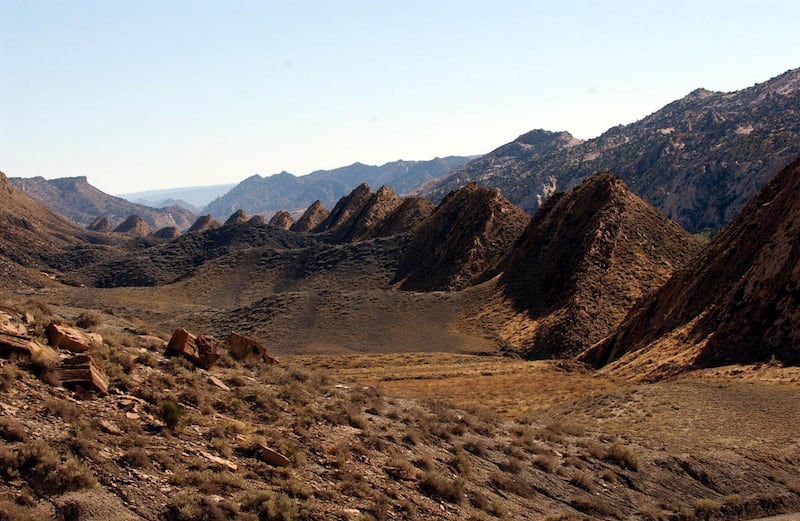

- Rep. Celeste Maloy intends to take steps to undo the Grand Staircase-Escalante National Monument land-use plan.
- The Utah Republican asked the Government Accountability Office to determine if the land-use plan is a "rule," making eligible to be overturned by the Congressional Review Act.
- The Southern Utah Wilderness Alliance and other groups oppose the use of the CRA in relation to the monument.
Last July, Rep. Celeste Maloy, R-Utah, sent a letter to the Government Accountability Office requesting its opinion on whether the Grand Staircase-Escalante National Monument land-use plan could be classified as a “rule.”
Such a request appears like a mundane congressional procedure, but after the introduction last year of a novel use of a 1996 law, many stakeholders are concerned about the potential implications.
That’s because whatever the GAO classifies as a rule can then be subject to the Congressional Review Act. That law gives Congress the ability to overturn executive agency decisions and prevent anything substantially similar from being put back into effect.
Over the fall, however, Congress passed several bills that used the CRA to forever alter management plans for federal land in Alaska, Montana, Wyoming and North Dakota.
What made those uses of the law novel was that it was applied to land-use plans. Such high-level federal oversight had never before been used on site-specific resource management plans like the one for Grand Staircase-Escalante.
“There have been lots of really smart people who have served at (the Department of the) Interior and served in Congress since the review act was passed and nobody has done what this Republican Congress is doing,” said Steve Bloch, legal director for the Southern Utah Wilderness Alliance. “Which is leveraging this pretty obscure law to step in and try to undo or dismantle management plans that — in almost every instance here — involved years of public input, involvement, federal agency experts, engagement and decision-making.”
Last week, the GAO — after conferring with the Trump administration and the Interior Department— determined that the Grand Staircase-Escalante land-use plan can be considered a “rule,” and is therefore subject to the Congressional Review Act.
Maloy wrote in a statement to the Deseret News that she has always been “clear in her opposition” to the current management plan for Grand Staircase-Escalante. She is an outspoken critic of the Antiquities Act, the law that gives the executive branch the ability to create national monuments.
Maloy wrote that her “opposition has never been a secret.”
But she did not comment on whether she intends to take further steps toward applying the law to Grand Staircase-Escalante’s land-use plan. Her statement, though, signaled an intent to return it to a prior version.

“The Biden-era RMP (Resource Management Plan) is fundamentally incompatible with state and local goals for wildlife management, grazing, recreation, and economic development,” Maloy wrote. “I am working to return the monument’s management plan to its previous framework, one that balances conservation with access and reflects the needs and voices of the people who live and work on this land.”
What comes next is uncertain, but some advocacy agencies and legal scholars think that it’s a matter of time until the CRA is applied to the controversial national monument.
Legal scholars and stakeholders weigh in
Grand Staircase-Escalante has had a tumultuous several years and, though there is nothing certain in the GAO’s office submitting an opinion, any actions in the direction of the national monument elicit passionate responses.
“This is a direct assault by Utah politicians on one of the crown jewels of America’s system of federal public lands,” Bloch said in a published statement from SUWA.
“Any attempt to leverage this obscure federal law against the monument is an effort to thwart the will of millions of Americans who have repeatedly stood up in support of Grand Staircase-Escalante, its wild red rock landscape, and its irreplaceable cultural and fossil resources.”
From a broad and strictly legal perspective, however, the use of the CRA against any land-use plans is concerning to some legal scholars. They say that this use of the law creates uncertainty for all existing plans determined since 1996, when the law was implemented.
One from the Mountain States Legal Foundation even said that such a use of the CRA could create “the Wild West” for land-use planning.
The most clear cause of that uncertainty is that the CRA stipulates — in the first line written in the bill — that only rules presented to Congress for review are legally enforceable.
The vast majority of all land-use plans have not been presented to Congress for review, which opens the door for arguments that question whether any of them are legally valid. Those possible lawsuits could be applied to public lands that are used for recreation and extraction alike.
In the case of Grand Staircase-Escalante, however, SUWA identified a specific concern with using the CRA for that location.
The other land-use plans that Congress applied the law to are managed by the Bureau of Land Management and fall under that agency’s “multiple use and sustained yields” mandate.

Grand Staircase-Escalante is a national monument with scientific, cultural and conservation priorities. The structure of its management plan is wholly different from the others.
“Introducing a bill to strike at the heart of the Grand Staircase-Escalante National Monument will represent a clear escalation of use of the CRA to attack the nation’s wildest public lands,” read SUWA’s statement. “As the first CRA attack on a national monument, this action threatens to upend public land protection.”
John Ruple, one of 30 other legal scholars from across the country who penned a letter sent to Senate leadership in stark opposition, called that use of the law “a terrible idea.”
“The plan was created after years of effort and close collaboration with wide-ranging stakeholders,” Ruple wrote in an email. “The only people who will benefit are the lawyers who will spend years untangling the mess caused by a CRA repeal.”
What happens next?
Before the CRA is applied to the new rule, a member of Congress will have to read the GAO’s opinion into the congressional record. This is not a literal reading, but rather officially submitting the opinion for consideration.
Following that, members of Congress will have to submit joint resolutions of disapproval regarding the rule in question. At that point, a clock starts that gives Congress 60 days to vote on overturning the rule.
The process serves as a fast-track method of legislation requiring a simple majority to pass, and one that has already been successful several times in the current Congress.
None of those actions have been executed at this point. Maloy’s office, too, did not comment on any future plans beyond her intention to try and return the Grand Staircase-Escalante land-use plan to its previous iteration.
“Local governments, trail users, agricultural producers, and rural communities across southern Utah have all spoken out against a plan that locks up land and ignores how these lands are actually used,” Maloy wrote.
“Asking federal agencies to do their jobs and respect congressional oversight is routine, and I do not issue a press release every time I speak with a government agency.”

Still, conservation advocates and legal scholars remain concerned and wait to see what next week brings.
“It’s one thing to use the Congressional Review Act to undo a land-use plan amendment in northeast Montana that deals specifically with coal or for 10,000 acres or so of mineral lands in North Dakota,” Bloch said. “It is something else entirely to leverage this law to try and undo a management plan for something like the Grand Staircase-Escalante National Monument ... It’s for sure an escalation, and we intend to move heaven and earth to defeat it.”