


- Utah policymakers blamed Minnesota leaders for a breakdown in communication with federal immigration authorities.
- Utah sheriffs worked over the past year to establish a strong relationship with ICE, including through 287(g) agreements.
- New Deseret News/Hinckley Institute of Politics Poll found a majority of Utah voters oppose ICE deportation methods.
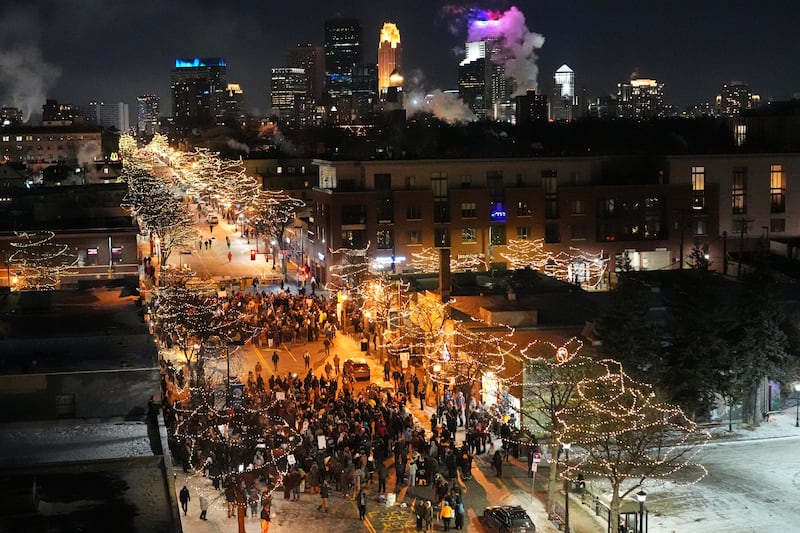
Utah leaders blamed a breakdown in communication between local and federal law enforcement for the deadly confrontations with immigration authorities in Minnesota as President Donald Trump continues his push for mass deportations.
Top policymakers promised to prevent similar chaos in Utah by collaborating with U.S. Immigration and Customs Enforcement and drafting a “jurisdictional protocol” to clarify relationships between local and federal partners.
“This wouldn’t happen in Utah, and it shouldn’t happen in Minnesota,” Utah House Speaker Mike Schultz, R-Hooper, said on Monday. “They need to find a way to come together ... the state and the locals and the federal government.”
Minnesota Gov. Tim Walz and Minneapolis Mayor Jacob Frey, both Democrats, have vocally opposed ICE in their state. After immigration authorities shot Renée Good on Jan. 7 and Alex Pretti on Saturday, federal officials blocked state investigations into their deaths.
On Monday, Trump appeared to reestablish communication through phone calls with Walz and Frey. The president also sent border czar Tom Homan to oversee operations in Minneapolis in response to deteriorating public opinion.
Majority of Utah disapproves of ICE tactics
The latest Deseret News/Hinckley Institute of Politics poll found a 12 percentage-point deficit among Utah voters in approval of the tactics ICE uses.
A majority, 53%, said they disapproved of the deportation methods used by ICE and Border Patrol, while 41% said they approved and 6% didn’t know.
Utah Republicans largely supported the deportation methods being used by federal agents, with 64% who approved, including 41% who strongly approved.
Meanwhile, disapproval reached 90% among Democrats, with 81% who strongly disapproved. Disapproval hit 67% among independents, with 47% who strongly disapproved.
The poll was conducted from Jan. 7-12 by Morning Consult among 799 registered Utah voters. The full sample has a margin of error of +/- 3.0 percentage points.

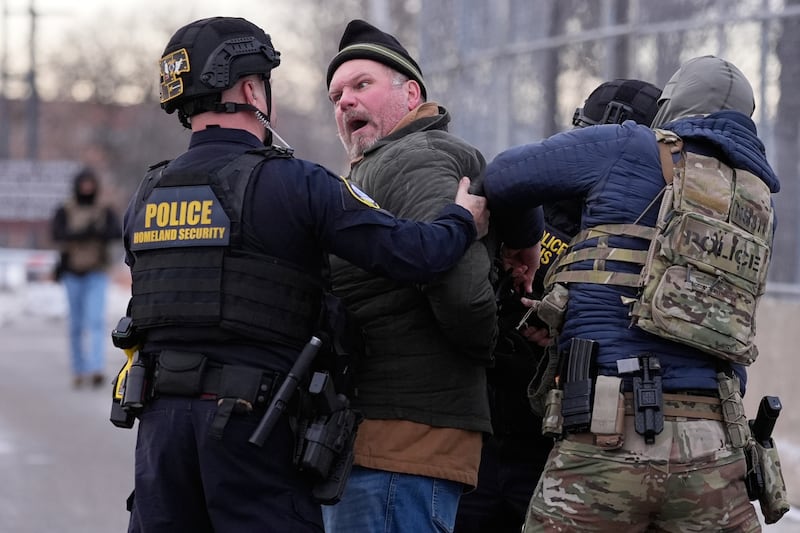
There have been documented shifts in the tactics used by ICE around the country and in Utah toward more street arrests of those with no criminal record, including traffic stops of suspected immigrants on their way to work.
But the reason immigration law enforcement is coming under increased pressure has more to do with who is in the White House and the way it is being covered by journalists, according to Utah County Sheriff Mike Smith.
“All of a sudden now it’s a bad thing for some reason, and I think we all know what the reasons are,” Smith said. “It just depends on what a media outlet wants to further the narrative.”
Since the passage of the One Big Beautiful Bill Act, ICE has become the most-funded federal law enforcement agency in the country, with its budget ballooning from around $6 billion in 2015, to more than $77 billion in Fiscal Year 2026.
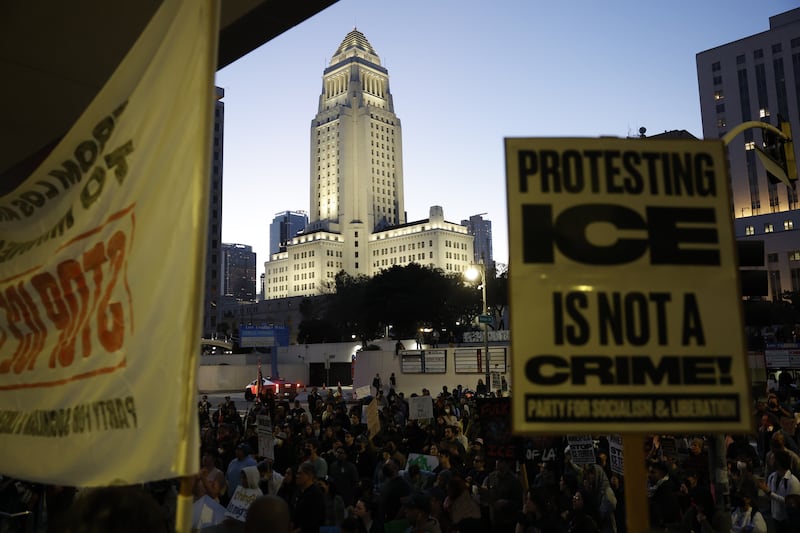
Increased ICE activity has been met with violent protests in cities like Los Angeles, Chicago and Minneapolis, with protesters often intentionally interfering with law enforcement operations and assaulting officers.
Utah’s relationship with ICE
Utah Sheriffs Association President Tracy Glover, state Rep. Jefferson Burton and Smith told the Deseret News they believe Minnesota officials failed to establish lines of communication with the Trump administration.
“You’ve got leaders in Minnesota that, frankly, are not adults, and they behave like children, and they’ve created some of this problem,” said Burton, R-Salem, who is the former head of the Utah National Guard.
“I think what’s happened is just an abdication of leadership on the part of folks in Minnesota.”
This month Minnesota leaders encouraged residents to protest. This stands in contrast to the work done by Utah leaders, according to Burton.
After the 2024 presidential election, Utah Gov. Spencer Cox announced the state would facilitate cooperation between local law enforcement and ICE.
The governor also sent a letter to the Trump administration recommending changes to make the detention and removal of immigrants easier.
What are 287(g) programs?
Many local law enforcement agencies have made special agreements to collaborate with ICE. Washington County became the first Utah municipality to start participating in ICE’s 287(g) Program in March 2025.

The county received “Jail Enforcement” authorities, enabling corrections officers to more easily identify and initiate deportation proceedings for jailed immigrants who entered the country illegally.
The county also accepted a “Task Force” designation, which ICE describes as being a “force multiplier,” allowing law enforcement agencies to use limited immigration authority during regular policing.
By the end of the year, nine other Utah counties, and the Utah Department of Corrections, had entered “Warrant Service Officer” agreements, which allows ICE to train officers to execute warrants on immigrants in their jails.
Riverton Police Department and Utah County had also begun the “Task Force” model. Shortly after the model was adopted in Utah County during a contentious county commission meeting Sheriff Mike Smith clarified what the program meant.
The new agreement would “provide greater access to federal data and resources to help identify individuals already in custody,” Smith said. “Our deputies will not participate in immigration sweeps or workplace raids.”
Is ICE coordinating with Utah police?
Utah’s top law enforcement officials have worked for years to improve relationships with ICE, according to Glover, who represents the state’s sheriffs in conversations with federal immigration authorities.
Utah sheriffs have visited Washington, D.C., twice to speak with ICE leadership under President Joe Biden, and Trump. Trust gained from these meetings led to the county 287(g) agreements, Glover said.

Sheriffs have navigated questions of federal jurisdiction under both Republican and Democratic administrations, including when FBI agents killed a Provo man during a 2023 raid without notifying local law enforcement.
Glover has found the best way to resolve tensions is through “respectful relationships that require collaboration, cooperation, and especially communication so that we don’t see what we see in Minneapolis.”
“To me, what’s happening in Minneapolis is a breakdown of communication,” Glover said. “Neither side trusts the other side, so they don’t want to communicate.”
As ICE activity in Utah has surged, the new director of the ICE Salt Lake City Field Office, Brian Henke, made a point of meeting with Glover and Utah Public Safety commissioner Beau Mason, Glover said.
Henke gives the sheriffs association monthly updates and regularly communicates with Glover, as president of the association. This close relationship may already be benefitting Utah communities, according to Glover.
In recent months, ICE alerted a Utah police chief of an upcoming raid on an apartment building to make arrests and the chief recommended a “safer way to go about it,” Glover said. “And they took him up on that.”
ICE facility in Utah?

But there are still plenty of signs of potential conflict as ICE ramps up street arrests across the state.
After Pretti’s death, large protests filled downtown Salt Lake City, blocking major roads. Protesters compared ICE to Nazi soldiers and demanded that ICE leave the state, with some protesters openly carrying firearms.
On Wednesday, Salt Lake City Mayor Erin Mendenhall delivered her annual state of the city address in which she promised that “Salt Lake City Police do not participate in federal immigration operations.”
Mendenhall also opposed the possibility of an ICE detention facility in the city. Last year, CNN and the New York Times reported that the Trump administration was considering a facility in the state.
On Monday, Utah Democratic lawmakers sent a letter urging Utah’s all-Republican congressional delegation to use their positions to prevent federal funding from being used to expand an immigration detention center in the state.
Glover, Smith and legislative leaders said they have received no details about a potential ICE facility in Utah. However, discussions about increasing ICE detention space in Utah have been ongoing for years.
Federalism commission
One group working proactively to clarify the relationship between local and federal law enforcement to prevent a Minneapolis situation is the Utah Commission on Federalism, chaired by Sen. Keven Stratton, R-Orem, and Rep. Ken Ivory, R-West Jordan.

At the group’s Jan. 9 meeting, Burton and Sen. Karen Kwan, D-Taylorsville — who chair the committee’s law enforcement task force — and Smith spoke in favor of creating a “jurisdictional protocol” to clearly outline how sheriffs should handle federal action in Utah.
“This is something that we are just beginning to work on through a bill that passed last year,” Kwan said. “And one of the pillars of that bill was to develop this 50-state coalition to begin these conversations of jurisdictional lines.”
Trump’s executive actions on federal law enforcement have helped to create “the opportunity of our lifetime” to get Democrats on board with a discussion on strengthening state sovereignty through principles of federalism, according to Ivory.
Ivory was the sponsor of HB488 last year which expanded the federalism commission, first created in 2011, to give it a national scope, with increased legislative and academic resources.
The jurisdictional protocol, which may be introduced as formal legislation next year, would ensure when an emergency arises that state, local and federal law enforcement have a clear understanding of their roles and a process for communicating, Ivory said.
The federalism commission is also working to meet with Henke to discuss these issues before they become a problem. By getting sheriffs and federal partners on the same page Utah is leading the country, according to Kael Weston, who represents the Utah Democratic Party on the commission.
“Ambiguity will kill,” Weston said. “Clarity is safety ... and the more clarity we can provide them about, ‘Hey, if ICE is going to be operating in your county ... this is the fine print, this is how that relationship is going to work.’”
Correction: An earlier version of this story had an incorrect timeline for shootings in Minnesota. It also incorrectly identified the chairs of the federalism commission. The chairs of the committee are Rep. Ken Ivory and Sen. Keven Stratton.