


Utah Gov. Spencer Cox ditched X six weeks ago and has taken up long-form reading. He is currently immersed in “David Copperfield,” a semiautobiographical novel by Charles Dickens, and suggests others should try it, too.
“I’m six weeks sober,” Cox said. “It’s the best thing I’ve done.”
The switch has been transformational for his health, his family and for having more face-to-face interactions with his constituents, he said on Wednesday. Cox spoke during a conversation with Rep. Jake Auchincloss, D-Mass., at Harvard University’s Kennedy School with a room full of Harvard students.
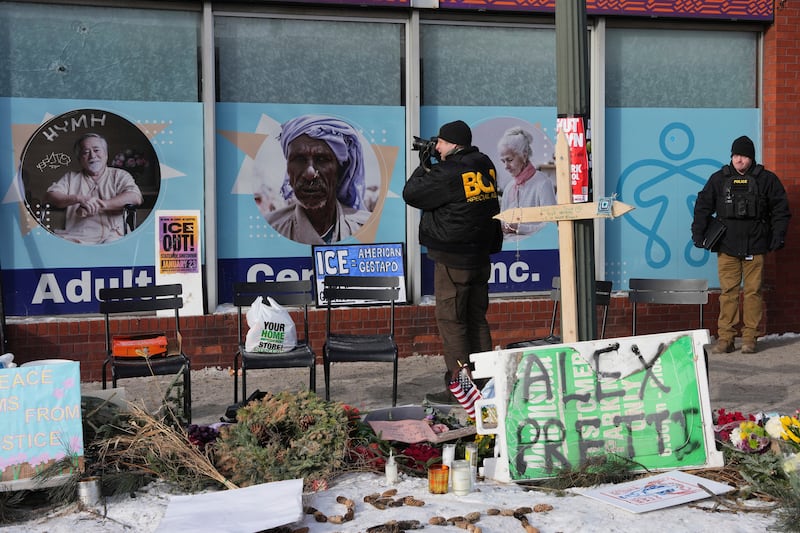
The speakers addressed the role of social media in fueling polarization, particularly in the aftermath of fatal shootings of Renée Good and Alex Pretti in Minneapolis. They also touched on the balance between politics and religion, AI regulation and the importance of local media.
Cox emphasized the power of elections and the ability of voters to catalyze change.
“Elections have consequences and that’s where we need to push back if that’s something that you don’t believe in,” he said.
On social media and violence
When asked about the role of social media within the latest unrest in Minnesota, Cox described the events in Minnesota as a “terrible tragedy.”
“It never should have happened,” he said. He remained hopeful about the takeaways.
“But I hope it gives us all a bit of faith in (James) Madison et al that there is still an impact — there is a massive change happening with the administration over the weekend, because we had this collective moment, because there was pushback, because people were seeing something that was different than what they were being told,” Cox said.
“I can tell you that the pushback was even greater than what you’ve seen behind the scenes. There was a lot of that happening and it did make a difference.”
Nancy R. Gibbs, Harvard professor and director of the Shorenstein Center, who moderated the discussion, asked speakers what in their view explained the tolerance for political violence among young people. A recent poll found that Gen Z are 20 percentage points more likely than the older generation to consider political violence as justified in certain situations.
Auchincloss argued that this trend may be rooted in a deeper breakdown of social cohesion: people are increasingly losing the sense that they share a common future with one another.
“And partly it’s because of social media, not entirely but partly, because we have atomized our attention spans through social media,” Auchincloss said.
Cox, who cited data that only 3% of Americans support political violence, pointed to eroding trust in institutions and noted that trust relies on two basic pillars: competence and ethics.
“The government is kind of bad at both of those right now,” Cox said. “We’re not delivering on the promises that we’ve made to people.”
Both politicians spoke in favor of temperance when it comes to social media and advocated for a public health approach to social media, similar to tobacco and alcohol.

On videos in Minnesota
As traditional forms of community have faded — churches, Rotary clubs, civic groups — people have channeled their hunger for connection into social media, which, in turn, through algorithms fractured users into antagonistic tribes, the Utah governor said.
“ We don’t have any real friends, but we can hate the same people together on social media. And so that becomes ... our tribe,” Cox said.
“From bowling alone to scrolling alone,” Auchincloss chimed in.
People are exhausted by politics, Auchincloss said, especially by the current administration, which he described as a “clown show” and the “witches brew of incompetence, cruelty and conspiracy.” Instead, he proposed “making politics boring.”
Auchincloss suggested that amid shrinking and fragmented attention spans, the documentation of the Minnesota events and watching them unfold collectively might actually be depolarizing.
“One of the surprising things actually about what’s happening in Minnesota is that it feels to me like for the first time in a long time, we’re actually all paying attention to the same thing right now as a country,” he said.
Cox countered that still fragmented perspectives remain. He recalled the aftermath of the assassination of Charlie Kirk in September and how different people saw entirely different realities in the same videos.
“It’s really hard to continue as a society when we have a person and we see two totally different variations of that person, and there is no interaction at all,” Cox said.
On regulating AI
Auchincloss framed AI regulation in terms of “regulating outcomes,” not “technologies themselves.” Congress often can’t keep up with the pace of developing AI.
“AI is changing every three months and Congress does not operate on three-month timelines,” he said.
He also suggested a partnership between the Consumer Product Safety Commission with The National Academies of Sciences, Engineering and Medicine to determine the effects of dopamine on the developing brain.
Cox also made a distinction between AI development and the tools for consumers. He described working with companies to set guardrails for AI therapy chatbots to prevent harm to vulnerable populations.
The goal is to harness AI for positive breakthroughs like cancer, while preventing abuses such as sexualized chatbots for children.
“We’re in an AI arms race with China, we need to win that,” he said.

On religion and change
The current entanglement of religion and politics, according to Cox, is a result of a backlash to excluding religion from public life entirely.
“For too long, we had to pretend like that’s something we can’t talk about in government and that I can’t be a whole person, I can’t let you know about my faith,” he said. “That was a mistake.”
Religion should not be used to benefit one group over another, he said, or to “force our God-like beliefs on other people.” “We do believe in a pluralistic society,” according to Cox.
The Founding Fathers, he said, believed that a “very religious people” can coexist with the government that was not mandating a specific religion.
“And that’s where I think we’ve started to cross over for sure,” he said. “And we have to be really careful about that.”
Moving beyond vilifying political opponents and disagreeing with more dignity and respect would take being in physical spaces together. Cox emphasized the power of elections and their outcomes.
“What I will say is elections have consequences and parties respond to shellacking, and we’ll see what happens this year,” he said. “But I do think it’s a collective decision — that we’re tired of this, that we want something different, that we start to support candidates who offer something different, and that we respond positively when the candidates do work across the aisle. … We should try to reward that type of behavior instead of punish that type of behavior."
Right now, politics rewards those who provoke outrage rather than those who achieve real results. “The incentive structure right now is so messed up and we’ve got to find ways to reward the boring stuff where we actually accomplish things instead of just the people who are really good at making you mad,” he said.

On local journalism and national media
Auchincloss called the decline of local journalism over the past 20 years an “epidemic.” Over the course of two decades, 40% of local newspapers have closed.
“Trust starts on a local level,” he said. One of his bills, he said, would take digital ad tax on social media platforms and channel it to fund tax credits for local journalism outlets. “ If we can build back up an ecosystem of local reporting — city hall, school committees — I think that national outlets can become healthier as a result of that.”
The rise of the booming media personalities on the political right came as a result of the national media skewing to the left, Cox said. “And yet, sadly, it’s opened the door to all kinds of misinformation.”
He echoed the concern about the extinction of local media. “That’s the whole ball game right there … and that’s why you’re seeing this lack of trust.”
But it’s not the only issue, according to Cox. “It isn’t so much that the national media is as skewed now as it is incompetent,” he said. Shrinking funding and loss of local media jobs mean talented reporters no longer have the traditional path to rise from local to national journalism.
Instead of going out and “changing the world,” Cox instead told the young people “to change their neighborhoods” — to volunteer, to care for their neighbors. " You are actually doing something where you can make a difference. ... Ultimately that is how we change the world."
