


People of faith have historically had lower levels of support of physician-assisted suicide, even as support has been rising across the nation. So it’s no surprise that Utah, one of the most religious states, does not allow physician-assisted suicide.
But a new poll from the Deseret News and the Hinckley Institute of Politics at the University of Utah shows that a slight majority of Utahns say physicians should “definitely” or “probably” be allowed to end a person’s life if they have an incurable disease. Those findings align with other polls nationally that show increasing support over time.
A granular look at the new data shows that support for physician-assisted suicide in Utah is largely bolstered by three groups: Democrats, liberals and Gen X.
Nearly three-quarters of people who identify as agnostic or “other” support physician-assisted suicide.
Meanwhile, Latter-day Saints are more likely than other Christians generally to oppose physician-assisted suicide, which The Church of Jesus Christ of Latter-day Saints calls “a violation of the commandments of God.”
The findings, according to political scientist and statistician Ryan Burge, are in keeping with both national trends and Utah’s religious identity. But they bear watching over time if the demographics of Utah change as the state continues to grow.
Physician-assisted suicide in Utah
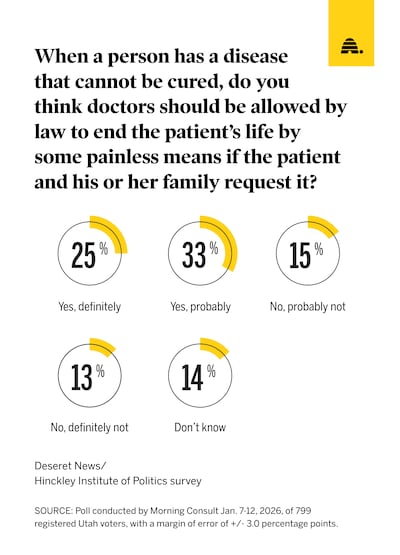
The poll, fielded Jan. 7-12 by Morning Consult, asked registered voters in Utah “When a person has a disease that cannot be cured, do you think doctors should be allowed by law to end the patient’s life by some painless means if the patient and his or her family request?”
Nearly 6 in 10 Utahns said physicians should “definitely” (25%) or “probably” (33%) be allowed to end a person’s life upon request if they have an incurable disease. Fifteen percent said “probably not,” and 13% said “definitely not.”
While a majority of all respondents said physician-assisted suicide should be allowed, there is a significant divide between those who identify as agnostic/other and those who say they are Christian.
Seventy-four percent of agnostic/other respondents said physician-assisted suicide should definitely (38%) or probably (36%) be allowed. Fourteen percent said probably not or definitely not.
Of all Christian respondents, 47% said physician-assisted suicide should definitely (16%) or probably (31%) be allowed, while 37% said definitely not or probably not.
Fewer Latter-day Saints expressed support.
Forty-three percent of Latter-day Saints said physician-assisted suicide should definitely (14%) or probably (29%) be allowed. Forty-one percent said probably not (24%) or definitely not (17%).
There was also a notable difference between Republicans and Democrats. Seventy-four percent of Democrats said physician-assisted suicide should definitely (37%) or probably (37%) be allowed, compared to 46% of Republicans, of whom 18% said physician-assisted suicide should definitely be allowed and 28% probably.
Fourteen percent of Democrats said physician-assisted suicide should probably not or definitely not be allowed, compared to 36% of Republicans.
Of independents, 63% said physician-assisted suicide should definitely or probably be allowed, while 27% said definitely or probably not.
Canada as a cautionary tale?
So what’s it all mean and what are the risks associated with this trend?
Canada may provide some insight. Although Canada’s laws regarding medical assistance in dying say they are intended for people with a “grievous and irremediable medical condition,” certain cases that have come to the public’s attention have sparked outrage in the United States.
Last month, radio host Glenn Beck offered to pay for the surgery of a Canadian woman who had been approved for medical assistance in dying and yet had been unable to get surgery to relieve a chronically painful condition because of a waiting list.
In a 2025 article entitled “Canada is Killing Itself" in The Atlantic, Elaina Plott Calabro wrote that medical assistance in dying is requested so much that doctors are struggling to meet the demand. In 2024, 5% of all deaths in Canada were through medical assistance. The figure is even higher in Quebec: 7%.
The rates may go even higher: Beginning in March of 2027, Canadians will be eligible to apply for such medical assistance not only because of a physical condition, but a mental illness. That opens a whole new host of issues.
Larry Worthen, executive director of the Christian Medical and Dental Association of Canada, said that while people who support physician-assisted suicide are usually motivated by compassion, many lack a comprehensive understanding of the issue. He believes that public support for medically assisted suicide is driven in part by media representations of people who are dying in unrelenting pain.
While no one wants to see people suffer, these kinds of stories don’t often address the wider social problems that the legalization of physician-assisted suicide presents, such as incentivizing of death over life and changing the very definition of healthcare to include ending lives, Worthen said. They also don’t represent everyone dying through medical assistance, he said, noting the case of a 26-year-old man who died in December after being approved based on diabetes, partial blindness and peripheral neuropathy.
“It’s like Pandora’s box; when you open it, you think, oh, we can just limit it to these particular circumstances. And what you find is, once you say it’s acceptable to kill a patient, then there is no logical place where that stops,” Worthen said.
How Gen X stands out
In the Deseret News/Hinckley Institute poll on physician-assisted suicide, there was little disparity when it came to gender and ethnicity: for example, 33% of men and 32% of women answered “yes probably.”
But Gen X, which Morning Consult defined as respondents born between 1965 and 1980, stands out when age groups are compared.
The generation between the Baby Boomers and millennials, they had the largest share of unequivocal support for physician-assisted suicide, with 36% saying it should definitely be allowed.
The next highest level of “definite” support came from Gen Z, at 23%, while 21% of millennials and 22% of Baby Boomers said physician-assisted suicide should definitely be allowed.
Gen X also had the highest level of “definitely not” — 17%.
While support for physician-assisted suicide spans generations, “What stands out is the level of support among Gen X, which appears to be shaped more by lived experience than ideology, particularly experiences like caring for aging parents or facing end-of-life decisions firsthand,” Hinckley Institute Director Jason Perry said.
He added, “While Baby Boomers remain the most hesitant, even there the level of opposition is more muted than it has been in the past.”
Burge, the political scientist and statistician who specializes in religion, compared the Deseret News/Hinckley Institute numbers to 2024 data from the General Social Survey. He said in an email that the level of support for physician-assisted suicide among all Christians in Utah (47%) is lower than the national Protestant average in the GSS (52%).
“Utah’s numbers aren’t wildly out of line with national trends, but they do skew slightly more conservative, which is exactly what you’d expect,” Burge said, adding that there is “a decades-long national trend toward greater acceptance of physician-assisted suicide, even among religious groups.”
This trend has also been noted by Lifeway Research, affiliated with the Southern Baptist Convention.
In its most recent poll on the topic, released in September of 2025, Lifeway asked respondents the degree to which they agreed with the statement “Physicians should be allowed to assist terminally ill patients in ending their life.”
Fifty-five percent strongly or somewhat agreed, slightly less than the 58% that “definitely” or “probably” support physician-assisted suicide in the Deseret News/Hinckley Institute poll.
Lifeway broke down its data by geographic region and noted, “U.S. adults in the West are more likely than those in the South to support it (57% v. 49%). This reflects the legal realities of the two regions. Half of the states where physician-assisted suicide is legal are in the West, while none are in the South.”
The Deseret News/Hinckley Institute poll surveyed 799 registered voters in Utah. It has a margin of error of 3 percentage points.