

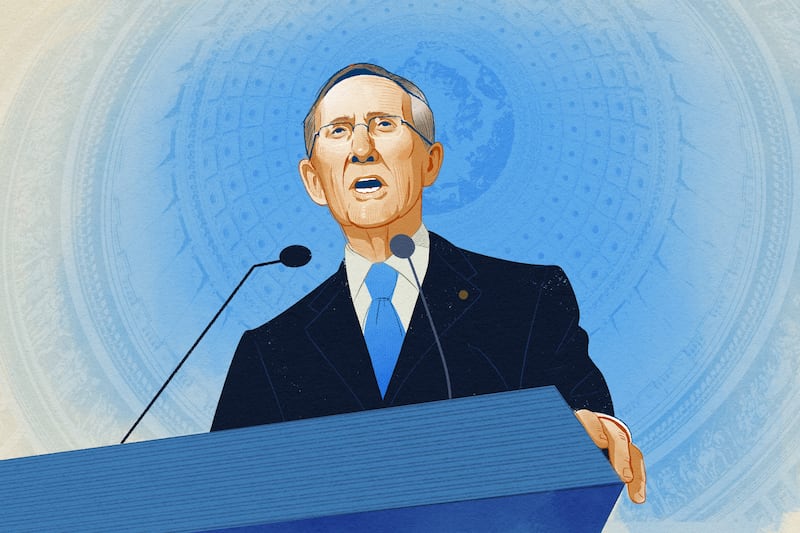

- New biography of former Nevada Sen. Harry Reid, "The Game Changer," released Jan. 20.
- Book details Reid's impact on Las Vegas gambling industry and top Democratic legislation.
- Gives new details on Reid's most controversial statements on Bush, Obama and Romney.
Former Sen. Harry Reid — son of a destitute miner, favorite of the Las Vegas gambling industry and the highest ranking Latter-day Saint politician in U.S. history — left a permanent mark on national politics.
The Democratic bulldog, who died in 2021 after 34 years in Congress, was one of the key figures in flipping Nevada blue, forcing the passage of Obamacare and ending the filibuster on judicial nominations.
An official biography of Reid, released on Jan. 20, details how he fought his way from the tiny town of Searchlight to the heights of American power as Senate majority leader — and how he transformed political norms along the way.
“Reid’s political legacy is indisputable,” writes Jon Ralston, author of the new book, “The Game Changer.” “(He) forever changed Washington with his ruthless, cutthroat style that led to spectacular victories and perpetual dysfunction.”
Ralston, CEO of The Nevada Independent, followed Reid’s career for four decades, starting with Reid’s first Senate campaign in 1986. At one point, Reid tried to get Ralston fired from a local news station — and succeeded.
Then, in 2021, Reid agreed to work with Ralston on a biography, participating in dozens of interviews spanning the course of his career, before he died of pancreatic cancer in December 2021 at the age of 82.
Here are some of the highlights from the life of Nevada’s longest-serving senator, and one of the most notable Democratic game changers of the political landscape in the American West as well as in Washington, D.C.
Biggest accomplishments
It didn’t take long for Reid’s ambition to lead him to politics.
After paying his way through law school as a U.S. Capitol Police officer, Reid was elected to the Nevada Assembly in 1968, where he sponsored 20% of the bills, ranging from increasing pawnshop rates to regulating the phone industry.
Two years later, at age 30, Reid became the youngest lieutenant governor in Nevada history, serving with his former high school history teacher, and mentor, Nevada Gov. Mike O’Callaghan.
After failed campaigns for U.S. Senate in 1974, and Las Vegas mayor in 1975, Reid, who worked as a trial attorney, was elected to the U.S. House in 1982, followed by the U.S. Senate in 1986, where he would stay for 30 years.
During his time in Congress, Reid developed a unique balancing act on his priority issues, advocating ceaselessly for the mining industry he had grown up with, while championing environmentalist causes in his home state.
Reid secured protected status for more than 5 million acres by creating the Great Basin National Park, and helping to establish the Tule Springs Fossil Beds, Basin and Range and Gold Butte national monuments.
After becoming Senate majority leader in 2007, Reid was President Barack Obama’s legislative liaison, lobbying for stimulus funding and negotiating the Affordable Care Act by carving out expensive exceptions for reluctant senators.
Reid is also credited with organizing the “Reid Machine” — a Democratic get-out-the-vote operation that shifted voter registration totals, got Democrats elected and helped designate Nevada as an early Democratic primary state.
Casino controversies
Along the way, Reid made his fair share of enemies.
He was known for his “ruthless” campaign style, which included a tendency to repeat rumors as if true, like implying without evidence that Nevada Gov. Paul Laxalt had used his position to become owner of a $7.5 million casino.
Many of Reid’s own criticisms came from his work with the gambling industry.
Reid was appointed as chairman of the Nevada Gaming Commission in 1977, where he informed the FBI on bribery schemes, confronted mob bosses, investigated Howard Hughes and gave a gaming license to Frank Sinatra.
As chair, Reid was credited with helping push the mob out of Las Vegas, denying licenses to individuals like Frank Rosenthal. This came at a cost, including a close call when something that looked like a bomb was placed in his wife’s car.
But Reid came under scrutiny when wiretaps named him as a mob source. While the investigation found Reid never engaged in illegal conduct, recordings identifying Reid as “Clean Face” followed him through his career.
Despite this, Reid never stopped championing the biggest players on the Las Vegas Strip, including by pushing banks during the Great Recession to support the MGM casino, which hired him as a consultant after he left the Senate.
“From the Strip to downtown, Reid was a gaming industry darling and would be for as long as he was in office,” Ralston writes.
Navigating political tension
Like many politicians, Reid evolved over time. But some of his transformations were stark.
As a young lawmaker, Reid had a “100% pro-life voting record.” He opposed Roe v. Wade, voted against federal plans paying for abortion and supported a constitutional amendment banning abortion from conception.
Reid was also one of 38 Democrats who killed the Equal Rights Amendment. But as he rose through party leadership, Reid developed more establishment Democratic views on abortion, same-sex marriage, gun rights and immigration.
While in the House, Reid lambasted Reagan’s immigrant amnesty program for allegedly rewarding lawbreakers by giving them legal status. In 1993, Reid introduced a bill outlawing birthright citizenship and lamented the impacts of mass immigration.
By the time he became majority leader, he was a key supporter of the DREAM Act for minors living in the country illegally, had lost his top rating from the National Rifle Association and had done a total reversal on the “nuclear option.”
In 2005, Reid had been one of the most vocal senators opposing an effort to remove the Senate’s 60-vote, filibuster-proof requirement to pass most legislation. In 2013, Reid did just that for most judicial nominations.
Reid also gained a reputation for his viral “Reidisms,” revealing his proclivity for speaking without a filter.
Such instances include when he called Federal Reserve Chair Alan Greenspan a “political hack,” and President George W. Bush a “liar” and a “loser,” or praised Obama for having “no Negro dialect, unless he wanted to have one.”
The most famous of these is when Reid accused, without evidence, then-presidential candidate Mitt Romney of not paying taxes, even though Reid, who had significant real estate holdings, secretly had a similar average tax rate.
Throughout his political endeavors, however, Reid remained a devout member of The Church of Jesus Christ of Latter-day Saints, Ralston writes, attending church regularly and reading scriptures every night.
Raised in abject poverty, in a town of several dozen with no church, the first time Reid “learned of a man named Jesus” was in a high school seminary class, which he attended with his friend to meet girls, Ralston writes.
He and his wife, Landra, began to take missionary lessons after eloping to Logan, Utah, to attend Utah State University. The two decided to join the church in 1960. Together Reid and Landra had five children.