

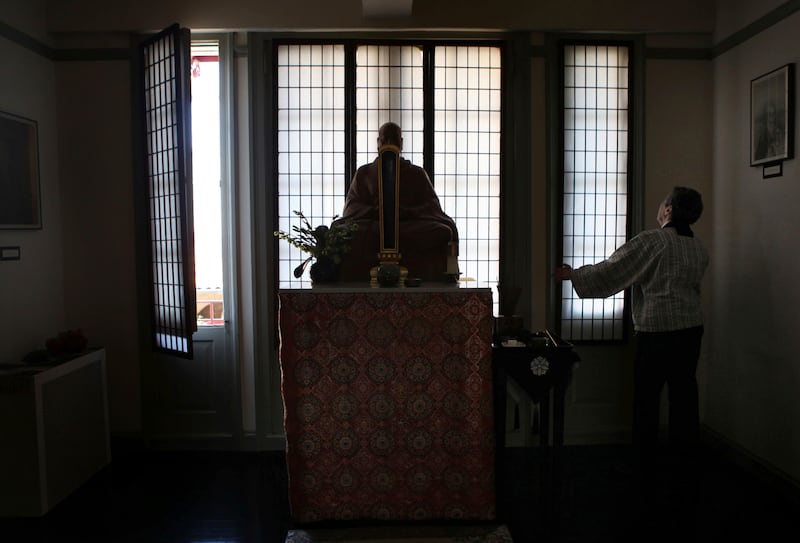

A new development emerged in a San Francisco court battle where one religious group is defending its right to decide what to pay its ministers.
Annette Lorenzo, a former monk-in-training, filed a lawsuit against the San Francisco Zen Center, claiming she was owed back pay of minimum wage and overtime.
Lorenzo spent years training and living at the religious center.
At the heart of this case is the question of whether courts can interfere in the employment decisions of religious organizations.
“A Buddhist monk in training and a Catholic seminarian aren’t your average 9-5 gigs, and courts shouldn’t treat them as such,” said Eric Rassbach, vice president and senior counsel at Becket, a Washington, D.C., law firm that aims to protect religious freedoms.
“Federal courts have long recognized that disputes over ministerial compensation invariably drag judges into matters of religious doctrine and practice. California’s ruling runs roughshod over that protection.”
On Thursday, John Garvey, former president of The Catholic University of America, filed a friend-of-the-court brief supporting the San Francisco Zen Center, saying that forcing religious institutions to comply with California’s wage laws would tear down respected and sacred religious traditions that have “been practiced for centuries.”
Ex-monk seeks compensation for unpaid wages
Garvey also argued that the federally recognized legal doctrine of ministerial exception aims to protect a religious organization’s autonomy in decision-making, regardless of whether that decision had a religious basis.
He cites the ministerial exception that protects the Catholic vows of poverty.
Monks also take a similar vow in addition to committing themselves to a period of manual labor.
The Zen Center is a nonprofit and earns revenue by renting rooms to non-practicing guests at three of its training centers — City Center, Tassajara and Green Gulch Farm. Visitors enjoy the baths and hot springs without being requested to practice Buddhism.
As a part of the religious residential training, participants devote themselves to a work practice apprenticeship, where they train and work at the temple. The idea of work includes gardening, cooking, cleaning, or helping with administrative duties, with each task done mindfully and attentively as a way of embodying Zen principles.
When Lorenzo worked there, she cleaned guest rooms, washed laundry, and gave tours. She served many different roles all across the facilities, from the kitchen to the bathhouse to the library. According to the court documents, “her final monthly stipend was $198.33.”
Religious Traditions vs. State Labor Laws
Following a hearing in response to Lorenzo’s claim, the Labor Commissioner ruled in Lorenzo’s favor and awarded her more than $149,000 in unpaid wages in July 2020.
The Zen Center appealed to the San Francisco Superior Court. The judge disagreed with the commissioner’s award, ruling that the “ministerial exception” bars wage-related claims.
Fast forward to November 2025; the California Court of Appeals reversed the trial court’s decision.
The appeals court sided with Lorenzo, stating “that religious employers are not categorically exempt from wage and hour obligations under state law.”
It also noted that “the ministerial exception is not an umbrella immunity; rather, it is limited to situations involving inquiries into strictly ecclesiastical matters, such as the selection or removal of ministers.”
Becket‘s Rassbach said that “Judges and juries” shouldn’t referee “disputes between religious groups and their ministers.”
“Yet the ruling below allows exactly that, pulling courts into religious questions the Constitution says they must leave alone,” he said. “We hope the court takes this case and ensures religious communities, not courts, remain in charge of their ministers.”
The Appeals court’s ruling allows Lorenzo to move forward with her claims unless there is an intervention.
Becket and other organizations championing religious freedom have urged the California Supreme Court to take on the Lorenzo v. San Francisco Zen Center case. A decision on whether the higher court will hear the case is expected in the coming months.