
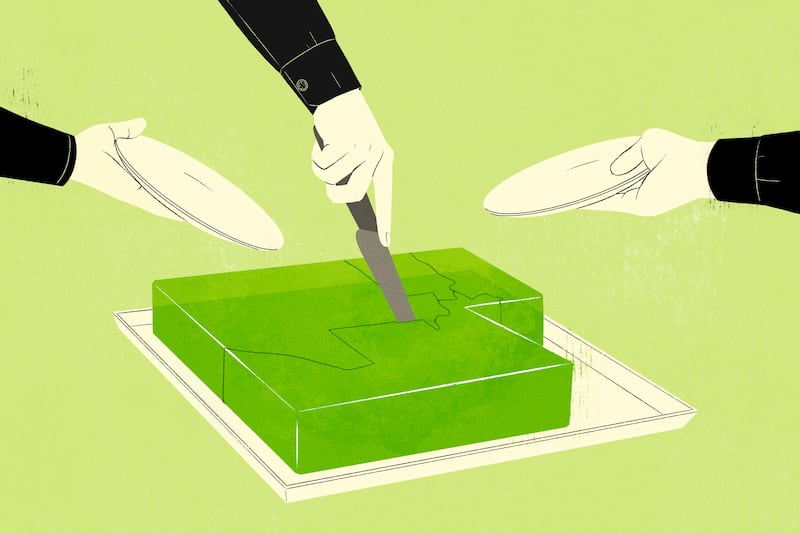

The state’s most powerful lawmakers laid bare their true feelings on Friday about the political upheaval caused by Utah’s Proposition 4 redistricting law, saying that it risks permanently upending the legislative system.
Eight years ago the Better Boundaries ballot initiative, or Prop 4, galvanized anti-gerrymandering organizers and led to sharp partisan pushback. On Friday, Utah Senate leadership made it clear the rancor has only intensified.
“It’s chaos,” said Sen. Scott Sandall, R-Tremonton, who chairs the Legislative Redistricting Committee. “This problem that is occurring right now is because the outcome was not what some wanted, so they attacked the process.”
But Prop 4 proponents allege the law’s fallout — including public outcry, a yearslong legal slugfest and a repeal petition — stems, instead, from legislators’ opposition to people placing a check on their authority to decide electoral boundaries.
Understanding where Utah is today, eight years into this fight, requires understanding how it began.
The stakes in Utah’s redistricting battle
Ever since voters approved Prop 4 in 2018 by a margin of less than 1%, the law has split Utah’s public officials. But over the past 18 months, the debate has erupted into what some top Republicans are calling a constitutional crisis.
In July 2024, the Utah Supreme Court flipped constitutional precedent on its head, according to critics. In a unanimous ruling, the GOP-nominated justices prohibited lawmakers from amending ballot initiatives in many circumstances.
“When our Supreme Court ruled that the initiative process had superiority over the statutory process they destroyed the Republic, in my mind,” Senate President Stuart Adams, R-Layton, said. “And that’s what’s caused the chaos.”
Last fall, a district judge eliminated Utah’s 2021 congressional map based on that ruling, declaring the map violated Prop 4’s intent. The judge later rejected lawmakers’ attempt to comply with the law, instead picking a map drawn by plaintiffs in the lawsuit.
Now, during the 2026 legislative session, with court cases in flux and candidates on edge ahead of the midterm elections, lawmakers continue to feel the disruption of Prop 4 as it reshapes Utah’s political landscape.
It has been difficult to keep up with the constantly evolving news cycle of late-night rulings, special sessions and court filings. Here are the key events in Utah’s tumultuous, and at times explosive, redistricting battle.
2018: Voters pass Prop 4
In 2017, five years after Utah lawmakers were accused of “cracking” Salt Lake County’s Democratic strongholds into three U.S. House seats, Better Boundaries was created to sponsor a statewide ballot initiative.
The initiative sought to increase transparency and implement guardrails around the once-in-a-decade redistricting process. It would establish an appointed commission to recommend district maps to the Legislature.
While ultimate redistricting authority would remain with lawmakers, Prop 4 required them to vote on recommended maps and for the final map to not “unduly favor” a political party, or else face lawsuits.
In 2018, a majority of voters in Salt Lake, Summit, Carbon and Grand counties — driven to the polls at least in part by other initiatives on the ballot that year, including legalizing medical marijuana and expanding Medicaid — approved of Prop 4, making it law.
2020: Prop 4 gets amended
Before the 2020 legislative session, Better Boundaries approached lawmakers with concerns that Prop 4 in its original form could invite constitutional challenges by interfering with legislators’ redistricting authority.
After more than a year of negotiations, lawmakers and ballot initiative sponsors held a press conference to champion what both sides called a compromise solution, which later passed both chambers with nearly total bipartisan support.
The bill reforming Prop 4, SB200, kept the seven-member redistricting commission, but removed the requirement for lawmakers to accept or reject its proposals, and to provide an explanation for their decision.
The bill also replaced Prop 4’s list of redistricting criteria — forbidding districts that protect incumbents and requiring districts to minimize municipal splits — with internal rules to avoid “purposeful or undue favoring” of parties.
2021: Legislature passes new map
The first round of Utah’s new redistricting commission did not go as smoothly as some had hoped. Commission member former Rep. Rob Bishop abruptly resigned in October 2021, arguing that the process was biased against rural Utah.
In November, the state Legislature’s redistricting committee largely dismissed three congressional maps drafted by the commission, which claimed it had followed a nonpartisan process, though one map used a tool with partisan data.
The Legislature ultimately endorsed a congressional map combining urban and rural representation and splitting Salt Lake County between four districts. Cox signed the map into law despite what he labeled a “partisan bend.”
Better Boundaries immediately threatened possible legal challenges or a new ballot initiative. After years of pushing for what the group characterized as fairer congressional representation, Utah appeared to have less competitive districts than before.
2022: Legislature is sued by special interest groups
In 2022, the League of Women Voters Utah, Mormon Women for Ethical Government and Millcreek residents, sued lawmakers for allegedly violating the state Constitution by ignoring voters’ right to initiate legislation and to rein in gerrymandering.
The Legislature grounded its defense in Utah’s Constitution, which states, “the Legislature shall divide the state into congressional … districts.” But lawmakers were about to receive an earthshaking message from Utah’s top court.
2024: Supreme Court shifts status quo
In the summer of 2024, the Supreme Court responded to an appeal of the lawsuit with a new interpretation of the state Constitution: ballot initiatives altering the structure of government would, from now on, be a wholly new class of laws.
The ruling prohibited lawmakers from amending initiatives that reform government unless they satisfied the highest legal standard of strict scrutiny, allowing changes only to address a compelling state interest in the least restrictive way possible.
2024: Failed constitutional amendment
Shocked by the Supreme Court’s ruling, legislative leadership met for a special session to draft a constitutional amendment that would clarify the Legislature’s ability to change or repeal ballot initiatives after they are approved by voters.
But, in a decision upheld by the Supreme Court, Gibson ruled that the so-called Amendment D was void because lawmakers did not meet the standard for advertising the amendment in newspapers and the ballot language was unclear.
2025: Judge throws out 2021 map
In an August 2025 ruling — months after a self-imposed deadline — 3rd District Judge Dianna Gibson ruled that SB200 “unconstitutionally impaired” Prop 4 and that the Legislature’s 2021 congressional map needed to be thrown out.
Gibson directed the Legislature to approve a remedial map in line with Prop 4. Working on a truncated timeline, lawmakers requested public feedback, and approved a map including two more competitive, but still Republican-leaning seats.
2025: Gibson chooses plaintiffs’ map
In a bombshell decision, delivered on Nov. 10, just minutes before a midnight deadline requested by Utah Lt. Gov. Deidre Henderson, Gibson rejected the Legislature’s offering as “an extreme partisan outlier” that failed to meet Prop 4 standards.
Up against an election timeline, Gibson said she felt she had no choice but to pick a map submitted by the plaintiffs. Utah’s new congressional map, Gibson said, should have a “Democratic-leaning district anchored in the northern portion of Salt Lake.”
2025: Legislature promises to appeal
The ruling ignited a Republican firestorm. Adams and House Speaker Mike Schultz, R-Hooper, vowed to repeal it, GOP lawmakers threatened impeachment and conservatives hurled the accusation of gerrymandering right back at Gibson.
Cox backed the Legislature, supporting an appeal and suggesting that Gibson’s delayed redistricting decision had limited the ability “for justice to fairly play out.” This was just the beginning of the Republicans’ attempt to counter the ruling.
2026: Challenge from U.S. Reps
On Monday, U.S. Reps. Burgess Owens and Celeste Maloy of Utah joined 11 local leaders in filing a federal lawsuit alleging the state’s court-ordered congressional map violates the Elections Clause of the U.S. Constitution.
The federal lawsuit marks just the latest effort to undo Gibson’s decision. Her ruling so far has prompted a partial appeal by the Legislature — as they are still waiting for Gibson to issue her final judgment — and a GOP initiative to repeal Prop 4 entirely.
“Whether by ballot initiative, litigation, or by supporting judicial reform, we will continue to fight for the rights of all Utahns by strengthening our constitutional republic,” Utah Republican Party chair Rob Axson said in a statement.
Beyond the backlash, Gibson’s ruling has clear political implications. By reducing Utah’s GOP-leaning districts from four to three, it has become unclear which districts Owens, Maloy or Reps. Blake Moore or Mike Kennedy will choose to run in.
2025-26: Democratic candidates see opportunity
Gibson’s map creates a Salt Lake City seat where Kamala Harris won by 23 percentage points in 2024. The district is home to 41% of the state’s actively registered Democrats and just 15% of the state’s registered Republicans.
At least seven Democratic candidates, including two state lawmakers, have announced their intention to run for the new 1st congressional district, which they see as an unprecedented chance to provide Democratic representation for the state.
Over 52% of actively registered Utah voters are Republican, less than 14% are Democrats and roughly 28% are unaffiliated. The other 6% are split among smaller parties. In the 2024 election, Trump won just under 60% of Utah’s vote, while Harris won 38%.
Looking ahead: Will Prop 4 be repealed?
In an effort to counter Gibson’s ruling using all means possible, Axson launched a ballot initiative of his own, with the support of Sen. Mike Lee and Attorney General Derek Brown, to repeal Prop 4.
The party recruited hundreds of volunteers and paid employees from around the country to try to get 141,000 signatures by Feb. 15 to put Prop 4 on the ballot again. As of Friday, the Lieutenant Governor’s Office had recorded over 76,000 valid signatures.
National GOP weighs in
The Beehive State’s ballot initiative has drawn attention from the highest levels of GOP politics. President Donald Trump endorsed the effort in January, after his son encouraged people to sign up to become paid signature gatherers in October.
The initiative also attracted GOP get-out-the-vote guru Scott Presler for an eight-day signature gathering blitz, and Turning Point Action, which is bringing its “super chaser” door-knocking strategy to Utah for the first time to repeal Prop 4.
Repeal effort boils over
As election season nears, Prop 4 has brought out the worst of Utah partisanship. Multiple police reports have been filed alleging assault and aggression toward GOP signature gatherers, resulting in at least several dozen lost signatures.
Many complaints have also been made by Utah voters who report signature gathers using misleading tactics to score signatures. Some gatherers have characterized the initiative as an effort to “stop gerrymandering” or “remove the crooked judge.”
Meanwhile, Better Boundaries has launched a signature removal campaign, mailing letters to thousands of voters who signed what the group calls “a pro-gerrymandering petition” and providing them with forms to remove their names.
A criminal investigation is now underway after the GOP’s political issues committee, Utahns for Representative Government, flagged potential fraud by its gatherers, with one county clerk disqualifying roughly 300 signatures, KSL reported.
Is the repeal popular?
A Deseret News/Hinckley Institute of Politics poll conducted in January found 44% of Utah voters don’t know whether they support the repeal effort. The rest of voters are split, with 26% supporting the proposition and 29% opposing it.
On Friday, Utah Senate Minority Leader Luz Escamilla, D-Salt Lake City, said she shared some concerns about a judge choosing electoral boundaries without legislative input. But many Utah voters have felt this way about the Legislature’s actions, she pointed out.
Utah is not unique in trying to implement a redistricting commission. Too often, Escamilla said, arguments made in favor of unfettered legislative control over redistricting are only supported by members of states’ dominant political party.
“We feel totally excluded from that process, and that hurts our districts that we represent, and I hope that’s also acknowledged,” Escamilla said.
“That’s also part of this exercise, that you realize human nature runs a lot of the stuff that’s happening.”