

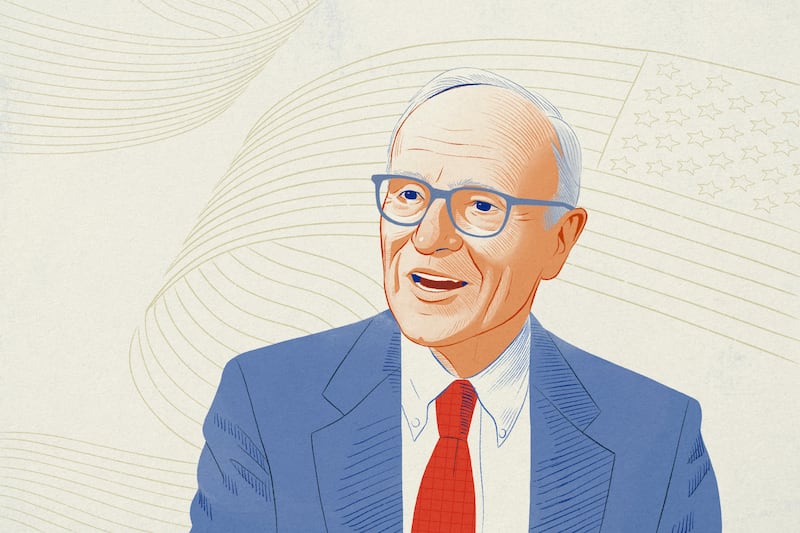

SOUTH HADLEY, Massachusetts — As a graduate student at Harvard University in the 1970s, George H. Nash was expected to write a dissertation that could become a book. He mulled writing on the Americans for Democratic Action, a liberal group that Ronald Reagan was a part of when he was a Democrat, but instead decided to delve into the intellectual side of conservatism, which to many people at the time seemed an oxymoron.
“I was writing at a time when conservatism was commonly thought of as synonymous with the John Birch Society, weirdos, and so on. The existing, scholarly literature about conservatism, such as it was, was essentially focused on the radical right. And the writing about the radical right was mostly being done by people on the left,” he said. “The intellectual dimension of conservatism was being neglected.”
Nash’s 1976 book, “The Conservative Intellectual Movement in America Since 1945,” changed that. Originally published by Basic Books, it has been described by Regnery Press as “the unquestioned standard in the field” and established Nash, then 31 years old, as the foremost expert on an ascendant political force.
At 80, he still is.
And in the age of Donald Trump, Nash’s unique historical perspectives, combined with his measured, non-polemic approach, makes his observations about the state of conservatism among the most important in the country.
“George is a man who not only wrote about conservatism, but really shaped the way we think about post-war intellectual conservatism as a movement,” said Jeff Nelson, executive director and CEO of The Russell Kirk Center for Cultural Renewal, where Nash has been a senior fellow since 1995.
It was Nash, Nelson said, who advanced an understanding of modern American conservatism as what came to be known in some quarters as a three-legged stool: an alliance of thinkers who had different priorities — foreign policy, economic and individual freedom, and morality and virtue — but who were able to coalesce through shared values.
And it was Nash’s presentation of conservatism as a body of important ideas with political implications, rather than a party guided only by political expediency, that helped the movement ascend to the fore of society. “Nobody else took (conservative thinkers) seriously in the way that George did at the time,” Nelson said.
But two Trump presidencies, and the cultural noise surrounding them, at times seem to drown out the intellectual foundations of conservatism, leading Nash to remind conservatives that to succeed, their movement needs not just voices, but minds. He describes the current era as “turbulent” and warns of foreseeable consequences if the waters can’t be calmed.
As Nash wrote in 2016 for The New Criterion, “American conservatism, then, remains at heart a coalition. Like all coalitions, it contains within itself the potential for splintering — and never more so than right now."
Still at work in the same community in western Massachusetts where he grew up, Nash ascribes to the philosophy “don’t retire — rewire," and he is still much in demand as a speaker and writer, both on conservatism, and on the 31st president, Herbert Hoover, of whom he wrote a three-volume biography.
While his seminal book hasn’t been updated since the 30th anniversary edition was issued, he is just as in tune with conservatism and its players as he was when he was interviewing people like William F. Buckley Jr., Milton Friedman, Russell Kirk and L. Brent Bozell Jr. a half-century ago.
Of today’s conservatism, he has thoughts, which he is always ready to share.
Who is George H. Nash?
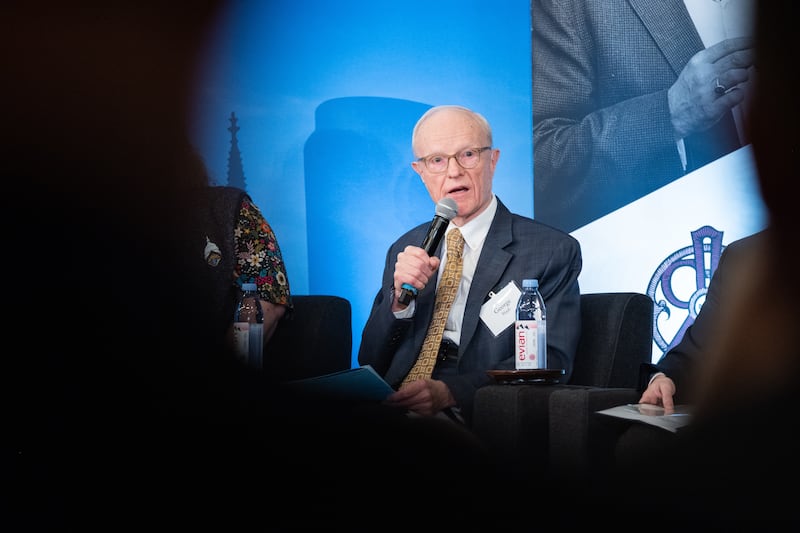
Nash arrived for our lunch looking much like a college professor minus the lectern: dressed in collared shirt, necktie and gray V-neck sweater.
He is an academic above all else, so it’s fitting he lives in a section of Massachusetts heavily populated with college towns. (In addition to Mount Holyoke College, within our view, Smith, Amherst and a dozen other colleges are near.)
He hails from a generation that could make a career out of studying and constructed that path for himself.
Born into a Protestant family that’s been described as “conservative Republican Yankees,” Nash’s interest in history was nurtured by his parents, both “great readers” (his father was a carpenter and cabinet maker, his mother a history major in college) and his maternal grandfather who gave him a 10-volume history of World War II when he was just 11. (The closeness of the family is evident in “The Conservative Intellectual Movement in America” which he dedicated to his parents and sister.)
He was valedictorian of his high school class, then enrolled at Amherst College to study history, graduating summa cum laude. From there, he left western Massachusetts for Cambridge.
At Harvard, he found two distinguished mentors: Bernard Bailyn, who won the Pulitzer Prize for history twice, and Donald Fleming, a scholar of history and intellectual history.
It was Fleming who suggested that Nash research American intellectual conservatism, an idea that at first seemed strange because the principals were still living, not historical figures. But that, Nash said, turned out to be “a blessing in disguise” because he got to talk to so many of the people he was writing about, like William F. Buckley Jr., who invited him to his home on the Connecticut shore the day after Thanksgiving in 1971.
The invitation was a shock to Nash, who’d called Buckley’s office hoping to maybe get an hour with him at his New York office. Instead, he got five hours in which to interview the National Review founder and Firing Line host, who sat at an enormous U-shaped table he bought in Mexico, with the music of Johann Sebastian Bach blaring and Buckley’s dog running in and out of the garage that had been converted into a study.
There would be many important people in conservatism that he would go on to interview, Milton Friedman, Irving Kristol and Russell Kirk among them. At that time, he could not foresee that he himself would become an important figure in conservatism; his goal, after all, had always been to be objective.
“Although I was sympathetic to many of the conservative intellectuals I was writing about, I was very careful about my approach. For one thing, I knew that people who would have to approve my dissertation were not necessarily sympathetic to the subject,” he told me. “Also, I knew that for a dissertation and eventual book on such a subject to be useful to the scholarly community, it must be as free as possible from bias.”
“I also felt that my purpose here was not to take sides and be a flag waver; this was a scholarly, academic book. When published, my volume turned out to be of value not only to people on the right, but also to people on the left who felt they learned something."
The book’s timing was fortuitous. Scheduled for publication in the fall of 1975, it was delayed by a printer’s strike. But National Review published an excerpt in its 20th anniversary issue, a few months before publication, and a conservative book club picked it up as one of its highlighted offerings. The paperback version came out in 1979, as Ronald Reagan had stepped onto the national stage. People were asking “What does it mean to be a conservative?” and while Nash offered no succinct definition, he offered wider parameters.
“So it suddenly became a kind of go-to book, in a way,” Nash told me, with characteristic modesty.
The book is still in print, and Nash would go on to write another book on conservatism, “Reappraising the Right,” a collection of essays on the past and future of conservatism, published in 2009. But Nash also developed a parallel interest— Herbert Hoover — whose presidency also became a subject of study.
The rise of Donald Trump
Two decades of work on the Hoover biographies was the closest that Nash has come to having traditional employment, and even then, he was working independently. Throughout his career, he has worked without the security of a tenured professorship, although he has been a senior fellow at the Kirk Center since its founding, lectures internationally and writes prolifically.
He has watched the rise of Trump with his trademark objectivity — he is a man who eschews polemics and told me he never wanted to write a book review that would be viewed as harsh — but he also eyes the Trump era with concern.
“I just see the current era as one of turbulence, and I don’t see any quick ending to it. I suppose if we had a smashing victory for one side or the other, that might stabilize the political scene. But barring some major external shock, like an economic downturn or a conflict abroad, something that might conceivably bring Americans together, I don’t foresee any imminent turning away from our current political strife."
Social media is in part to blame, he said. And today’s old-school conservatives also have a challenge that the predecessors didn’t face: They’re not just battling the left, but the far right, which often uses “the rhetoric of war,” Nash told me. “Each side has the incentive to keep the temperature boiling.”
He went on: “I think Trump is his own best advertiser, but he is not his own best advocate. He does not explain well. He emotes, or says things that become shocking and controversial, like the Greenland business ... I also think Trump is his own worst enemy. But it may be that the excesses of his enemies will save him from himself, and maybe that’s what he’s counting on in this off-year election.”
I asked Nash if there was another time in the past century or so where conservatives were so acrimonious within the party.
“In 1964, Goldwater versus Rockefeller, that was a pretty uproarious presidential primary and national convention. But the public didn’t experience it in the same way. It didn’t dominate the airwaves all the time.
“In 1952, the battle between Eisenhower and Robert Taft led to one of the bitterest conventions Republicans have ever had. It was a very close contest, marked by a lot of anger and bitterness. And in 1940-41, the great national debate over isolation and intervention in World War II was intense. But much of the anger at that time was manifested in print. Today, when we hear the actual sound of acrimony, it affects us more deeply than if we simply read about it.
“So I think the omnipresence of the media, and its love of excitement, have become an incentive toward combativeness in our politics. The media are part of the problem here.
“But then, when I’m traveling and I look around at all the people in the airport, I think: Maybe they’re not paying as much attention as people like myself to the political turmoil around us. ... We are a country of 330 million people, and I’m happy that not everyone is interested in politics 24/7, because if they were, we would have a very stressed-out country, and it’s stressed-out enough already.”
An unlikely ‘rock star’
Upon earning his master’s and Ph.D. from Harvard, Nash was considering his employment options when he got an interesting phone call from West Branch, Iowa.
Members of the Herbert Hoover Presidential Library Association were looking for a scholar to write a definitive biography of Hoover and had been impressed by Nash’s work.
While researching Hoover “wasn’t something I’d been dreaming of since I was 10,” Nash knew that Hoover had been a friend and patron of some of the people he’d written about in his dissertation, and as he considered the offer, “I realized Hoover was an understudied and underappreciated figure in history.” But like his approach to his previous book, Nash wanted to be completely objective and not be beholden to the group that commissioned the book.
He accepted the job on the condition that there would be no censorship; if the group didn’t like the finished product, they didn’t have to publish it, and Nash would own the rights. It would end up being a 20-year project, culminating in three volumes. In all the reviews, Nash said there was just one person who said something about the book’s genesis.
Nelson, at the Russell Kirk Center for Cultural Renewal, said that it’s notable how favorably Nash’s work has been viewed over time. “Of all the various groups, everybody fights among themselves and throws labels at each other very easily, but very few attack George Nash. ... Everybody respects him, everybody listens to him.”
That includes young people who come to the Kirk Center for its educational offerings. Nelson noted that some had put on their evaluations of Nash’s talks that he’s a rock star. “That’s the most unlikely thing to say about George Nash,” he added, saying that Nash comes across as humble and “very proper,” but students talk about being electrified by what he says and writes.
There is a divide between Nash and his younger fans in one area, which is social media. Nash spends little time there — he has an X account, he said, but only so he can keep up with what his friends and colleagues post; Nash said he recoils from what he calls “sound-bite certitude.”
In keeping with his belief that conservatism needs minds, as well as voices, he thinks conservatives should look regularly to groups providing substantive content about conservative ideas and not simply follow “the events of the hour.”
To that end, he suggests the Kirk Center’s University Bookman, which offers thoughtful book reviews, as well as the websites of the Acton Institute, the American Institute for Economic Research, Civitas Institute, the Ethics & Public Policy Center, The Imaginative Conservative, Modern Age, and Public Discourse.
He also recommends Law and Liberty, which publishes essays and book reviews, and says National Review “is very strong, still.”
Charlie Kirk and Russell Kirk through-line
I asked Nash if there is a through line from Russell Kirk to Charlie Kirk, who are unrelated but for their association with conservatism.
On the surface, the men were vastly different: Charlie Kirk, who died at 31, was known for political activism; Russell Kirk, who died at 75, was a bookish intellectual who didn’t often venture into the political realm.
“However, there is one element maybe of continuity between them that’s worth mentioning,” Nash said.
“Russell Kirk was a Christian convert. He was a man who believed that politics had only so much of a claim on our lives, that there are other things that we should think about as we live out our lives. And as I understand Charlie Kirk’s tragically short career, he was moving in a direction where it wasn’t just politics that was motivating him. He was appealing to young people to get married, to have children, to be people of faith. ... Charlie Kirk was promoting a vision of the good life that was congruent with Russell Kirk’s.”
He added, “I’ve met young people who seem to be turning away from the noisiness of our political contests and are looking for something deeper, more meaningful, more true, and the term they use is, ‘We’re looking for the good, the true and the beautiful.’ They are seeking a mooring in what Russell Kirk called the ‘permanent things.’
“I think that these attempts at cultural renewal, and reorientation of our lives and reading habits toward higher things, are having some impact, and I hope they will have more.”
Finally, I asked Nash, “What is a conservative?,” a question he is famously resistant to answering, because, as he notes, it means different things in different times and cultures, and it means different things even at this moment, and in this culture.
“It may even be true that conservatism is inherently resistant to precise definition,” Nash has written.
But gamely, he tried to come up with a definition, and after three or four minutes of explaining, said somewhat apologetically, “To me, that’s pretty concise.”
He tried again. “The conservative has a disposition, he said, toward “freedom, virtue and safety” as essential components of a well-lived life and well-ordered society.
“And also the awareness that none of us is smart enough to know how to rule the world all by ourselves. A conservative would say, we have a great tradition of thought, philosophical and religious, that has taught us many things about the good life and how to expect to live in this fallen world. And that means that one must be skeptical of radical utopianism, because it usually leads to something worse.”