

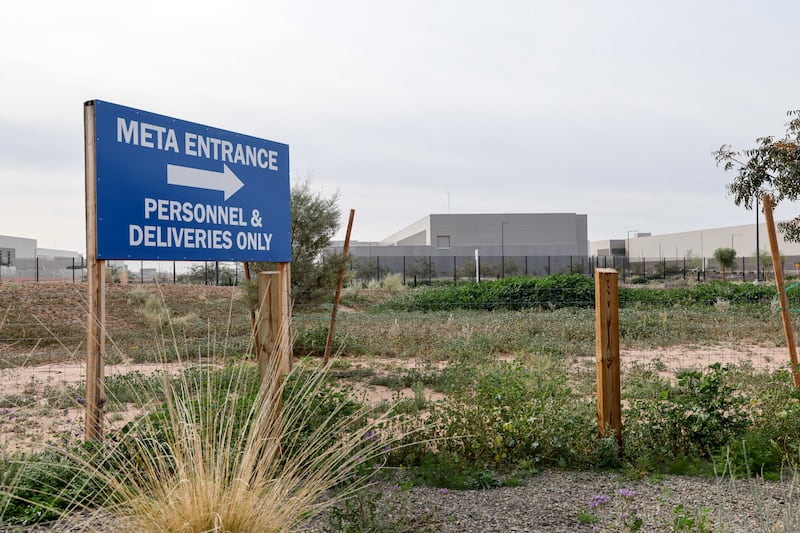

With the rapid expansion of the number of data centers in the Mountain West, concerns over resource management and regulation are becoming more pressing.
One of Arizona Gov. Katie Hobbs’ hopes for this year is to rein in the data center industry that has exploded in her state. She proposed reversing a tax credit and charging these facilities a water use fee.
Arizona Senate Minority Leader Priya Sundareshan told the Deseret News earlier in February, “Everyone in Arizona is starting to realize how rapidly data centers have expanded here.”
“With data centers expanding and Colorado River negotiations ongoing, we have been trying to figure out how we are going to meet the state’s water needs for the next 10, 20, 30, or 40 years,” she said.
Sundareshan has backed several bills to regulate data centers, such as repealing the tax exemption, requiring data centers to pay for their own energy infrastructure upgrades, monitoring energy and water use, and imposing a fee on water consumed by these facilities. The idea is to ensure that these data centers are a “net positive” for their communities.
But Sundareshan noted she has received pushback from the Republican majority in the Arizona legislature.
“That’s not to say that these aren’t good ideas. These are good ideas,” she added. “This is the time when data centers are front and center for so many people across the political spectrum.”
Trump administration wants to limit regulations on AI
The battle over data centers isn’t the only fight when it comes to AI.
As the Deseret News previously reported, Utah Rep. Doug Fiefia, a Republican, was pressured by the White House to drop some of the AI transparency and children’s safety regulations he is proposing.
The proposals would require AI companies to publish plans to safeguard children and protect whistleblowers who may have concerns.
“We, as a state, are trying to find the right balance between innovation and protecting consumers, and this means that we have to have hard discussions,” Fiefia, R-Herriman, told the Deseret News.
Fiefia also emphasized the importance of transparency with data centers, too.
Water monitoring
The Beehive State takes water conservation as seriously as its neighbors.
“Utah’s long-term viability depends on water stewardship,” said Fiefia, who is on Utah’s National Taskforce on Artificial Intelligence, Cybersecurity, and Privacy.
“Any major industrial user, AI data centers included, must fit into a sustainable water plan that includes efficiency and transparency.”
He pointed to a recent bill introduced by Utah Rep. Jill Koford, a Republican, that requires data centers to be transparent about their water consumption.
This proposal, which passed in the House last month, aims to keep track of critical resources.
“Now, not all data centers use the same cooling system — some are far more water-intensive than others,” Fiefia noted. Utah should prioritize facilities that use less or very little water and require clear reporting, he added.
Are data centers using less water?
But William Beard, the municipal affairs liaison at the Goldwater Institute and co-author of a report on AI data center regulation, doubled down on rapidly evolving technology as the answer to the water problem.
His report concluded that free market principles serve as the best course of action for AI and data center regulation.
Five years ago, data centers commonly used giant swamp coolers, where water evaporates and cools the air. This method is water-intensive, but in recent days, these facilities have opted for cooling fluid in pipes that constantly recirculates, leading to less than 1% water loss.
The industry is moving toward systems that hardly use any water at all, Beard argued.
“I won’t dismiss the concerns about water, but as a primary motivating factor on whether yea or nay is decided on a data center — it’s kind of more in the rearview mirror,” he said.
But Sundareshan pushed back on this, saying, “That’s not where the inquiry ends.”
“Yes, there are technologies that use less water, but that means they’re relying much more heavily on air cooling, which is much more energy intensive.”
“Where is the energy being created and how much water is being used in the production of that electricity?” the Arizona Senate minority leader said.
During her time in office, Sundareshan has championed an environmentally sustainable Arizona. As a student of water law at the University of Arizona, water conservation has played a significant role in her work as a legislator.
There’s also the issue of air pollution, she said as she pointed to the view outside her office window.
Energy demands
Data centers can use as much energy as entire towns, according to a Bloomberg report. Since a data center’s needs go beyond the scope of existing power grids, contracts between these facilities and utility companies include clauses that require data centers to cover the cost of building energy infrastructure.
In Mesa, for example, Google funded a substation and transmission lines in partnership with the Salt River Project, an Arizona utility company.
Google’s $600 million energy infrastructure investment led EdgeCore, a wholesale data center developer, to acquire a $1.2 billion land parcel in the area.
Some agreements between data center operators and utility companies also include a “Take-or-Pay” clause designed to protect residents, said Beard.
This requires a facility to pay for 100% of the power they requested, even if they don’t use it. Meanwhile, the utility company can sell the unused power on the open market, lowering rates for the average consumer, Beard noted.
Unlike residential neighborhoods, where power needs dip and peak depending on the time of day, data centers use power efficiently, like a giant high-tech refrigerator that doesn’t stop running. Research backs this up, Beard added.
“Such ‘large users of power’ tend to subsidize those smaller users of power, like the residential customer, over the lifespan of that power-generating entity,” he said.
He pointed to the history of the commercialization of electricity at scale in the United States.
In the 19th and 20th centuries, utility grids required an industrial anchor, such as a mill or a factory. The revenue from one large consumer subsidized the cost for residential consumers.
But according to a report from Harvard Law School’s environmental and energy program, the volume and pace of growth of data center facilities could shift the risk of long-term costs onto residential areas. The report correlated higher electricity bills to data center growth in neighborhoods.
Taking Google’s investment in Mesa as an example, the electric utility company SRP needs to feed the substation Google built, which would require setting up a power plant.
In this instance, SRP is building 12 new natural gas turbines that will support the entire grid and the 24/7 demand of data centers. Meanwhile, the utility company, SRP, has proposed raising prices by 3.4% in residential areas.
One of Sundareshan’s bills would protect ratepayers by asking large load-bearing facilities to pay for energy infrastructure.
Tax incentives
At the heart of Sundareshan’s efforts is the repeal of Arizona’s “preferential” tax incentives for data center developers.
A big reason Phoenix attracted this industry is because of generous tax incentives, stable weather conditions and affordability.
Phoenix is a data center hub with roughly 170 facilities, compared to Tucson’s 10 facilities, according to the Data Center Map.
Salt Lake City is home to 29 data centers.
To even the playing field and return to a “free market” baseline, the tax incentives, which cost the state $38.5 million in 2025, should be removed from the books, Sundareshan said.
Fiefia told the Deseret News he doesn’t view tax incentives to attract businesses as “inherently bad.” Instead, it’s a question of return on investment, he added.
“If Utah offers tax credits, they should be performance-based, transparent, and tied to measurable outcomes like job growth, capital investment and infrastructure improvements.”
Data centers are “capital-intensive, but not labor-intensive,” and incentivizing them aggressively comes with the risk of depleting resources, like water and energy, and creating poorly-planned, cluttered areas, Fiefia said.
Case study of Phoenix and Tucson
As Western states struggle to put guardrails on this growing industry, municipalities are taking matters into their own hands.
Cities like Phoenix and Tucson have imposed ordinances blocking data center development, risking legal challenges related to property rights, Beard said.
Last summer, the city of Phoenix passed an ordinance that redirected new data center development to specific areas away from transit and residential areas.
But according to the Goldwater Institute report, this local regulation goes against Arizona’s Proposition 207, which requires “the government to compensate property owners when regulations diminish the value or viable use of their property.”
“Municipal efforts to retroactively restrict or prohibit new data center construction through zoning changes violate both the spirit and the plain language of the law, exposing cities to significant and avoidable litigation risks,” the report added.
Beard said many developments in Phoenix are in the process of filing property rights claims “that could run into the hundreds of millions or even billions of dollars,” all because of the city’s ordinances.
“It comes down to individuals making decisions on their particular chunk of dirt. The government shouldn’t really be putting its thumb on the scale one way or the other,” he said.
Tucson’s ordinances also put it “crosswise with state law,” said Beard. The city approached development by regulating water use.
These municipal-level regulations can become a barrier to entry for data centers and other businesses, ultimately posing a challenge to economic progress in that community, he said.
According to Beard, elected officials and public concerns over data centers ignore property rights.
“Historically speaking, when the market is free to determine supply and demand … that’s best for everyone involved, be they the property owners, the developers, or the endpoint consumers,” said Beard.
Fiefia said Utah is closely watching states like Arizona and learning from their successes and failures.
The goal is to move “toward intentional and deliberate AI growth, not reactionary expansion and not heavy-handed regulation,” he added.
“We want to push innovation in a state like Utah,” Fiefia said, but added that some guardrails in place are helpful.
“I don’t think our requirements and our bills are meant to overburden or be an onerous burden on the companies,” he said, noting that Utah is “a very pro-business state and we want to keep it that way.”