

- Former Trump National Security Adviser Robert O'Brien said U.S. military buildup will force Iran to negotiating table.
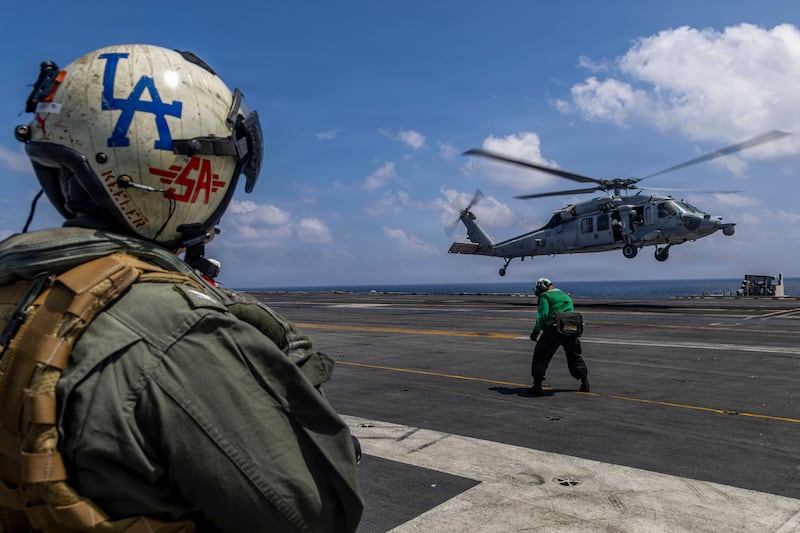
- The deployment is the largest since the Iraq War, with hundreds of fighter planes and two aircraft carriers en route.
- Attacks will likely focus on Iran missile system and drones, but could target Iranian regime leadership, experts said.
President Donald Trump has ordered the largest buildup of U.S. military forces in decades to apply unprecedented pressure on Iran, and potentially to launch devastating attacks against the regime, national security experts told the Deseret News.
Trump told global leaders on Thursday that they would find out within 10 days whether he will take negotiations with Iran “a step further.” The two countries have engaged in talks even as hundreds of military assets have shifted to the Middle East.
The buildup is the largest since the Iraq War over twenty years ago, according to Trump’s former National Security Adviser Robert O’Brien and former Pentagon official Alex Plitsas. The escalation includes over 100 attack planes and two aircraft carrier groups.
“Trump is exercising a tremendous amount of power. He’s very confident in his foreign policy skills at this point in his administration, and he’s very confident in the U.S. military,” O’Brien said. “He will be in a position to fully degrade Iran if they don’t come to the table.”
The threat of force comes as Trump demands that the Islamic republic give up their offensive missiles, stop their state-sponsored terrorism and put an end to what is left of their nuclear enrichment program after last June’s bomb strike, O’Brien told the Deseret News.
Now Trump plans to use military force for maximum leverage, O’Brien said. Trump’s ultimatum emerged after the theocratic government responded to one of the largest uprisings in Iran’s history by massacring tens of thousands of protesters in January.
America has struggled to strike deals with Iran’s authoritarian leaders since the Carter administration in the 1970s, according to O’Brien. “They’re very, very, very difficult negotiators,” he said. “What they haven’t run into is a Donald Trump before.”

But the display of military might could suggest the time for diplomacy has already come to an end. Deployments of this size almost always mean leaders have decided to use the force of war, according to Plitsas, who is a senior fellow at the Atlantic Council.
Then again, “Trump is not a traditional actor,” Plitsas said. During both terms, there were two instances when Trump called off strikes to Iran, and two when he moved ahead: to kill Iranian commander Qasem Soleimani and to destroy Iranian nuclear sites.
“So he’s quite literally 50/50 in terms of his decision making on Iran,” Plitsas told the Deseret News. “If they’re ... meeting his red lines, there will be a path forward. If they’re not, the military hardware is now in place to execute whatever option he decides.”
On Wednesday, White House press secretary Karoline Leavitt said diplomacy is always the president’s first option. Discussions will continue with Iranian counterparts over the “next couple of weeks,” but the two sides remain “very far apart on some issues,” she said.
What would an attack look like?
U.S. senators have not been briefed on plans for an attack on Iran since they got out of session over a week ago, Sen. John Curtis told the Deseret News on Thursday. An updated briefing has become even more “relevant” as the “buildup escalates,” Curtis said.
The senator — who chairs the Senate Foreign Relations subcommittee on democracy, human rights and global women’s issues — said he has learned not to try to “outguess” the president’s strategy but said he is watching the buildup “very carefully.”
“It’s really impossible for all of us to know, or tell, if the buildup is a leverage point, or exactly what his plans are,” Curtis said. “I think there has been, and will continue to be pressure from Congress to say, like, ‘There’s clearly places where we should be notified.’”
Curtis reiterated his prior approval for Midnight Hammer, the operation Trump ordered on June 22 to bomb three nuclear facilities in Iran during the country’s 12-day war with Israel. But he said if future campaigns in Iran are “broader” Trump will have “less support.”
Signs are growing that an attack is imminent.
The Pentagon is moving personnel out of the Middle East in anticipation of potential counterattacks, CBS reported. A Trump adviser told Axios there is a “90% chance” of kinetic action “in the next few weeks,” and Israeli officials said Israel is preparing for war “within days.”
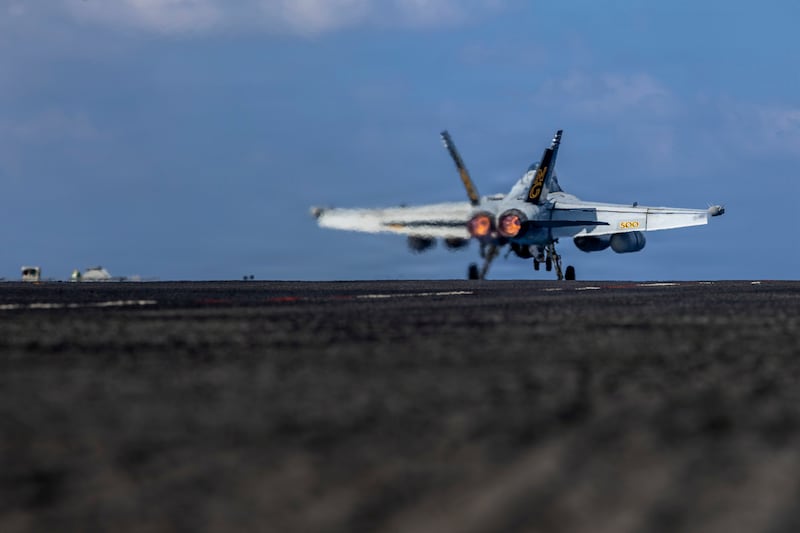
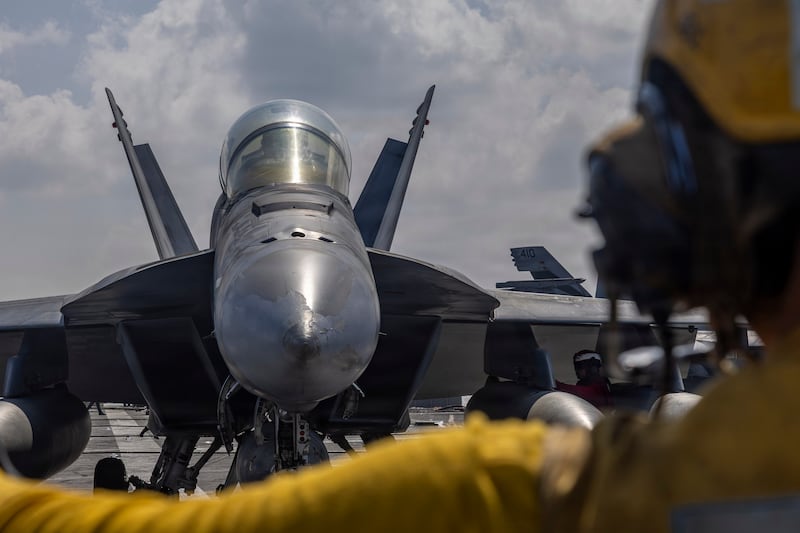
If an attack occurs, the U.S. is positioned “to deliver hundreds and hundreds and hundreds of strikes,” from “well over 100″ fighter planes, Plitsas said, including F-15s, F-16s, F-18s, F-22s and F-35s, in some cases representing “40-45% of the entire U.S. military’s inventory.”
The buildup also includes the U.S.S. Abraham Lincoln Strike Group, an aircraft carrier accompanied by warships which is off the sea of Oman, according to Plitsas, and the U.S.S. Gerald Ford, the largest warship ever constructed, which is entering the Mediterranean.

Potential military force could vary widely in scope. O’Brien predicted an initial attack would not be a “devastating blow,” but rather “a very clear message” to Iran that they need to make a deal. If that doesn’t work, top regime targets will be on the table, O’Brien said.
Plitsas says the two options would have very different objectives — the administration could conduct narrow strikes to eliminate Iran’s ballistic missiles and drones, or it could expand its aim to engage in “targeted decapitation strikes” against Iranian leadership.
While much of Iran’s missile system was destroyed by Israel last year, Iran has vowed to make it a regional conflict if war breaks out. This could entail attacks on Israel by proxy groups like Hezbollah, or attacks on the U.S. embassy in Iraq by militias, Plitsas said.
“The Iranians are now completely vulnerable ... and their reaction to that is trying to rebuild their ballistic missile stock, and ... funneling probably a billion dollars at least to Hezbollah,” Plitsas said. “They have continued to engage in the same behavior.”
Does Trump want regime change in Iran?
After Trump captured Venezuelan President Nicolás Maduro in January, some suggested that, despite his campaign to end “forever wars,” Trump had adopted a policy of regime change. He said as much in posts following the June bombings that favored regime change in Iran.
But there are strong indications that even if Trump were to seek to remove Iranian leadership, it would not turn into the kind of decades-long intervention Trump ran against. The biggest sign this is not Iraq, according to Plitsas, is that the buildup does not include ground troops.
While he has shown a willingness to engage in bold military action, like destroying Iran’s nuclear facilities and capturing Maduro, these operations each lasted a number of hours, and did not include long-term commitments that could turn into “another quagmire,” Plitsas said.
But even a targeted campaign might not go well for the U.S. If Iran’s Supreme Leader Ayatollah Ali Khamenei was removed, U.S. intelligence suggests that it could lead to Iran’s military force, the Islamic Revolutionary Guard Corps, taking over the country, Plitsas said.
According to O’Brien, the Iranian people will have to stand up if there is going to be regime change because Trump is not interested in “American boots on the ground.” But even if the U.S. only acts in support of Iranian protesters, regime change remains in America’s interest.
“Iran is kind of the root of all evil in the Middle East,” said O’Brien, who played an important role in negotiating the Abraham Accords between Israel and several Muslim nations. “If you had a peaceful Iran, the entire Middle East could be peaceful.”