

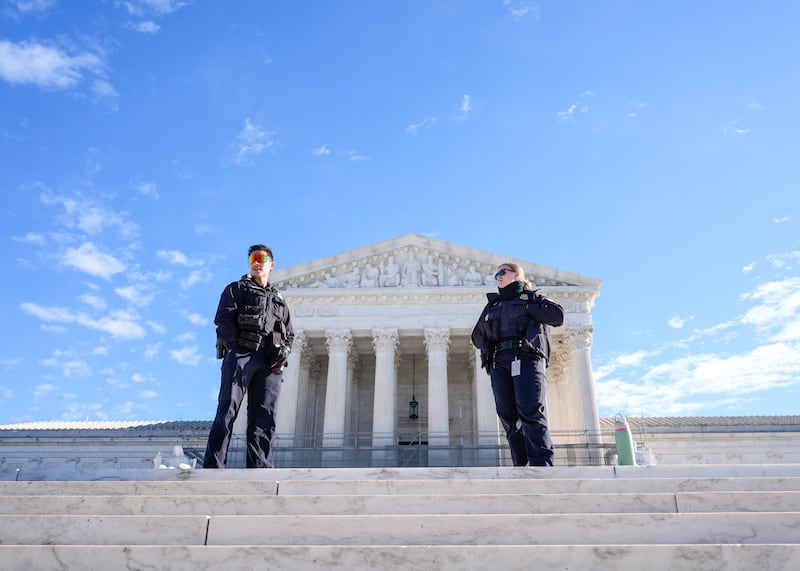

President Donald Trump criticized the Supreme Court on Friday after they struck down his sweeping tariff agenda, delivering the president a significant loss on his economic plan.
Trump suggested at a press conference held Friday that he would pursue tariffs using a different legal justification after the court struck down his first option.
Trump said he found the decision was “deeply disappointing,” and criticized several justices by name.
In a 6-3 decision, the justices said that Trump’s unilaterally imposed “reciprocal” tariffs on nearly every country exceeded his power as president.
The majority of the court found that the Constitution gives Congress the power to impose taxes and tariffs, not the president.

“The Framers did not vest any part of the taxing power in the Executive Branch,” Chief Justice John Roberts wrote.
Justice Brett Kavanaugh was one of three justices who thought Trump’s tariffs were lawful. In a dissenting opinion, he said that the tariffs may or may not be a wise policy choice, but as “a matter of text, history, and precedent, they are clearly lawful.”
Kavanaugh was joined by Justices Clarence Thomas and Samuel Alito in saying Trump’s tariffs were lawful.
Roberts was joined by liberal Justices Sonia Sotomayor, Elena Kagan and Ketanji Brown Jackson. Justices Neil Gorsuch and Amy Coney Barrett also sided with the majority opinion.
Trump spoke about wanting to implement tariffs on other countries after retaking the White House last year. One of his first actions in his second term was to place tariffs on goods coming into the United States from Canada, China and Mexico. In April of last year, which he dubbed “Liberation Day,” he implemented reciprocal tariffs on virtually every other country in the world.
Trump has defended his use of the tariffs by declaring a national emergency under the International Emergency Economic Powers Act, or IEEPA. The president argued that under IEEPA and the Constitution, he can impose the tariffs to manage trade imbalances with other countries.
“Our task today is to decide only whether the power to ‘regulate ... importation,’ as granted to the president under IEEPA, embraces the power to impose tariffs. It does not,” Roberts wrote.
The case was brought before the Supreme Court after lower courts found that the emergency law Trump used doesn’t give him the unlimited power to enact tariffs since the Constitution gives that power to Congress.
The justices heard oral arguments in the case last November and appeared skeptical about the power of the president to levy tariffs.
Solicitor General D. John Sauer faced some of his toughest questioning from Gorsuch, who sided with the majority. Gorsuch at one point noted that he was “struggling” to understand some of the administration’s arguments and even got Sauer to admit that a president doesn’t have authority over tariffs during peacetime or a time when a national emergency is not declared.
Gorsuch and other justices also expressed skepticism about the administration bypassing the major questions doctrine, which means that if Congress wanted to give the president economic power, it would have done so.
The president was vocal about the case ahead of oral arguments. The case’s outcome will have major implications for U.S. businesses and Trump’s trade agenda.
A group of small businesses celebrated the ruling on Friday. We Pay the Tariffs, an organization made up of small business members, released a statement following the decision.
“Today’s Supreme Court decision is a tremendous victory for America’s small businesses who have been bearing the crushing weight of these tariffs,” the organization’s executive director Dan Anthony said in a statement. “Our coalition members, who work through hard work, late nights, and sweat equity built local businesses, have paid billions in tariffs that never should have been imposed.”
The Deseret News has reached out to the White House for comment.
Trump criticizes decision and justices, as he offers alternative tariffs
The Supreme Court, which has a 6-3 conservative majority, has previously found several of the Trump administration’s initiatives lawful since he returned to office, particularly in the emergency docket process which means decisions were made on a quicker timeline.
The justices are set to hear oral arguments on April 1 in a case challenging Trump’s attempt to end the constitutional right of birthright citizenship.
While small businesses applauded the court’s decision and are hopeful about getting a refund of the fees imposed under the tariffs over the last year, Kavanaugh noted that the court’s decision Friday says nothing about “whether, and if so how, the Government should go about returning the billions of dollars” it has collected from importers.
“That process is likely to be a ‘mess,’ as was acknowledged at oral argument,” Kavanaugh wrote.
Trump held a press conference following the decision and praised Alito, Thomas and Kavanaugh for ruling in his favor. He expressed frustration with the court’s liberal justices and Roberts, Barrett and Gorsuch who joined them in ruling against the tariffs.
“They’re just bing fools and lap dogs for the RINOs and the radical left Democrats, and not that they should have anything at all to do with it. They’re very unpatriotic and disloyal to our Constitution,” he said. “It’s my opinion that the court has been swayed by foreign interest and a political movement that is far smaller than people ever think.”
Trump said he believes there are “great alternatives” to implement tariffs now that the court ruled against his first attempt. He said that the ruling may not “substantially constrain” tariffs going forward, noting the Trade Expansion Act and the Tariff Act of 1930.
He shared that he will sign an executive order to enact a 10% global tariff.
Trump pushed back on some questions from reporters, including that some Republican Senators are praising the decision. He also said he didn’t need to work with Congress to push the tariffs on other countries because “I’ve always had the right to do tariffs.”
Trump noted that the justices are still invited to his State of the Union address next Tuesday. Justices typically sit directly in front of the president during the address.
“Barely,” he said. “Honestly I could care less if they come.”