



- Federal judges said it was too close to Utah primary elections to change congressional district boundaries.
- A Utah court that replaced lawmakers' 2021 map with its own likely acted within its authority, the judges said.
- Utah Reps. Burgess Owens and Celeste Maloy had asked to return to the 2021 map approved by lawmakers.
A federal three-judge panel on Monday denied a request by U.S. Reps. Burgess Owens and Celeste Maloy to replace Utah’s court-ordered congressional district map with one approved by state lawmakers for the 2026 midterm elections.
The U.S. District Court for Utah decision relies heavily on the “Purcell principle,” a U.S. Supreme Court precedent cautioning federal courts from altering state election rules close to an election. Utah’s party nomination process is just weeks away.
The federal judges also found flaws in plaintiffs’ argument alleging that 3rd District Judge Dianna Gibson had violated the U.S. Constitution’s Elections Clause when she selected new electoral boundaries in November without legislative approval.
While the clause says legislatures shall choose the “Times, Places and Manner of holding Elections for Senators and Representatives,” the law allows courts to exercise judicial review to ensure election proceedings follow state law.
In a joint statement, Owens, Maloy and 11 local leaders said they received the unanimous decision with “profound disappointment” but respected the court’s “careful review.” The plaintiffs also left the door open for an appeal.
“This case concerns the Constitution’s allocation of authority over federal elections, a question of lasting importance beyond any single election cycle,” the statement said.
“We remain convinced that the Constitution assigns this responsibility to the State’s lawmaking authority and that this principle is essential to preserving constitutional order and the rule of law.”
How did we get here?
Utah Senate President Stuart Adams, R-Layton, said on Monday that Republican elected officials are not done challenging all of the repercussions of the yearslong Prop 4 legal saga. Adams said he “absolutely” hopes Owens and Maloy make an appeal to the U.S. Supreme Court.
Over the past 18 months, the Utah Supreme Court and district court ruled the Utah Legislature violated Utah’s Constitution by amending the Proposition 4 ballot initiative in 2020, and passing a map in 2021 that did not comply with the original law.
In 2022, the League of Women Voters and Mormon Women for Ethical Government sued the state, arguing the new map, which split one Salt Lake County neighborhood four ways, was an unlawful partisan gerrymander that violated Utahn’s right to initiate legislation.
Utah courts have continuously sided with the nonprofit advocacy groups. Building on the Utah Supreme Court’s decision protecting initiatives from changes, Gibson rejected Utah’s 2021 map in August and asked lawmakers to draft a new one complying with Prop 4.
After the Legislature submitted a new map, Gibson ruled on Nov. 10 that the Legislature had again failed to follow the law approved by voters in 2018. Prop 4 established an appointed commission to recommend maps to the Legislature based on rules preventing municipal splits and undue favoring of parties.
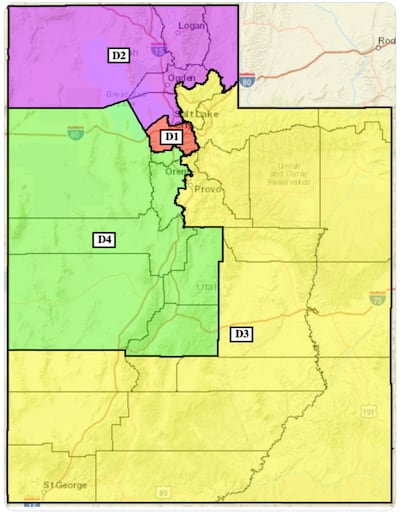
Faced with impending election deadlines, Gibson imposed a map submitted by the plaintiffs which she said complied with Prop 4’s prioritized list of redistricting criteria. Gibson cited federal statute that allows courts to ensure maps are in place prior to elections.
The new boundaries, known as “Map 1,″ outraged Utah leaders, both for skipping legislative approval and creating a new deeply Democratic seat in northern Salt Lake County. Kamala Harris would have won the new District 1 by 23 percentage points in 2024.
Utah Supreme Court denies request
On Friday, the Utah Supreme Court denied a request by the Utah Legislature to reinstate Utah’s 2021 map while lawmakers wait to fully appeal the lawsuit over the Prop 4 redistricting law. Lawmakers had missed the proper 30-day window, according to the justices.
In a statement to the Deseret News, the League of Women Voters, which also argued before the federal three-judge panel, said that the series of court challenges from elected officials had created uncertainty for Utahns participating in their elections.
“We are pleased the court protected this fair map and remain focused on protecting voters’ ability to make their voices heard,” president Katharine Biele said. “We only wish that the futile attempts to undermine this fair map would cease so we could focus on what is important to Utahns.”
On Monday, top GOP lawmakers blamed Gibson for the chaos, saying her failure to deliver a final judgement in the Prop 4 lawsuit had prevented a proper appeals process. There remain several outstanding complaints that have not been resolved in the case.
Despite years of vocal opposition to the law, Adams said the GOP-led Legislature was actually trying to follow Prop 4 by making sure map-drawing authority remains in legislative hands where it is accountable to voters.
“Everybody I talked to knows that the new map is gerrymandered,” Adams said. “It’s pretty clear when you draw a circle around Salt Lake City that that’s a Democrat district. Right now we have the most Democratic district possible.”
State Speaker Mike Schultz, R-Hooper, called the Utah Supreme Court ruling a “huge setback for this election cycle. The Legislature is looking for “other options,” but is limited because Gibson has yet to deliver her final ruling, Schultz said.