


Americans are much more comfortable with swearing than they used to be, but a new survey shows a majority of Americans still don’t like it when their politicians use profanity in public.
It seems like profanity is everywhere. Swearing has become common on TV, cable or otherwise. Teachers report an increase in the number of students who swear at them in the classroom. And, in the past decade, linguistics experts have seen a rapid increase in how often political leaders use profanity in public.
When President Donald Trump rode down that golden escalator to announce his presidential bid in 2015, he was a reflection of that societal shift. It’s no secret that lawmakers for decades have cursed and used foul language behind closed doors, but in the 2010s, the swearing seemed to burst out into the public sphere.
When the transcription of tapes recorded by former President Richard Nixon showed how often he used profanity, it tarnished his reputation and left Americans feeling lied to about his private beliefs versus public behavior.
When former Vice President Dick Cheney was caught on a hot mic in 2004 on the Senate floor saying the “F word,” it was a scandal described at the time by The New York Times as “using an obscenity in a heated exchange” that proved to be “yet another sign of the deteriorating relations between Republicans and Democrats in the capital.”
Just six years later, when then-Vice President Joe Biden was also caught on a hot mic using an “F word” in relation to the passage of the Obama administration’s signature health care bill, NPR said he was “joyful.”
When then-Vice President Kamala Harris was running for president in 2024, the British newspaper The Telegraph said she was “on track to be the sweariest president in U.S. history,” as the Deseret News previously reported.
And almost no one batted an eye and the media moved on when Trump, during an October Cabinet meeting, said then-Venezuelan President Nicolás Maduro “doesn’t want to (expletive) around with the United States.”
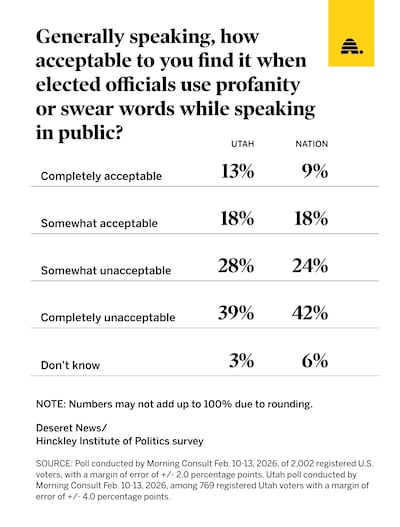
But new polling from the Deseret News and Hinckley Institute of Politics, conducted by Morning Consult, found that only about 3 in 10 Americans — and around the same number of Utahns — say they find politicians cursing somewhat or completely acceptable.
According to the UC Santa Barbara presidential archive, presidents and presidential candidates cursed in public dating back to Woodrow Wilson in 1919, but the majority of the public use of expletives happened in the last decade and can be attributed to two of the nation’s top recent leaders: Trump and former President Biden.
There have been studies that show if a teacher uses verbally aggressive language with a student, they lose their authority.
So, what does it mean for the current state of politics and society in America when our politicians seem OK with swearing in public?
Changes over time
While it wasn’t always the “norm” for presidents to curse during Cabinet meetings, campaign speeches and in posts online, politicians have used that language in private for generations, Patrick Riccards, a crisis communications expert, said.
“I mean, if we thought that Lyndon Johnson spoke like a choir boy, then we were soundly mistaken,” he said.
Riccards has worked on Capitol Hill and in several presidential administrations since the 1990s. As a communications director, it would have been a major scandal and huge stressor if the lawmaker you worked for cursed in public or in the media, he said.
“I think presidents for generations have used such language in private, and I think we’ve all known that. I think members on (Capitol) Hill have used such language in private,” he said, later adding, “Obviously, the times have changed a great deal.”
Joseph Phillips, a lecturer in politics at Cardiff University, examined how the use of profanity in American politics is more prevalent than ever. Using Santa Barbara’s presidential archive, he tracked how often some of the country’s top lawmakers cursed.
The most common vulgarities uttered by presidents, vice presidents or presidential candidates over the years are “crap” and “damn,” Phillips found.
The word “damn” was first used by Woodrow Wilson in 1919, then again by Franklin D. Roosevelt in 1933; Harry S. Truman said it nine times, and so on with other leaders like Jimmy Carter, Ronald Reagan and more.
Phillips did note that decades ago, record keeping and archiving could have been edited to protect the public from seeing — and potentially being offended by — the expletive. John Nance Garner, who served as Franklin D. Roosevelt’s vice president, famously said that being a vice president “is not worth a bucket of warm spit.” Spit, Phillips noted, likely was actually the word “piss,” but was often changed, or “sanitized” to be spit.
The ultimate winner for this particular vulgarity is Biden.
“Biden loves damn,” Phillips said, counting that the former vice president and 46th president used the word damn while in higher office or seeking higher office 257 times. Biden has also used other profanities in public, including those that are more harsh.
Other public officials who also used curse words in public include Kamala Harris, Secretary of State Marco Rubio during his 2016 run for president, former President Bill Clinton in 1997, and four of the 2020 Democratic primary candidates.
There were many other instances where candidates seeking office or sitting in the nation’s most powerful office publicly said curse words, including some more extreme examples.
However, Trump still takes the cake. According to Phillips’ records, Trump was the first president to say several profanities in public, including several considered more coarse.
When Trump was running for president in 2024, Franklin Graham, the president and CEO of the Billy Graham Evangelistic Association and the humanitarian aid group Samaritan’s Purse, wrote Trump a letter asking him to “please” stop using profanity during his rallies.
Graham told the Deseret News, “It seems like when he slips momentarily, my letter comes to his mind, and he tells the audience about it, so it must have struck a chord with him.”
In his State of the Union address on Tuesday evening Trump did curse once, saying the word “hell.” Trump was the first president to use profanity in his speech during his first term, while Biden also said the word “hell” in one of his addresses.
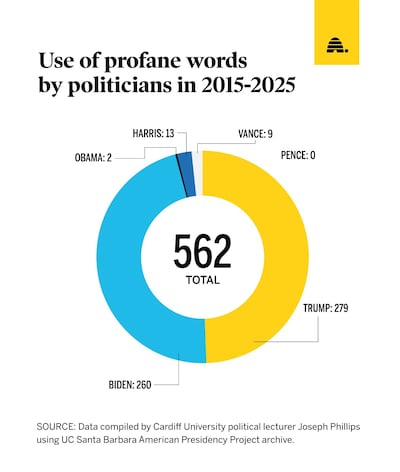
“The vast majority of it comes down to two people,” Phillips said, referring to Trump and Biden.
Loss of authenticity
Even just a few years ago, the use of profanity in politics was flashy, garnering headlines, clicks, and attention on social media. However, the question now is, is it being overused?
“It used to be that it got your attention. Now, I would argue it doesn’t,” Riccards said. “When you’re forced to pedal in vulgarity, it just means that you’re truly unable to communicate what you believe, you can’t find the right words to express your feelings.”
Political consultants and pundits for about a decade have discussed and debated whether Trump’s down-to-earth, conversational style earned points with middle- and working-class voters. Riccards noted that Trump believes including vulgarity in his communication with those voters will benefit him by “coming across as an every man.”
“He’s no longer a billionaire from New York City, but he’s an everyday (person) and he talks like one, too,” Riccards said.
Phillips agreed. He argued that in recent years, politicians saw that the “sky didn’t fall” when they cursed, but this is also coupled with record low trust among Americans in elected officials.
“In decades past, when there was higher political trust, people treated politicians as (filling) a role with esteem, you need to rise to the occasion and fill the role and treat the office with dignity,” he said. “But nowadays, people, for the most part, just don’t trust anything that politicians say.”
There’s been discussion about how in the digital age, elected officials are able to reach more Americans than ever before. They have appealed to voters by trying to seem like an authentic, reachable human, rather than a Washington-based person they don’t know very well.
But Riccards argued that at this point, the words no longer make the politician come across as authentic.
“You’re using profanity for performative value, you’re using it to demonstrate that somehow you’re more serious than people thought you were,” he said.
“And what that does is it takes away your sense of authority. It takes away your sense of seriousness,” Riccards continued, later adding, “How ridiculous is it that you have a 60-, 70-year-old politician trying to find his ‘authentic voice’ by cursing on a platform and trying to then pretend to be authentic to 20-somethings?”
How Utahns compare to the rest of the nation
But what do voters think about politicians cursing?
According to the new Deseret News/Hinckley Institute poll, they don’t like it.
There was one somewhat surprising finding — Utahns were slightly more likely than the rest of the country to say it’s acceptable for politicians to use profanity.
The survey found that 31% of Utah voters say it’s either completely or somewhat acceptable for elected officials to curse; compared to 27% of voters nationwide.
The findings show that there are differences across generations.
People who are 65 years old or older are less likely to say politicians should use profanity, and in Utah, that group of respondents overwhelmingly (84%) said it is unacceptable.
The generation in Utah most likely to say it is acceptable are Millennials, at 39%, and nationally it was Gen Zers at 43%.
While the survey found virtually no difference among voters in different income brackets, there were differences when it came to religion.
According to the results, 75% of Utahns who identify as Christian say that it’s either somewhat or completely unacceptable for politicians to use profanity. Similarly, 72% of Christians nationwide say the same.
Among Latter-day Saints in Utah, 81% say it is somewhat or completely unacceptable for elected officials to swear in public.
Among Utah voters who identify as agnostic or “nothing in particular,” 54% say that it’s either somewhat or completely unacceptable for politicians to use profanity. Nationally, 57% of voters in that category say the same.
“I’m sure people, particularly very religious people in Trump’s coalition who do not like Trump’s vocabulary, but at the end of the day it is that Trump is way more aligned with them on a lot of the policy issues that they care about, and are they really going to go over to a left-wing party over Trump’s potty mouth?” Phillips continued. “Probably not.”
Nationally, there wasn’t much difference between Democrats and Republicans on this issue, but in Utah, Democrats were 10 points more likely, at 38%, to say it is somewhat or completely acceptable for politicians to swear in public, compared to the state’s Republicans, at 28%.
Where to go from here?
The increasing use of profanity in politics is reflective of the divisiveness and anger in America today, and contributes to the divide between the political parties, Riccards said.
He said things have changed since he worked on Capitol Hill.
“I think what we used to have, is even if you didn’t respect your opponent, you at least respected the office. We respected the presidency itself, we respected the U.S. Senate itself,” he said.
In a divided nation, Riccards argued that politicians should maintain an even higher level of decorum in order to heal the divide.
“I think words matter,” he said. “And quite frankly, I think we should hold our politicians to the same standards we hold our kids to. I wouldn’t want to see my 14-year-old saying the words that we currently see our presidents and lawmakers saying.”