


In his State of the Union address, President Donald Trump declared America “bigger, better, richer and stronger than ever before” because of initiatives in the first year of his second term.
Americans aren’t as convinced, according to a new Deseret News/Hinckley Institute of Politics poll conducted by Morning Consult.
The poll, fielded before Tuesday’s speech, found that fewer than a quarter of Americans — 22% — consider Trump’s first year in office “definitely a success,” while a significantly larger share — 39% — pronounce it “definitely a failure.”
While, overall, more Americans talk about Trump’s first year in terms of failure than success, the same isn’t true for Utahns.
Residents of the Beehive State were more likely to rate the first year of Trump’s second term as “definitely” or “somewhat” of a success than “definitely” or “somewhat” a failure.
Is this because they’re more optimistic than Americans as a whole?
The polling offers a glimpse into Utahns’ optimism about the future as well, and shows that most Utahns are optimistic about the future of the Beehive State, but less so, the country overall.
Hinckley Institute director Jason Perry pointed out why Utahns might feel differently about the president’s first year in office than they do about the future of the country.
“Deciding whether Trump’s first year was a success is about what he has done so far. Optimism about the country is about where things feel like they’re going,” he said. “A voter can think the administration delivered on some priorities and still worry that the country feels divided or unsettled.”
In a week in which Trump asserted “The state of the nation is strong,” the findings offer a snapshot into what Americans really believe, regardless of what they’ve been told.
And the poll also uncovered a surprise: They may not make themselves known on social media, but there are some liberals out there who think Trump is doing a good job.
What Americans think about Trump’s first year

In Trump’s speech, which lasted one hour and 47 minutes, setting a record for State of the Union addresses, the president enumerated successes that he attributes to his policies: lower gas prices, mortgage rates and inflation, record highs in the stock market, lower costs of prescription drugs and fewer murders across the U.S.
“Our nation is back,” Trump said. “Bigger, better, richer and stronger than ever before.”
However, when Americans were asked, in an online poll conducted Feb. 11-14, to rate Trump’s first year on a graduated scale of success and failure, 49% said it was either “definitely” or “somewhat” a failure. Thirty-eight percent of respondents rated it “definitely” or “somewhat” a success.
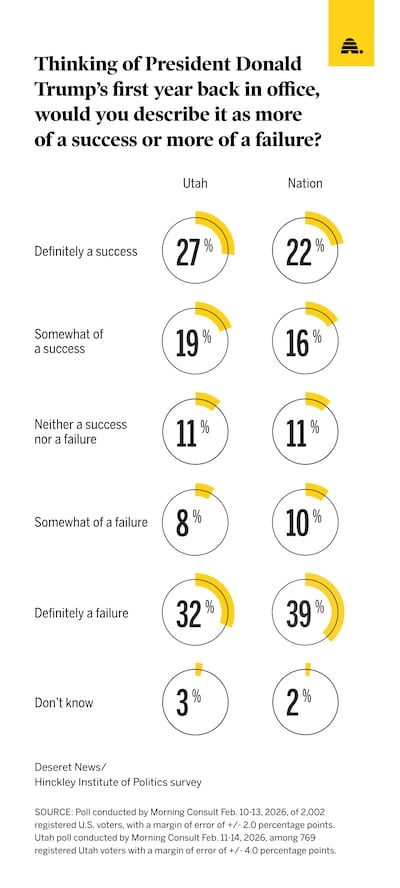
When looking at the responses of Utah residents only, the numbers improve for the president. More Utahns rated his first year as definitely or somewhat a success (46%) than those who rate it definitely or somewhat a failure (40%).
Among all Christians in Utah, 55% say Trump’s first year in office was definitely or somewhat of a success, while 30% rate it a failure.
Members of The Church of Jesus Christ of Latter-day Saints in Utah were slightly more positive about Trump’s first year. Fifty-seven percent of Utah Latter-day Saints rate Trump’s first year as definitely or somewhat of a success, while 26% say it is definitely or somewhat a failure.
Ryan Burge, a political scientist and statistician who specializes in religion, wasn’t surprised by those numbers.
“These results align with the overall consensus when looking at Latter-day Saints: they are often less conservative than white evangelicals, however their politics are distinctly right-leaning and they have seemed to warm noticeably to Donald Trump from when he first entered electoral politics about a decade ago,” Burge said in an email.
He noted that 52% of Latter-day Saints voted for Trump in 2016, but two-thirds of Latter-day Saint voters did so in both 2020 and 2024.
That said, having voted for Trump doesn’t guarantee approval of his first year. In the Deseret News/Hinckley Institute poll, 4% of respondents who voted for Trump in 2024 said his first year was definitely a failure and 7% said it was somewhat of a failure.
Like Burge, Perry also noted the shift from 2016 to later elections among Latter-day Saint voters.
“In 2016, many Latter-day Saints in Utah were hesitant about Trump, and that showed up in the vote,” he said. “But over the past two cycles, much of that hesitation has faded, and Latter-day Saint voters have largely returned to supporting the Republican candidate.”
“These numbers suggest that pattern is continuing, with Latter-day Saint voters viewing his first year more positively than Utahns overall, even if some still have personal reservations about his tone and approach,” he added.
Are Americans optimistic about the future?
Trump, raised by a father who believed in positive thinking, is famously optimistic, and his 2026 State of the Union address reflected that.
“This July 4th, we will mark two and a half centuries of liberty and triumph, progress and freedom in the most incredible and exceptional nation ever to exist on the face of the Earth. And we’ve seen nothing yet. We’re going to do better and better and better. This is the golden age of America,” he said.
According to the Deseret News/Hinckley Institute poll, Americans are equally split on the “better and better and better” that Trump says awaits the nation.
Thirty-nine percent of respondents said they are very or somewhat optimistic about the future of the nation, while 39% said they are very or somewhat pessimistic.
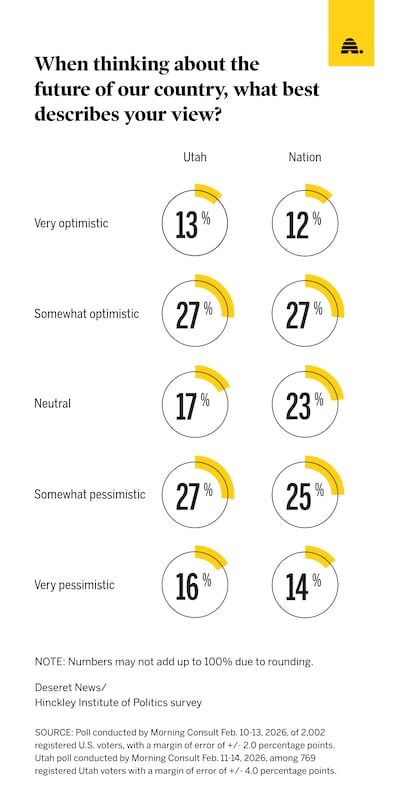
Utahns were only slightly more hopeful than the rest of the country — 40% said they were very or somewhat optimistic. But a greater share of Utahns were also pessimistic. Forty-three percent said they were very or somewhat pessimistic about the future of the country.
How do Utahns feel about the future of Utah?
Another poll question examined how Utah voters feel about their elected officials. Fifty-two percent said they approve or strongly approve of the performance of Gov. Spencer Cox.
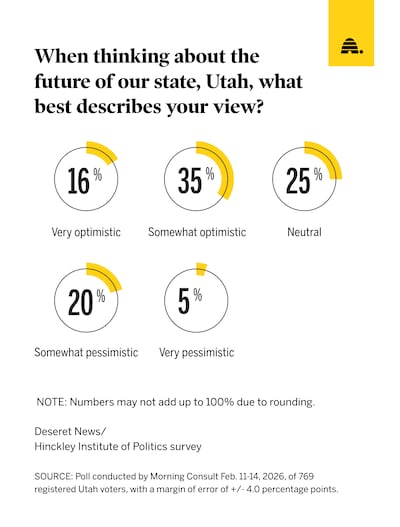
That finding may help to explain why a majority of Utahns (51%) say they are very or somewhat optimistic about the future of their state, even though just 40% say the same about their country.
Twenty-five percent of Utahns said they are very or somewhat pessimistic about the future of their state, while another 25% say they are neutral on the question.
Do any liberals support Donald Trump?
On most questions, a partisan divide was apparent. It’s no surprise, for example, that more people who voted for Donald Trump in 2024 and/or people who identify as conservative consider his first year a success.
Sixty-one percent of liberals, for example, said Trump’s first year was definitely a failure, as did 70% of Kamala Harris voters, compared to 6% of conservatives and 4% of Trump voters.
But within Utah’s electorate was a surprise: 13% of self-identified liberals joined with 47% of conservatives in saying that Trump’s first year was definitely a success.
By comparison, just 8% of Utah moderates said Trump’s first year was definitely a success.
Perry pointed out that what we see online is not always a reflection of reality.
“Social media captures the loudest voices. Polling captures everyone else,” he said. “In Utah, ideological labels are softer, and some self-described liberals may still give Trump credit for parts of his first year. Voters are often more nuanced than what online posts suggest.”
The national poll of 2,002 registered U.S. voters was conducted by Morning Consult Feb. 10-13 and has a margin of error of +/- 2.0 percentage points.
The Utah poll was conducted by Morning Consult Feb. 11-14 among 769 registered Utah voters and has a margin of error of +/- 4.0 percentage points.