

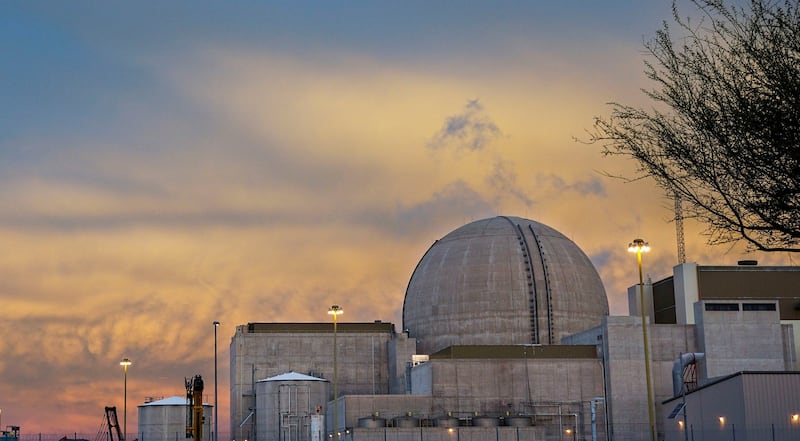

At the Arizona Corporation Commission’s latest workshop in Palo Verde, home to Arizona’s only nuclear power facility, Commissioner Lea Márquez Peterson said, with enthusiasm, “nuclear power is poised for a comeback.”
The Palo Verde Generating Station, 55 miles west of Phoenix, powers millions of homes across Arizona, California, New Mexico, and Texas.
Officials at the workshop hailed it as a great example of clean, consistent energy in the era of artificial intelligence and data centers.
Projections indicate nationwide electricity demands will surge up to 25% by 2030 and 78% by 2050, according to a 2025 study.
Utah Gov. Spencer Cox shared the same perspective as Peterson during the Western Governors’ Association conference in Idaho in September 2025, hailing a nuclear renaissance in the 21st century.

“Now the rest of the country and the rest of the world are realizing that they made a huge mistake,” Cox said. Utah’s “Operation Gigawatt” sets out to close the gap between energy supply and consumption.
The rising electricity demand cannot be ignored, nor can nuclear energy’s ability to solve the problem by producing zero-carbon-emission power.
Bipartisan support for nuclear energy
Arizona Corporation Commission Chairman Nick Myers said, “The future is here. AI is here only as soon as we are here. We need more energy. I think this is a great approach to be more flexible and create more energy options in the future.”
The Arizona Corporation Commission’s series of workshops features representatives from both sides of the aisle, including the offices of Arizona’s two Democratic U.S. senators, Ruben Gallego and Mark Kelly, as well as Rep. David Schweikert, a Republican running for governor to replace incumbent Katie Hobbs.

The U.S. Department of Energy, the Governor’s Office of Resiliency, the Nuclear Energy Institute, Guggenheim Partners, and the Arizona Chamber of Commerce also presented.
Myers said, “If we are serious about ensuring a reliable and resilient grid in the years ahead, we will need more dependable baseload power — and nuclear energy is a key part of that equation.”
“It’s a nonpartisan issue; it’s something we need to move forward on as quickly as possible,” he added.
Arizona Legislature’s nuclear energy bills
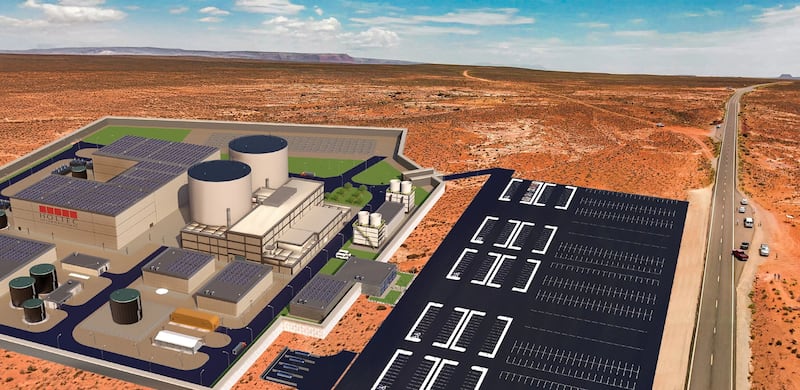
Small modular reactors offer an alternative to giant nuclear power plants. Ideally, SMRs could be mass-produced and take several years to set up instead of decades.
But the U.S. doesn’t have any large-scale operational SMRs. A few projects have received regulatory approvals on design, with deployment still years away. Even though Russia and China lead in this technology, they face similar high-cost challenges.
At the workshop, Arizona state Rep. James Taylor, a Republican, said that the Legislature is considering six bills that would make it easier to construct small modular nuclear reactors.
These bills aim to prevent county governments from prohibiting the construction or operation of SMRs, incentivize SMRs located near data centers or other large industrial energy users, and allow utility companies to switch from gas and oil as their power sources to SMRs.
One of the bills would also prevent counties from interfering with SMR developments that follow federal guidelines.
Are SMRs the best path forward right now?
Sandy Bahr, the director of the Sierra Club’s Grand Canyon chapter, testified against SMR-related bills at committee hearings and before the Arizona Corporation Commission.
“We have seen an unprecedented number of bills focused on small modular nuclear reactors this year. Last year, there was one,” noted Bahr.
She referred to a 2025 proposal that would allow SMRs to colocate with data centers and strip down the barriers raised by local governments while dismissing concerns from locals. Gov. Katie Hobbs vetoed that bill last year.
She told the Deseret News, Republican legislators aren’t “very realistic about where we’re at with SMRs. They think they’re some kind of near-term energy source.” Nuclear plants, although very costly, are still cheaper to build in North America than SMRs.
She pointed to Georgia, where setting up a commercial nuclear plant operation took $30 billion and more than seven years to complete. Plant Vogtle is one of the largest nuclear plant in the U.S.
“Even if you thought these were a good idea,” she said, “it is premature to put money into SMRs. I don’t think the people of Arizona want to be the guinea pigs for this — and I know our budget can’t take it.”
Bahr said the state is losing time and should instead invest in energy solutions for pre-existing resources.
“We’re losing time to implement some of the energy solutions that we have,” Bahr said. “For places like Arizona, one of the sunniest states in the country, we should be utilizing our solar resources better and finding various ways to store them.”
As SMRs remain a ways away, Arizona’s top utility companies — Arizona Public Service, Salt River Project, and Tucson Electric Power — filed an application earlier this month, requesting $25 million for a three-year site selection process for a nuclear power plant.