



The Utah legislative branch took on the state’s court system this legislative session as high-profile legal battles over redistricting and other top legislative priorities transform the state’s political landscape.
Lawmakers also returned to unfinished fights on immigration, Big Tech and elections. Shaping these discussions were Trump administration actions on deportations, artificial intelligence and the budget.
The federal “big, beautiful bill” erased revenue surpluses as Utah leadership asked agencies to recommend 5% reductions to increase government efficiency and pay for tax cuts focused on family affordability.
Despite the tricky budget year, lawmakers increased education spending and secured critical ongoing funds for Utah Gov. Spencer Cox’s homelessness initiatives. The governor praised the work of elected representatives.
“This is probably my favorite session, certainly my favorite session since I became governor,” Cox told the Deseret News on Friday. “And that’s because of the collaboration, the way we worked together, it doesn’t mean I like every bill.”
“It doesn’t mean I got everything I wanted, but the process played out in a much fairer way, a better way where we got good results and results that I can support.”


In recent years, Cox called on lawmakers to increase public transparency and to limit the number of bills considered in a session as lawmakers repeatedly broke their own record for the number of laws passed every year.
Legislative leadership said this year they leaned on committees to more thoroughly vet bills through the process. As a result fewer than 550 bills passed, compared to 582 in 2025 and 591 in 2024.
Unlike past years, Cox said he had not compiled a private “veto list” during the session because he was able to work directly with legislative leadership. But he said he is sure he will “find some (he’s) concerned about.”
Judicial transparency, or takeover?
The judiciary-focused bills sparked debate at nearly every stage of the legislative process this session. Senate President Stuart Adams said on Friday the judicial bill package produces “a fairness that (will go) on forever.”
But Sen. Minority Leader Luz Escamilla, D-Salt Lake City, in the same meeting, said her Democratic constituents did not approve of the process, and so she and her colleagues voted against the bills.
Certain bills, such as expanding the state Supreme Court from five to seven justices and establishing a new three-judge constitutional court, were introduced early in the session and seemed to make it to the governor’s desk at a uniquely quick pace.
That sparked ire among petitioners in lawsuits against the state of Utah, especially after the state invoked the new laws and forced the civil actions to be transferred from a single district judge to a three-judge district panel.
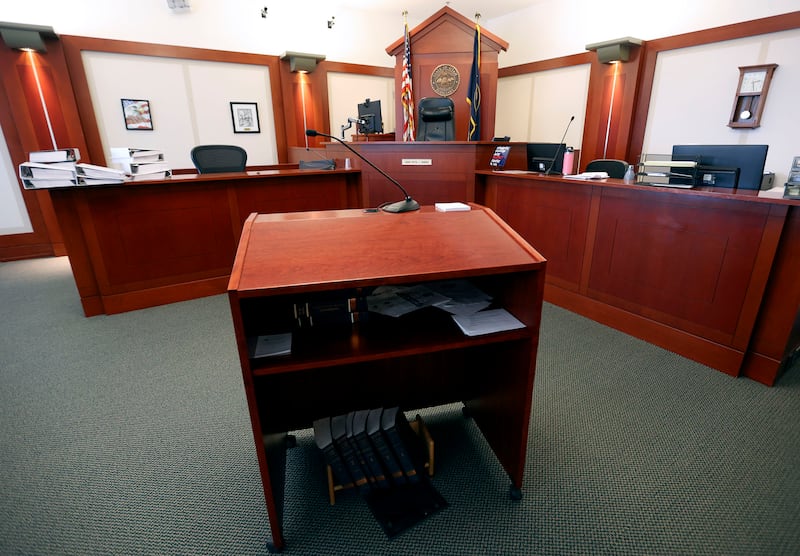
The legislature’s solution — or insurance — was amending the judicial modifications bill that would allow any litigant in a civil suit against the state to file a notice requiring a constitutional challenge to be heard by a three-judge panel instead of a single district judge.
If the recently enacted three-judge panel system for constitutional challenges is struck down by the courts, then a trigger in the bill would automatically create a new constitutional court to hear the case.
State lawmakers argued that more eyes on an issue ensure greater transparency, but critics accused them of changing the rules when they realized they were losing the game.
Big investments in literacy and higher ed
While higher education budget reallocations grabbed last year’s headlines, the 2026 Legislature focused its education attention primarily on Utah’s K-12 schools.
Navigating the uneasy confluence of technology and the classroom defined several education bills earning passing grades by the Legislature.
Last year, lawmakers tackled the vexing cellphones in school challenge by ratifying a law prohibiting the devices during class instruction. They expanded that limit in 2026, forbidding student cellphone use from opening bell until closing bell.

Local schools and districts can still establish their own cellphone policies — but “bell-to-bell” appears to be the state-wide choice.
Meanwhile, a pair of classroom technology bills — the so-called SAFE Act and the Balance Act – are now slated to become laws. The education measures require school software vendors to meet child safety requirements and establish age-appropriate screen time guidelines.
Responding to sobering reading proficiency scores, lawmakers passed a bill calling for early literacy strategies — including a provision requiring a student to repeat third grade if he or she isn’t meeting minimum standards.
Lawmakers also supported scientific research at Utah’s public colleges — passing a bill that creates a grant program for research funding in vital areas such as critical minerals, AI and aerospace.
Major election reforms rejected. Why?
Utah lawmakers passed minimal updates to the state’s vote-by-mail system. They approved SB194, ensuring county clerks continue to verify signatures in addition to the last four digits of a government ID.
The bill would require the lieutenant governor to create an official conflict of interest avoidance plan for overseeing her own election. Lawmakers also passed HB209 requiring documentary proof of U.S. citizenship to vote in state elections.

But the bigger story on elections this year might be what the Legislature did not pass. Senate Republicans broke with their House counterparts by rejecting HB479, which would have established an opt-in process to submit a ballot through the mail or vote in-person with photo ID.
Senate leadership also squashed HB529, which would have transferred election oversight away from the lieutenant governor to a new secretary of state position.
Utah Compact survives GOP divides
The Utah Legislature upheld the state’s 15-year-old compact on immigration amid Republican division over whether to revisit policies that make the state a welcoming place for illegal immigrants.
Lawmakers did pass one bill to address some of the public safety concerns associated with illegal immigration. HB136 would empower police officers to enforce traffic citations against unlicensed drivers.
The bill would allow law enforcement, after pulling someone over for a traffic violation, to impound an adult’s car and to do a fingerprint scan if they have no driving credential and no one can pick up the vehicle.

However, HB141, taxing foreign money transfers by illegal immigrants, HB294, requiring more businesses to verify legal status and HB386, ending subsidies for illegal immigrants never got a Senate vote.
The bill, HB386, would have repealed one of the pillars of the Utah Compact policy package — a state-run migrant worker visa program that never received a federal waiver to be implemented.
The bill passed 39-33 before stalling when no senator would sponsor it. This was because it sought to unravel a hard-won consensus with no effort to build an alternative, according to Senate leadership.
Big Tech
Utah lawmakers have led the nation in passing regulations to protect children from the harms of social media. But opposition from the White House and industry giants this year led to a mixed bag for Utah’s anti-Big Tech crusaders.
In a stunning move, the Trump administration sent a memo to legislative leadership halfway through the session crushing HB286, which would have required new AI models to publish risk assessments and child protection plans.
An alternate proposal, HB438, would have imposed penalties for AI chatbots that engage in harmful conversations with minors. Despite support from legislative leadership, the bill failed on Thursday after lobbyists descended on lawmakers to oppose the measure.

The Legislature did take the bold step, however, of becoming only the second state in the nation to levy a tax on the nation’s biggest online advertising companies, Meta and Google, through SB287.
“They are killing our children,” House Majority Leader Casey Snider, R-Paradise, said on Friday. “When we know a product exists that destroys the lives of our children it is our obligation to do the right thing to diminish the reach of that horrible and horrendous behavior. Social media is not our friend.”
Lawmakers cut spending to cut taxes
Lawmakers navigated a difficult budget environment to prioritize tax relief for Utahns and Utah businesses. As federal changes from the “Big, Beautiful Bill” erased Utah’s $300 million budget surplus, lawmakers asked state agencies to recommend 5% spending reductions.
The Legislature ultimately reallocated $275 million from state programs, about 2.4% of agency budgets, while setting aside $123 million to continue Utah’s six-year-streak of income tax cuts.

Legislative leadership framed the process as ensuring government efficiency and supporting family affordability. In addition to reducing the individual and corporate income tax from 4.5% to 4.45%, lawmakers passed HB290 to expand the child tax credit to up to 20,000 additional families with children under 6, and HB190 to increase the tax break for Utah businesses who provide employer-owned child care facilities to cover up to 80% of related costs.
The Legislature also passed HB575 to lower the gas tax from $0.38 per gallon to $0.32. Lawmakers abandoned the original proposal which would have paid for the cut by raising taxes on fuel sent out of state. Lawmakers also backed away from several bills to cap local property taxes.
Instead, the Legislature passed HB236 to facilitate public participation in local property taxes and SB238 to prevent individuals from claiming multiple property tax exemptions.
Cox wins big with homelessness funding
The Legislature backed Gov. Cox’s priority of shifting homelessness policy to target criminal recidivism among the chronically homeless and to strengthen the state’s network of long-term recovery resources.
Lawmakers approved nearly $44 million, including $18 million in new ongoing money, to orient programs toward repeat offenders, with isolated shelter space for “high utilizers,” while the state awaits federal support for a central homelessness campus.

Lawmakers also passed HB308, which simplifies reporting requirements, creates a loan program for businesses harmed by nearby shelters, lets shelters expand to 135% of capacity if needed and requires non-shelter cities to contribute more to help mitigate costs associated with homeless shelters.
Proposals to increase housing options and to place guardrails around the central campus, if built in northwest Salt Lake City, did not proceed to a floor vote.
The affordability session
Before the start of the legislative session, the Deseret News/Hinckley Institute of Politics published a poll that showed housing affordability was the No. 1 issue Utah voters wanted the Utah Legislature to address this year.
During the session lawmakers presented the Utah Housing Strategic Plan that aims to “ensure that every resident in Utah has access to safe, affordable and stable housing options.”
One bill that went along with the plan is HB492, sponsored by Rep. Calvin Roberts, R-Draper, which passed on Friday. The bill would help build infrastructure that would allow thousands of houses around the state to be built.

The money for these projects would come from funds that already exist within the state. The first-time homebuyers program from Senate President Stuart Adams, R-Layton, received an appropriation of $10 million this year. The program gives $20,000 to individuals to use for a down payment, closing costs or to buy down the rate.
Roberts also led a bill to create the Division of Housing and Community Development, which would sit within the Governor’s Office of Economic Opportunity to help centralize and organize how housing policy is handled in the state. HB68 would also establish the position of state housing coordinator to lead the division.
Efforts made to help families and children overall in Utah
Senate minority leader Luz Escamilla, D-Salt Lake City, sponsored multiple bills aimed to help children and child care this session that failed to pass.
One bill would have provided grants for home-based child care centers and another would have set up a child care facility for state employees. She also sponsored a bill to increase how many children get free lunch and one to provide dental care for uninsured kids — but both failed.
Rep. Ariel DeFay, R-Kaysville led a bill, HB329, to increase maternity leave for state employees to 12 weeks, and will set protections for pumping breast milk in public. Families with children will also benefit from the child tax credit and the child care business tax credit.
Great Salt Lake/Natural resources
To pull the Great Salt Lake out of its currently-labeled “serious adverse effects” status, an additional 261 billion gallons of water (800,000 acre-feet) will need to be added.
As President Donald Trump, who recently took interest in the lake’s conservation, put it, “We’re losing water rapidly, rapidly, and it’s getting smaller, smaller, drier, drier.” The lake has shrunk 600 square miles since 1986.
The 2026 legislative session saw a range of bills brought forward to help conserve not only the Great Salt Lake, but Utah’s water generally.

Rep. Jill Koford, R-Ogden, sponsored legislation that would allow farmers to temporarily sell their water rights to the state. One such bill, HB410, is on its way to Cox’s desk.
Other bills were aimed at giving Utah better ability to manage land within its borders. While more than half of Utah’s land is federally owned, a vast majority is held under “proprietorial interest only,” Rep. Ken Ivory, R-West Jordan, told the Deseret News.
He sponsored HB546 to assess the access, health and productivity of the land. The bill was passed by the Legislature and is also ready for Cox’s signature.
“The first step is to gather the data and then we go from there,” Ivory said.
Energy
The 2026 legislative session will change Utah’s energy and environmental sectors in several distinct ways.
First, SB135 authorizes Utah to pursue nuclear fuel recycling and an advanced nuclear development hub, called a “Nuclear Lifecycle Innovation Campus.” The bill also requires the state to conduct a study of its own laws and regulations to find where nuclear energy is currently held back in the state.

The Legislature also passed HB76, which requires data centers to report how much water they use. For each day the operator of a large data center fails to report, the state will impose a $100 fine.
While estimates vary, data centers’ daily water consumption is generally thought to be hundreds of millions of gallons.
Salt Lake City/Transportation
Salt Lake City found itself at the center of a few more bills this year, but it didn’t appear to be a target quite as much as last year.
SB242 ended up being one of the biggest bills that affected Utah’s capital city this year, prohibiting Salt Lake City from conducting lane reduction projects on major corridors. It also gives the Utah Department of Transportation more say in whether the city can create similar projects on bigger city roads.
Salt Lake City Mayor Erin Mendenhall called it an improvement to last year’s SB195, which paused several road projects in the city and called for a study of the impacts of recently-completed ones. Still, many residents showed up to meetings to voice their disapproval of the bill, which is why the bill was rejected by many legislative Democrats.

Utah lawmakers passed HB302, which tells local governments to fly one flag but allows them to adopt others for ceremonial purposes that could be flown in select places, like City Hall. That was in response to Salt Lake City adding three flags last year to bypass a bill prohibiting governments from flying LGBTQ, Juneteenth or other flags.
There weren’t many public safety measures focusing on Salt Lake City this year, though. Mendenhall credits that to the city’s new public safety plan and improvements implemented by Salt Lake City Police Chief Brian Redd, who celebrated his first anniversary on the job this week.
A look at miscellaneous measures passed by the Legislature this year
There were a number of bills introduced this session dealing with the welfare of animals, specifically animals in shelters. HB87, also known as “Biscuit’s bill,” focuses on animals that are stuck in shelters for years after being victims of animal abuse and neglect. The bill was sponsored by Rep. Verona Mauga, D-Salt Lake City. It will help speed up the adoption process and provides options for how these animals can be adopted.

SB201, sponsored by Sen. Keith Grover, R-Provo, would make it so fewer shelter animals in the state are euthanized. The bill would give animal rescues and other organizations the ability to pull animals before they are euthanized.
At the start of the session there were three different bills that regulated the use and sale of kratom in Utah in different ways. By the end of the session, parts of all the bills were merged together into SB45, which passed on Wednesday. The bill started as a complete ban on kratom but was changed to allow only the sale of pure leaf kratom in smoke shops to people 21 and older.

Utah lawmakers also increased the tax on nicotine and tobacco products through HB337. The bill raised taxes on cigarettes by 50 cents per pack and also put a $1 tax on alternative nicotine products, like Zyn, that have up to 20 pouches. There is also a tax raise on e-cigarettes and vaping products.
Lawmakers have also added a new state holiday this session. Good Friday will be an official state legal holiday starting next year, but workers will only get a half day off for the holiday. State employees will also receive a new benefits package, created by SB229, which changes how their leave works.
The governor and other elected officials in the executive branch will see major pay increases after lawmakers made the governor’s salary equal to that of the state Supreme Court’s chief justice. Under SB235 the governor will now make around $247,225, while the attorney general will earn $234,863 and the Lt. Gov, state auditor and state treasurer will make around $225,500.
Last year, lawmakers set up a system to screen firefighters for cancer as they have a much higher risk for certain cancers than most people. This year they passed HB416 to establish a cancer benefit trust fund to help these firefighters pay their medical bills and lessen the burden on them and their families.
Contributing: Carter Williams