

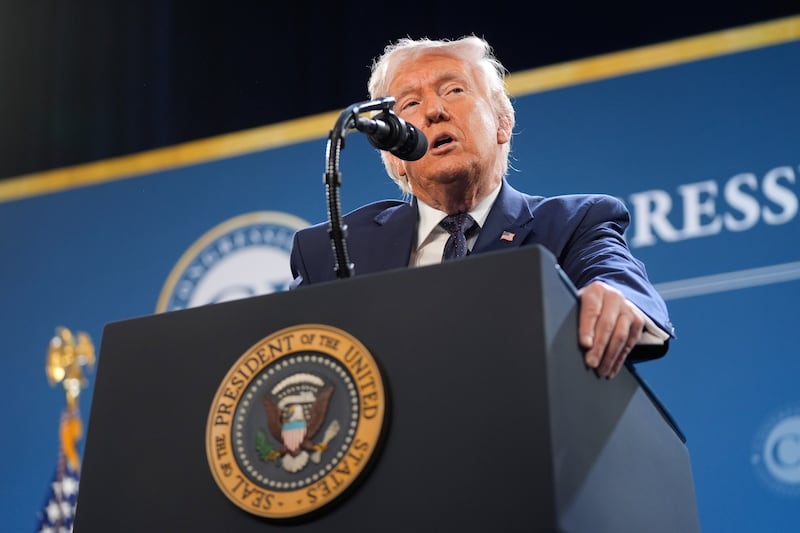

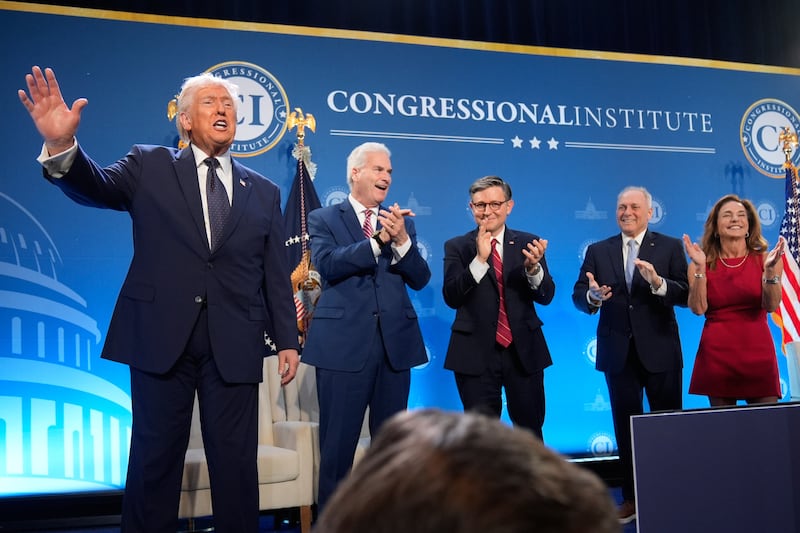
As Republicans gather at the Trump National Doral Miami resort this week to strategize for the midterm elections, the president laid out what he believes should be the top priority over the next eight months — but the path forward seems easier said than done.
As President Donald Trump huddled with House Republicans on Monday evening, he pinpointed one piece of legislation that he said must be passed before the November elections in order to “guarantee” a Republican sweep. That bill, the SAVE America Act, has become Trump’s fixation in recent weeks as he urges Republicans to crack down on voter fraud and enforce identification requirements.
“Let’s go for the gold,” he said. “It’s actually a matter, in a serious way, of national survival. We can’t have these elections going on like this anymore.”
Trump spent roughly a quarter of his remarks to House Republicans talking on the subject, and reiterated the message to reporters in a news conference shortly after.
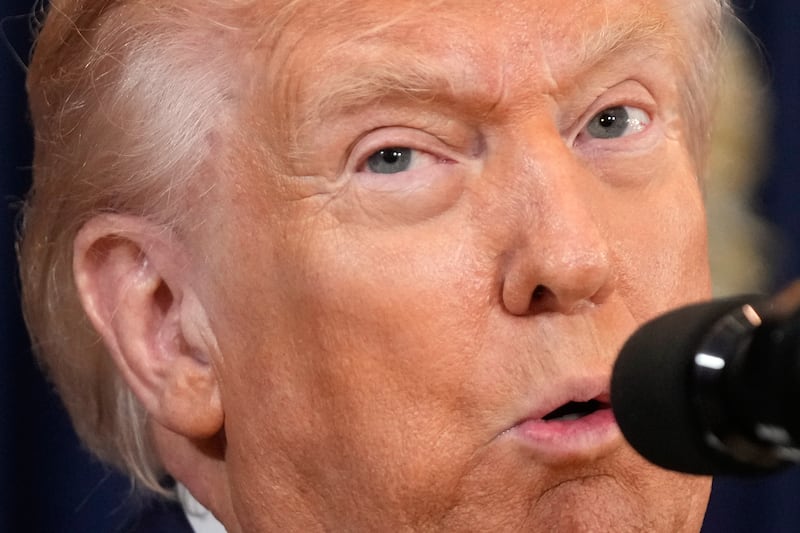
Trump wants to expand SAVE America Act to nonelection policies
At its core, the SAVE America Act would establish proof-of-citizenship requirements in order to vote in federal elections by requiring voters to provide documentation when they register to vote. The legislation would also require voters to show some form of photo ID when they go to submit a ballot.
But now, Trump appears to want to go even further — and transform the SAVE America Act into a megabill of sorts to pass a number of Republican’s policy priorities in one fell swoop.
“We’ve added two things,” Trump told Republicans on Monday. “(We want to add) no men in women’s sports and no transgender mutilation of our children.”
It’s not clear how Trump plans to include those policies, or how quickly it could feasibly happen. It would require rewriting the bill and sending it back to the House for another vote, despite already passing the lower chamber in two previous versions.
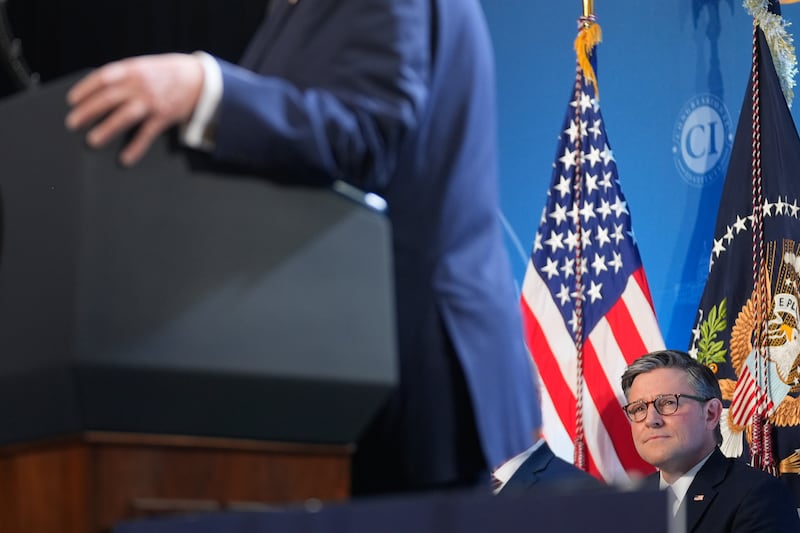
Trump reiterates threat to delay legislation
Utah Sen. Mike Lee, an original sponsor and leading voice to pass the SAVE America Act, has been pushing for a vote in the Senate for weeks. But the Utah senator has faced an uphill battle due to procedural rules that would require some Democratic support in order to advance — something the minority party has refused to provide.
Instead, Lee wants to revive an arcane Senate rule known as the talking filibuster to circumvent Democratic opposition — a strategy that could take weeks of debate and would delay the passage of other legislation.
Trump, though, seems open to that strategy. The president even said on Sunday that he would not enact any laws until the flagship election bill is passed, marking the president’s strongest threat yet to his own agenda.
“(The Senate has) to get it done,” Trump said on Monday. “If it takes you six months — I’m for not approving anything. ... I don’t think we should approve anything until this is approved.”
When asked if he would still approve some legislation, such as a bill to reopen the Department of Homeland Security, the president sidestepped questions on specifics. Instead, Trump simply said “certain things will take place” while the talking filibuster occupies the floor.
Republican leaders hesitant of talking filibuster plan
Back home in Washington, D.C., Republican leaders appear to have given up on the prospect of a talking filibuster altogether.
Senate Majority Leader John Thune, R-S.D., seemed to pour cold water on the strategy on Monday, telling reporters he would “find it very hard” to see it successful.
“This particular approach in terms of the process is much more complicated and risky than people are assuming at the moment,” Thune said. “Having studied (the talking filibuster), researched it pretty thoroughly, you have to show me how — in the end — it prevails and succeeds.”
Thune also pointed to the fact that Senate Republicans would need unanimous support to block amendments, which Democrats could introduce an unlimited number of during debate. But that unanimity is anything but assured — especially with at least three Republicans, Utah Sen. John Curtis included, who have said they would not back any changes to filibuster rules.
Thune acknowledged that Trump said he would not sign anything into law until the SAVE America Act is passed, but noted that was ultimately a decision left to the president to make necessary exceptions.
“That’s what he said. I think he’s since modified it with respect to DHS appropriations and hopefully that’ll be true on other issues,” Thune said. “If we can get some stuff done up here, I hope we can get some things signed into law. But that’s a question I think probably for him.”