

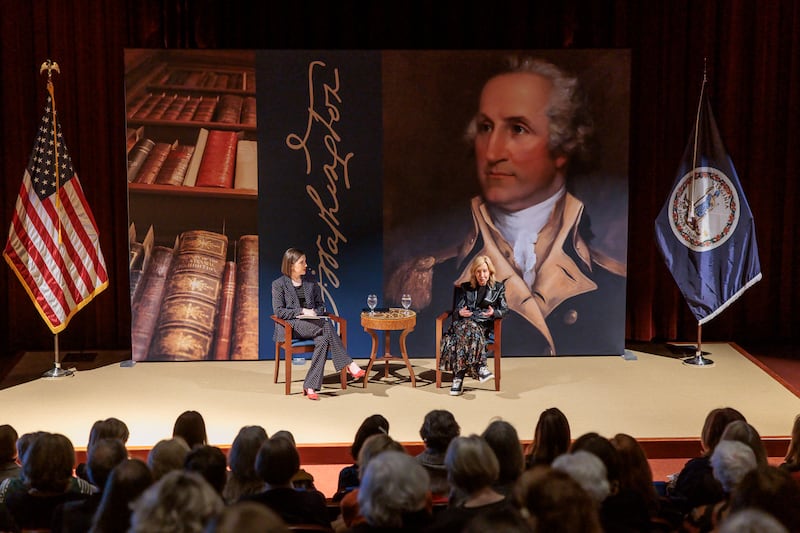

For years, the Mount Vernon Ladies Association was the only national historic preservation organization in the United States. Women banded together to save Washington’s beloved home in Virginia, just south of Washington, D.C.
Ahead of the country’s 250th birthday, women gathered at Washington’s residence last week for the Mount Vernon Women’s Leadership Summit where they focused on how to heal a divided nation.
Lindsay Chervinsky, the executive director of the George Washington Presidential Library, dreamed up the idea last year in preparation for America’s 250th celebrations. The inaugural event, she said, was created to honor the women who led the preservation of Washington’s home, but also to invite modern women and modern politics to the mix.
“So much of our national story has been shaped by women behind the scenes,” she said. “Mount Vernon Ladies Association is, of course, an example of that, but it’s everything — from family scrapbooks and letters that are passed down — those are always women’s roles.”
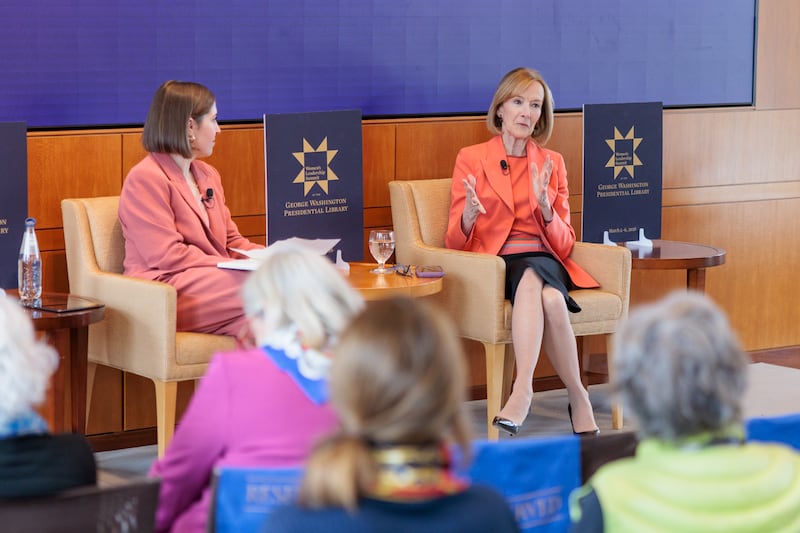
Panelists at the multiday summit included award-winning journalists Anne Applebaum and Judy Woodruff, as well as presidential historian Doris Kearns Goodwin, among others. Their conversations focused on the state of democracy in the United States, ways to heal a divided nation, the country’s 250th birthday, and women’s role in preserving history and storytelling.
Women’s role in storytelling
Chervinsky noted that women’s roles in preserving history began by passing down items to younger generations. Property and finances were often passed down through men, but furniture, clothing and art could go to women.
“Women were more engaged in civic spaces, preservation, history, genealogy; preserving the story of the family was a safe space for women to engage in a social sphere that wasn’t challenging gender stereotypes or wasn’t threatening to various power structures,” she said.
In her book “Writing with Scissors,” Ellen Gruber Garvey noted that more than 150 years ago women and African Americans would collect and document important news and personal items through scrapbooking, particularly in a time when they were not represented in larger culture and media. They created their own archives and ways to navigate the fast-changing world and women kept the tradition alive decades later.
Chervinsky said that some of the country’s earliest civic organizations, including religious spaces, were dominated by women and still are today. She pointed to the Mount Vernon Ladies Association’s 1853 founding and how Ann Pamela Cunningham’s mother inspired the work that led to the preservation of George Washington’s estate.
Chervinsky noted that with the Civil War as the backdrop for the organization’s founding, the role of women in the war and in that moment of history “often gets erased because they’re not the ones holding the guns.”
Goodwin got her start in storytelling by recording the score of the Brooklyn Dodgers games as a child to tell her father when he returned home from work. She later went on to be an assistant to President Lyndon B. Johnson and helped write his memoirs later in his life.
Goodwin has written biographies of numerous U.S. presidents, including Johnson, Abraham Lincoln, Franklin Roosevelt and John F. Kennedy. Her book about Lincoln was adapted into Steven Spielberg’s 2012 film and her book on the Roosevelts won her a Pulitzer Prize.
“I think I felt a sense from that experience of understanding a president from the inside out, rather than judging them from the outside in. … I didn’t want to judge them. I just wanted to understand them and to talk to them and so I did spend many years talking to them. They never answered me, but I had lots of conversations,” Goodwin said.
“It’s something I would never change. I’ve been able to catapult myself back to different decades to live with these people,” she continued. “The only fear is that in the afterlife, there’s going to be a panel of all these guys, everyone will tell me everything I missed about them.”
Goodwin noted how being one of the only female historians for decades was lonely and it was difficult to juggle work and raising a family, a uniquely female struggle. She also shared that future generations of historians will not only include more women in the field, but also have the opportunity and ability to capture and document the female perspective in other sectors.
“I think it’s a wonderfully interesting time to be a historian,” Goodwin said, later adding, “That’s why I said I’d love to be young again. There are so many things I’d like to know about women in all these periods of time. I think that there’s going to be more papers uncovered, more studies uncovered, so many things to be told and it’s just going to make America a much fuller place.”
Journalists Anne Applebaum and Judy Woodruff shared examples of how there were advantages and disadvantages to being a woman in the media industry. They noted how having a female lens on the world and gravitating toward issues women care about makes the world a better place, because in decades past, topics like maternal health were not covered.
Applebaum’s career as a young reporter in Warsaw was memorable because there were no other female journalists in the area at the time. Woodruff detailed how she knew she was in the minority and had to work harder to be taken seriously because there were virtually no female reporters in the ’60s and particularly none that covered politics.
Preserving and living through history
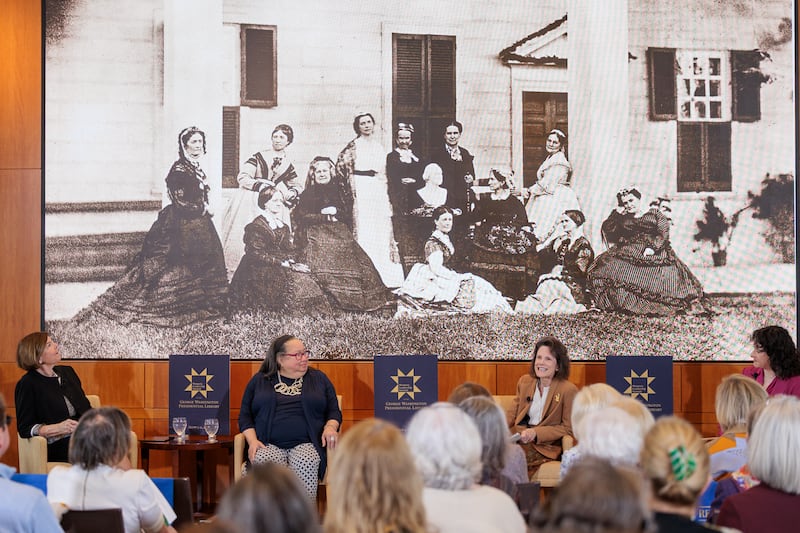
One of the summit’s themes was about the importance of preserving history and ongoing preservation efforts. Panelists across multiple days of talks highlighted the importance of preservation and the role that it plays in expanding our understanding of life back then.
“I think that historic preservation is an ever-evolving opportunity to tell a richer story,” Dede Neal Petri, regent of the Mount Vernon Ladies’ Association, said.
Gloria Kenyon, the executive director of the National Society of the Colonial Dames of America, shared how important it is for younger generations to learn the history of this country and be able to physically see that the figures of our past were real.
“For someone to come into a historic home, even though this home existed before their great-great-grandparents, where is that connection? How do they see themselves? Are they the children who might have been playing on the floor?” she said. “Look how far we’ve come, look at the changes we’ve made and how much we can continue to do. Because if you understand that path and you understand the history, you can continue to celebrate the amazing work that has been done and we can continue to understand we can change our history and we can be better going forward.”
Petri noted that the summit had Mount Vernon as a backdrop and it is a unique place of history, spanning about 500 acres along the Potomac River.
“In order to know George Washington, you need to know Mount Vernon. You need to see the land that he loves,” she said. “We attempt to really bring it to life here so that people … can spread the word about our origins.”
The panel also featured sections about the first ladies and their influence in the White House, because to know a president and his accomplishments, one must also consider the role of the first lady.
MS Now’s Ali Vitali posed the question about why only now in the modern era the public is coming to see the influence and work done by first ladies throughout history, questioning if it was the male-dominated press that wasn’t able to tap into the lived experience of women. Stephanie Bohnak, the director of education and curatorial services at the National First Ladies Library and Museum, provided examples of some sexist first lady media coverage that male reporters got wrong.
“I think it’s just this gender difference that is still evolving and we still see it in media and criticism of first ladies today,” she said.
“I think it’s journalists. It’s also historians as well, that are using the work of journalism and adding to it in new and unique ways. And I think one of the things that some of the first lady scholarship and some of the work that has been done … you have to think that there was a real problem,” Colleen Shogan, the 11th archivist of the United States, added. “As recent as LBJ’s presidency, there’s been a lot of people who have spent a lot of time on LBJ’s presidency, including prominent histories, and they completely missed the influence of Lady Bird Johnson completely.”
The next 250 years
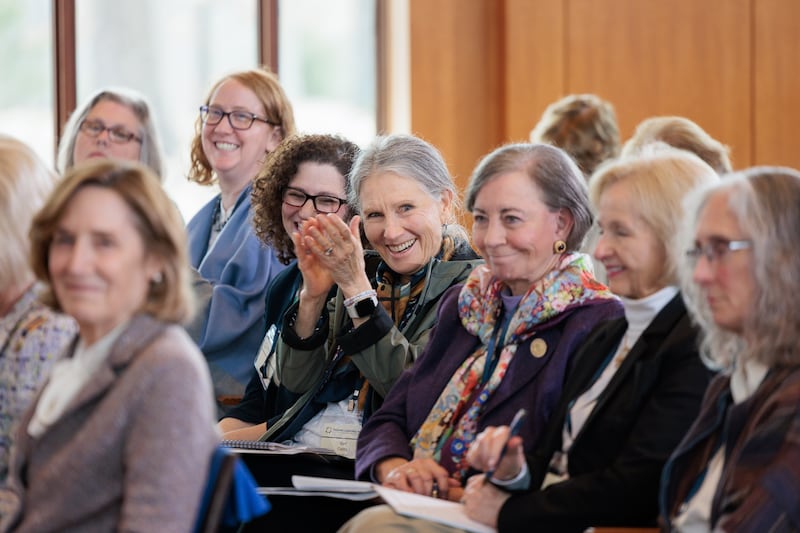
The panelists noted how divided the country seems to be ahead of its 250th birthday, but they also highlighted the inspiration that can come from reflecting on the nation’s founding.
Many spoke about the importance of getting young people and children interested in history and preservation.
By visiting historic sites and learning about the people and events that shaped this country, kids will have a greater understanding and appreciation for the institutions that remain vital to a healthy democracy. “It sticks,” Goodwin said. “Somehow it sticks with you.”
Young people, several panelists noted, actually are determined and optimistic about the future, too. They have grown up in a moment of extreme political division in the country and have asked how things could be different going forward, the speakers said.
“Their entire understanding of political life has been colored by this extreme polarization,” Applebaum said. “And yet, they understand the ugliness and they’re asking, what can we do differently?”
Speaking about changes and looking to improve morale in the country, Goodwin argued that to look forward, we must look backward. She noted that during World War II, when it looked like the Nazis were going to conquer Europe, there was major concern about the future, yet the Allied countries won.
“I think history really can give us a sense of solace and perspective about what’s happening now, because we are living in a really, really hard time, but we’ve lived through really, really, really hard times before,” she said. “We have to just remember that we’ve come through tough times before and we can do it again.”
Chervinsky said she thinks the anniversary of America’s founding is important for several reasons. First, it’s the fact that most republics don’t live longer than 300 years, and it’s an accomplishment the U.S. has made it this far. Second, it’s an important time to remind ourselves about why our democracy was created.
“The anniversary is an amazing time to say, what do we need to do as the next generation to uphold our institutions, to uphold our ideas and ensure we can keep going?” she said. “And I think women have an essential part in that.”