

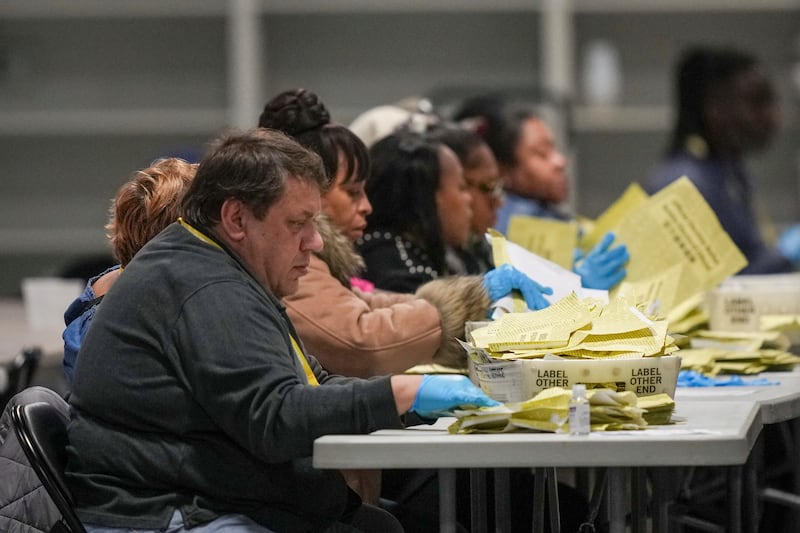

Tucked into the national fight to ban noncitizens from voting in federal elections is a provision that has been pushed by President Donald Trump for years: limiting who can cast their ballots by mail.
The Senate has begun debate on the SAVE America Act, Utah Sen. Mike Lee’s flagship legislation to establish proof of citizenship and voter ID requirements for Americans to register and vote in federal elections. The process could take days, if not weeks, of floor time — and its future is still uncertain as Democrats and a handful of Republicans say they won’t support it.
“I think it would be a suicidal move for us as Senate Republicans, for Republicans in general, if we don’t give everything into this,” Lee said on Wednesday. “I think we need to debate this as long as it takes to get it done, and we’re not there yet.”
One of Democrats’ main concerns with the bill is proposed language to restrict mail-in voting, saving that option only for those with illness or disability, or those who are in the military.
The SAVE America Act does not explicitly ban mail-in voting. But it does restrict the process by no longer permitting election officials to automatically send ballots to individuals on the voter rolls and instead requiring them to opt in. Those voters must then also prove their citizenship through some form of documentation.
But a proposed amendment to update the bill would seek to end mail-in voting altogether, except for some limited exceptions.
“What I’m proposing in the amendment to deal with mail-in balloting fraud and these scams that exist is just to make sure ... we’re no longer going to allow ballots to be sent out willy-nilly without verifying addresses,” said Sen. Eric Schmitt, R-Mo., who is leading the amendment. “If you have a hardship because of a disability or an illness or because of travel, or you’re a caregiver or some other hardship that the state can identify, you can vote by absentee, you have to request it, and then you vote absentee.”
That could bring major changes to Utah’s vote-by-mail system, which has been in place for over a decade and roughly 90% of voters utilized during the 2022 midterm elections.
Lee argued the changes would not be disruptive as Utah has handled the process “safer than how most states handle it.” For example, he said, Utah does not engage in ballot harvesting and the state has established “pretty good signature verification procedures.”
But, the Utah senator acknowledged, if changes are made through the SAVE America Act, he said he was confident the Beehive State could adjust.
“My state is very capable,” Lee told reporters on Wednesday. “Should that amendment pass and the bill as a whole become law with that (provision) in there, I’m confident that Utah can catch up, and other states can do that as well.”
Despite hailing from a state that lauds its vote-by-mail system, Lee warned that absentee ballots can lead to widespread voter fraud when applied nationally.
“The fact that (Utah voters have) grown accustomed to it doesn’t mean that we couldn’t adjust it again,” Lee said.
The SAVE America Act has become a political flashpoint in recent months, even getting the attention of Trump, who has instructed Republicans to make it their “No. 1 priority” heading into the midterm elections.
But the bill still has an uphill battle, and its chances of becoming law are still slim. Still, Lee and other Republicans say they are prepared to continue debate until it becomes law — which could delay other must-pass legislation depending on how long that takes.