

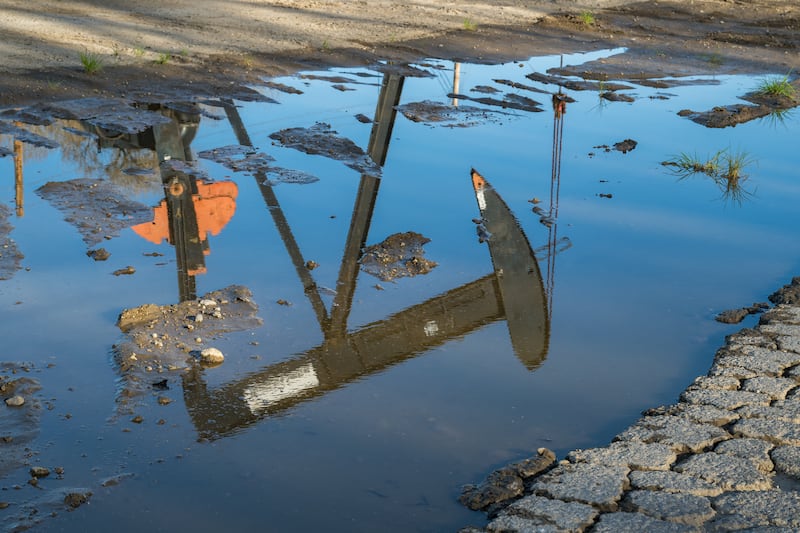

Recent lawsuits between California, oil companies and the federal government raise the question: Who has final say on energy infrastructure — the federal government or the states?
Last Friday, President Donald Trump invoked emergency powers to help the U.S. mitigate oil price inflation from the Iran war. Gas prices across the United States have increased since the initial attack, with average prices sitting at $3.84 a gallon, as of Wednesday. In California, Washington and Hawaii, averages sit above $5 a gallon of regular gas.
In response to Trump’s order, the Department of Energy directed offshore oil production to resume at a Southern California site, which has been dormant for a decade. On Saturday, for the first time since 2015, oil began flowing in Santa Barbara County.
California’s state leaders are not happy about the move.
On the same day the DOE issued the order, California Gov. Gavin Newsom promised to take the department to court. The decision “sacrifice(s) our coastal communities, our environment and our $51 billion coastal economy,” he said.
Many Californians have been wary of the pipeline, the Santa Ynez Pipeline System, since its significant oil spill in 2015.
External corrosion ruptured the pipeline, releasing 2,934 barrels of crude oil (more than 100,000 gallons) into the Pacific Ocean and nearby beaches.
The oil operation has since been sold to the Houston-based company, Sable Offshore Corp.
How much will the pipeline increase California’s oil production?
Sable says resuming operations will increase in-state oil production by 17% and reduce California’s need for foreign crude oil by 1.5 million barrels a month. The company expects sales to hit the market by April 1.
For the last four decades, California has experienced a linear decline in oil production. In February 1986, the state produced 1.1 million barrels a day, a number which has dropped to 246,000 barrels a day as of last December.
This 77% decrease coincides with the state’s loss of oil refineries. In 1985, California was home to more than 40 refinery operations, and in 2025 there are fewer than a dozen.
While oil consumption in California has decreased, the state still consumes 1.8 million barrels a day — roughly 650 million barrels a year.
In 2025, California’s major oil suppliers were Brazil (18% of total imports), Iraq (17.5%), Guyana (14%), Canada (12%), Ecuador (12%), Argentina (9%), Saudi Arabia (8%).
The California v. petroleum legal battles
Last April, the California Coastal Commission fined Sable $18 million for not complying with two cease-and-desist orders, demanding that Sable Offshore Corp stop doing work on the pipeline.
Several months later, the Santa Barbara County District Attorney filed 21 criminal counts against the company. The charges included five felony counts, which accuse the company of discharging material into creeks and waterways.
Then in October, California’s fire marshal announced that they wouldn’t consider Sable’s restart application until the state approved the company’s corrosion repairs.
Sable countered that the fire marshal had added a “brand-new requirement as part of a last-minute hit designed to block the company’s path,” the Santa Barbara Independent reported.
More recently, on March 13, Sable Offshore Corp and Pacific Pipeline Company sued California’s parks and recreation department. The lawsuit alleges that California cannot block or regulate the federally requested pipeline restart, and it asks that Sable not be punished for following a federal order.
On Monday, March 16, California Attorney General Rob Bonta filed an emergency motion in federal court, asking Sable Offshore Corp to comply with state law, which prohibits them from operating.