

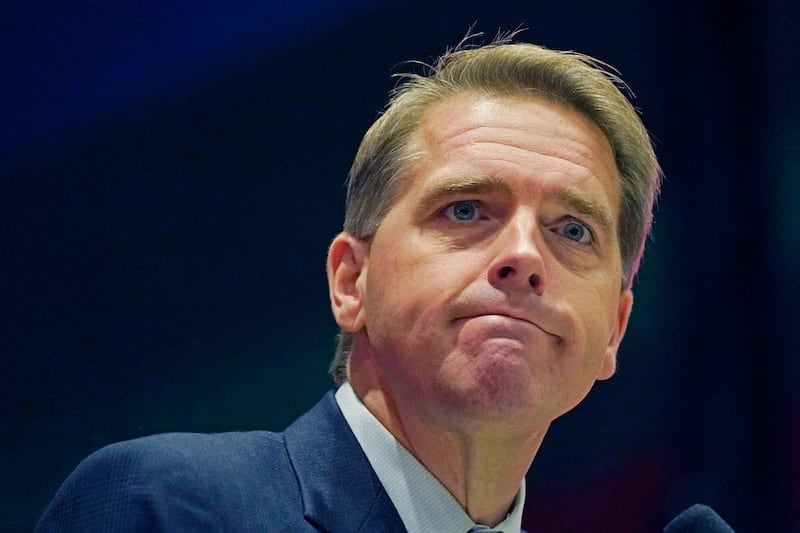

When David Axelrod, a Democratic strategist, and Scott Jennings, a Republican consultant, sat down for a frank conversation at Arizona State University, both of them repeatedly stressed that they are the best of friends.
Kicking off ASU’s Dialogues for Democracy event on March 17, they were joined by former Sen. Jeff Flake, who was also a U.S. ambassador to Turkey and now serves as the founding director of Arizona State University’s Institute of Politics.
Axelrod and Jennings blazed through some of the biggest hot-button issues right now, like the Iran war and the SAVE Act, with Axelrod questioning the sitting administration’s priorities while Jennings defended the Trump White House.
That’s just another Tuesday for this pair of political pundits from opposite ends of the political spectrum.
But in a day and age when politics feels personal, Jennings and Axelrod have managed to forge a friendship despite their political differences.
Axelrod asked Jennings, “How is it that we have gotten to the point where being friends with someone who has a different point of view than you is considered somehow inappropriate — or worse?”
Jennings, in response, talked about what drew him to Axelrod at CNN.
“Most people don’t listen to anything other than themselves, but Ax tends to open his heart and his ears before he opens his mouth,” said Jennings.
“Even though we’ve had some sharp disagreements, I never doubt his sincerity or the way he approaches the job. He’s not there to hurt anybody; he’s there to help the conversation.”
Axelrod deflected the stream of compliments and, in response, acknowledged Jennings as “one of the smartest guys I’ve ever sat down with on a television set.”
Axelrod and Jennings couldn’t be more different politically. The former worked as an adviser to former President Barack Obama, and the latter assisted former President George W. Bush.
But they spoke to each other with great ease.
“We need to be able to have these discussions,” Axelrod said toward the end. “We’re so separated by our media and our politics that we often don’t get to know each other, and it’s easy to assume the worst about each other.”
“My hope is that we can find a way back to a place where we seek out our common humanity instead of wallowing in our differences. Because I think that is the fundamental challenge for our democracy.”
The news we consume
Axelrod has served as a senior political commentator for CNN for over a decade.
Jennings joined the network as an on-air political contributor in June 2017. He frequently appears on programs like “NewsNight with Abby Phillip,” known for its lively and at times chaotic debates. Jennings said he knew the show would produce “the most exciting possible content,” especially in 2023, as the presidential campaigns went into full swing.
“I don’t know why we can’t have informative political discussions and also make them entertaining. I think most nights we do that,” he said. “Some nights we get off the rails.”
The key is to get the right set of informed guests, he said.
Clips from the show often go viral and have expanded CNN’s brand, Jennings noted. But does this kind of quick content, where Jennings, the “MAGA explainer,” debates five people at once, have any caloric value? Axelrod asked.
Jennings said it does when experienced experts can keep the guests well informed.
He recently made headlines for laughing during a fiery debate over a fellow panelist’s remark that the U.S. war in Iran is a “disaster.”
“Maybe it’s funny to you,” former Clinton aide Keith Boykin says to Jennings on the show, who quickly fires back, “It’s funny to me that you’re hoping we lose this war to Iran.”
After the event, Jennings told the Deseret News that the polling on the rising distrust in media “bothers him,” but he added that “we bring it on ourselves.”
For Jennings, the media industry is responsible for earning its credibility.
“I believe in a trusted free press,” he said. “The best way to recover from mistakes is to just own up to them and … say how you’re going to do better. That’s true for most businesses.”
Jennings added, “But that hasn’t always happened.”
As for news consumers, Jennings said his advice to people is to diversity their media diet to avoid getting stuck in an echo chamber. “That happens to a lot of people,” he added.
Do the powers of a president go too far?
Axelrod made a bold declaration on Tuesday night, noting that his confession came in front of former Sen. Jeff Flake, who was also a U.S. ambassador to Turkey, and other conservatives in the audience.
“I think Donald Trump has made me more of a conservative,” the former adviser to Obama said.
He said he grew up admiring the Franklin D. Roosevelt administration, crediting Roosevelt with saving the country during the Great Depression and World War II by taking on significant authority during a time of crisis.
“He was heroic to lots of Americans for having done it,” Axelrod noted. His integrity allowed him to exercise power in alignment with the Constitution, but the same can’t be said for every president, he added.
Noting his time advising presidents, Axelrod said he wonders whether the power of presidents should be dialed back or if they should have more authority to cut through the gridlocks in a divided Congress.
Jennings pointed to a simple lesson he learned a long time ago: “Instant coffee ruined the world.” People now want and expect results instantly. Congress doesn’t produce results as fast as the White House, and the current administration realizes this, said Jennings.
“The constituents are demanding quicker action, which I think then leads presidents to want to move,” he said.
“Sometimes these guys get their ears pinned back by the courts. Happened to Biden. Happened to Trump,” said Jennings, “and it will continue to happen to presidents.”
Axelrod argued that this approach can prevent “substantive and sustainable” solutions.
Jennings defended what he sees as the Trump presidency’s success in fulfilling campaign promises, whether it was in relation to tariffs or border security. He also touted the feat of “the smallest federal government since 1966.”
“Every Republican I ever worked for in 26 years said they were going to shrink government. Trump is the only one who actually did,” Jennings said.
In its first year, the Trump administration deployed tactics that “overwhelmed” everyone in Washington, nationwide and abroad. But Jennings made a case for this. During Trump’s first term, he said, Republicans felt ambushed by layers of bureaucracy, the media and the judicial system.
“This time, they made the decision, ‘We are not going to be overwhelmed. We are going to overwhelm them,’” Jennings said, noting that it has been “largely successful.”
In his latest book, “A Revolution of Common Sense: How Donald Trump Stormed Washington and Fought for Western Civilization,” Jennings details scenes from the Oval Office and Air Force One, exploring Trump’s second term. The book has Trump’s endorsement.
“What Trump felt the first time around is that Washington had such a negative reaction to someone like him taking the presidency that these interests colluded to destroy his first term, and this time around, they were determined not to let that happen,” Jennings said.
“They knew they had a limited amount of time. I mean, one term left, and every day is a day that is lost and doesn’t come back, and they weren’t really going to pace themselves.”
The war in Iran
On Iran, Axelrod asked whether Trump should have explained “to the nation in advance” about U.S. intervention in Iran, or at least laid the groundwork for his plans.
He noted that at his State of the Union address, Trump spoke for an hour and 47 minutes. “A lot of it was about the economy. Three minutes were on Iran, and then two days later, we basically went to war,” he said.
“Look, I think you and I have a disagreement about this,” Jennings said to Axelrod.
The Republican strategist argued that the reason behind the White House’s decision has been thoroughly explained.
“Whether you want to go back in time for the last 47 years, or whether you want to go into the short term,” he said, noting Iran’s “missiles, drones, aggressive navy, (and) the insatiable appetite to build nuclear weapons,” as well as its role in “exporting terrorism and destabilizing the Middle East.”
He defended Trump’s clear wishes not to allow Iran to bear nuclear weapons, adding, “I think he’s executed that.”
“Militarily, they believe we’re getting close to a point where you can say we’ve met our military objectives; we’ve destroyed all the targets,” Jennings said.
“Right now, I’m not sure we know who we’re dealing with. We have not seen the current supreme leader in public,” he said, pointing to the latest intelligence publicly revealed by U.S. Defense Secretary Pete Hegseth that Supreme Leader Mojtaba Khamenei was likely wounded.
Axelrod and Jennings find some common ground on the SAVE Act
Axelrod also touched on the SAVE Act, which is causing a stir in Congress, during the hourlong conversation. This bill, proposed by Sen. Mike Lee, R-Utah, and endorsed by Trump, would require proof of citizenship to register to vote.
He confessed he didn’t have much against the bill since Arizona already requires voter ID. But the narrative from Republicans in Washington suggests the SAVE Act would solve the problem of election fraud. Axelrod asked Jennings if he thought the fraud problem had legs.
“There’s certainly evidence that voter rolls across the country are filled with phantom voters,” Jennings said.
Axelrod said he raised the question because they were in Maricopa County, a focal point of extensive scrutiny over the results of the 2020 election. Numerous investigations and audits have found no evidence of the alleged widespread fraud.
Earlier this month, the FBI took Maricopa County’s documents related to that election as part of an undisclosed investigation. When Axelrod asked how much evidence is necessary to move on from the 2020 contest, Jennings said he believes that there is evidence of fraud, and in races with close margins, even small instances can change the result.
The SAVE Act specifically aims to eliminate noncitizens from voting, even though noncitizens are already prohibited from doing so under federal and state statutes. Axelrod pointed to the lack of evidence of noncitizens voting, aside from a few rare cases, but Jennings countered that it’s about how much people are willing to accept.
“You can allow the states and the counties to run their elections, but if we do have some nationwide basic standards about ID, citizenship and voting rolls, most people would reasonably say that gives me some confidence in the system.”
Axelrod responded, “I’m asking you about the president’s insistence here in the state of Arizona, where they were traumatized by all of this, his continued insistence that American elections are fraudulent, that the 2020 election was fraudulent. Doesn’t that undermine democracy?”