

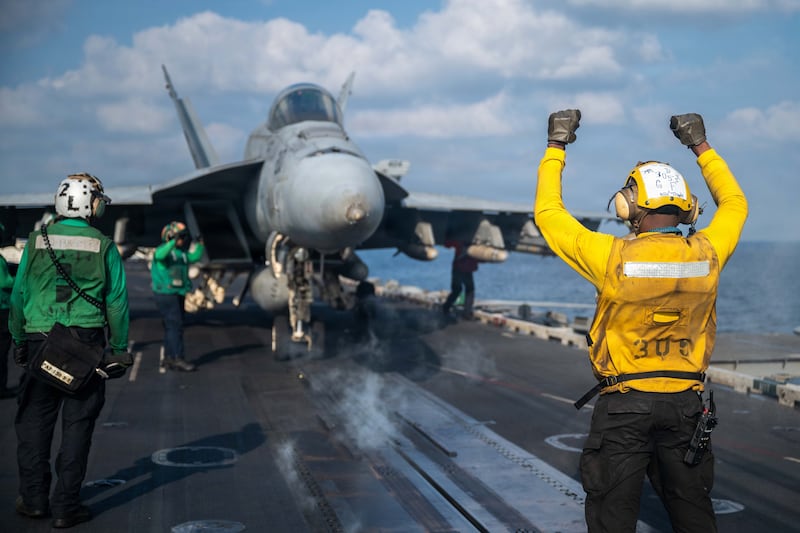

The war in Iran has reached its three-week mark. The United States, along with Israel, launched its military operation in the Middle East in late February.
The countries have stated that the war was intended to destroy Iran’s ability to create nuclear weapons, as well as its missile capabilities.
The initial strikes have taken out much of the Iranian regime’s leadership, including the Supreme Leader Ayatollah Ali Khamenei.
Here’s the latest:
Trump considers more action
Despite insisting that the U.S. and its military have had a successful mission that is ahead of schedule, President Donald Trump is considering putting boots on the ground by occupying Iran’s Kharg Island. Putting troops on the ground in the Middle East is something Trump has not ruled out since the start of the war.
Iran has retaliated since the start of the war, hitting U.S. bases and Israel sites, as well as other Gulf states. At least 13 U.S. service members have been killed so far and several hundred have been injured.
In his first public remarks since the start of the war, Trump said that the strikes were to end Iran’s nuclear capabilities, which could hit Europe or some of the U.S. bases “both local and overseas.” They would soon be able to hit the United States, he said.
Trump, along with Secretary of State Marco Rubio and Defense Secretary Pete Hegseth, has been celebrating the success of the military operation so far and laid out the plan for the future.
They have not given a timeline for how long the operation would last, despite saying it was ahead of schedule. Trump has said that it would be a “short-term excursion.”
The United States’ European allies have been frustrating the president. While NATO allies say that they support the military operation, they have not aided the U.S. in its war. They have largely said that they do not want to be involved.
The war is also turning some of Trump’s base against him. Joe Kent, the former director of the National Counterterrorism Center, resigned last week over the war.
Kent, a veteran whose wife died in combat, said he could no longer support the president’s mission, despite being a Trump ally for years. He argued that the war was being fought on behalf of Israeli interest.
During a testimony to Congress this week, Kent’s superior, Director of National Intelligence Tulsi Gabbard, admitted that from U.S. strikes in the summer of 2025, Iran’s missile capabilities were wiped out. She said that Iran had made no effort since the 2025 strikes to rebuild, but the country had “maintained the intention to rebuild.”
Impacts in the U.S.
Consumers in the U.S. are already seeing the impacts of the war in the Middle East.
Gas prices are rising and the stock market is fluctuating as the Strait of Hormuz continues to be blocked.
According to the American Automobile Association, the average price of gas across the country went up to the highest it has been in over a year.
The national average, as of Friday, was $3.912 per gallon. A week ago, the average was $3.539 and a month ago it was $2.917.
The average price per gallon in Utah is slightly under the national average, coming in at $3.883 per gallon.
AAA has said that prices usually tick up in the spring and summer months as road travel increases, but this year there’s additional pressure on the pump.
Trump has maintained that the hurt Americans will feel will be temporary.
“I can tell you that when this is over, oil prices are going to go down very, very rapidly. So is inflation. So is everything else,” he said. “But frankly, much more important than short-term or even long-term oil prices. You can’t let the most violent, vicious country in the last 50 years have a nuclear weapon.”
The future
It’s unclear what the future of the war will look like.
The Trump administration has been vague about what the timeline for the war will look like. Several weeks ago, Trump and Hegseth gave an estimate of four to six weeks, but they both have also celebrated the success of the operation and said that it is ahead of schedule.
Israeli Prime Minister Benjamin Netanyahu is also celebrating the success. There’s been some speculation that the U.S. went to war with Iran on behalf of Israeli interests, which Netanyahu dismissed on Thursday.
It appears that the United States’ relationship with NATO is on the outs. Trump sharply criticized European allies for not joining with Israel in aiding in the war. He argued that while the allies support his efforts, they are making no attempt to join the U.S.
With the supreme leader killed in early strikes, the new leader, his son, Ayatollah Mojtaba Khamenei, was wounded and “likely disfigured.”
Iran’s Assembly of Experts named him the country’s next leader, but he has not been seen in public since March 8. While he is officially in charge of Iran and its armed forces, his lack of public appearances has left questions open about who is actually ordering the military to retaliate. Some experts argue that the power is now with the Islamic Revolutionary Guard Corps.
Rep. Rick Crawford, R-Ark., part of the “Gang of Eight” in Congress, said he doesn’t really know who is in charge of Iran.
“I think what we’ve seen is a total disruption of leadership in Iran,” he said. “That could be what facilitates regime change.”
Before leaving the White House for the weekend, Trump addressed the media and spoke about where things stood with Iran. He said that NATO countries needed to help but “haven’t had the courage to do so.” Trump celebrated the success of the operation, noting that Iran’s military was “all gone.”
With talks ramping up of taking Kharg Island, it’s unclear how much more military action will be happening in the Middle East.