

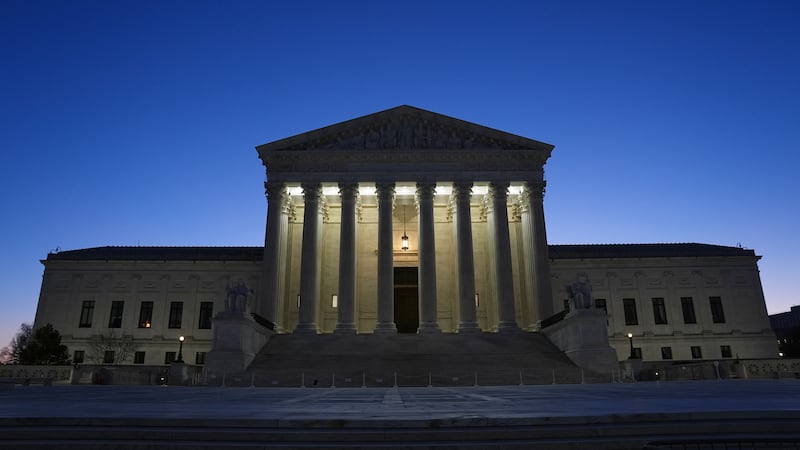

The U.S. Supreme Court overturned a lower court decision stemming from an incident between a law enforcement officer and a protester nearly a decade ago.
The incident dates back to 2015, during the Vermont gubernatorial inauguration. Protesters, including Shela Linton, participated in a sit-in on the House floor in demand of universal health care. As they were being removed from the Capitol, Linton refused to leave.
“Sergeant Jacob Zorn asked Shela Linton to stand up and warned her that he would eventually have to use force to remove her,” per the court’s filing. ”Zorn took Linton’s arm, put it behind her back, placed pressure on her wrist, and lifted her to her feet.”
Linton then sued Zorn, accusing him of violating her Fourth Amendment right and causing damage to her physical and mental health.
The Supreme Court ruled on Monday that Zorn’s actions qualify for immunity from litigation.
“The Second Circuit held that Zorn was not entitled to qualified immunity. We reverse,” the justices’ per curiam opinion, from which the three liberal justices dissented, states.
The majority ruling also explained that law enforcement officers are typically protected from civil liability unless prior case law proves their actions were unlawful. The six justices concluded that the case law used in the 2nd Circuit Court did not prove Zorn violated Linton’s constitutional rights.
However, in her dissenting opinion, Justice Sonia Sotomayor argued that “given that this case is at the summary judgment stage, the Court must ‘view the evidence ... in the light most favorable to’ Linton, the nonmovant, ‘with respect to the central facts of the case.’”
She accused her colleagues of a “one-sided approach” that “transforms the doctrine into an absolute shield for law enforcement officers, gutting the deterrent effect of the Fourth Amendment.”
“The majority today gives officers license to inflict gratuitous pain on a nonviolent protestor even where there is no threat to officer safety or any other reason to do so,” Sotomayor continued. “That is plainly inconsistent with the Fourth Amendment’s fundamental guarantee that officers may only use ‘the amount of force that is necessary’ under the circumstances.”