

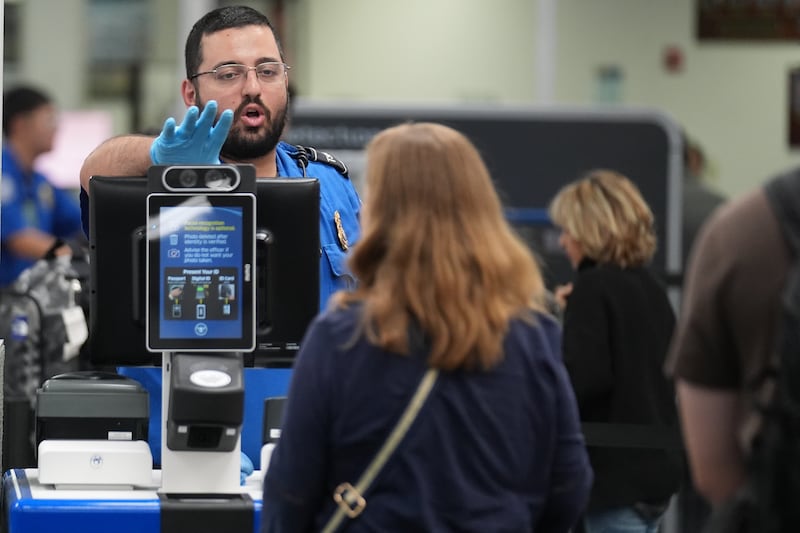

- About 50,000 TSA workers began receiving back pay Monday after President Donald Trump ordered DHS to redirect funding, but tens of thousands of other DHS employees remain unpaid.
- Unpaid workers still include civilian staff in Federal Emergency Management Agency, Cybersecurity and Infrastructure Security Agency and the civilian side of the Coast Guard, as well as civilian employees at ICE, CBP and the Secret Service.
- Congressional Democrats are refusing to pass broader DHS funding unless it includes restrictions on ICE and Border Patrol tactics, while Republicans say some demands — such as banning masks and requiring warrants for home entry — are unacceptable.
After more than six weeks with no pay, TSA workers started to see paychecks hit their bank accounts on Monday, thanks to an executive order President Donald Trump signed on Friday.
The order directs Department of Homeland Security officials to redirect funds in order to pay TSA employees.
However, tens of thousands of other DHS staffers will continue to go without pay until Congress can pass longer-term funding. This includes employees at the Cybersecurity and Infrastructure Security Agency and Federal Emergency Management Agency.
The DHS funding drought started on Feb. 13, when its short-term continuing resolution money ran out. This payment freeze follows a six-week payment drought from last October, during the 43-day federal government shutdown.
So far, Democrats in Congress have been unwilling to pass funding for Immigration and Customs Enforcement and Border Patrol, unless the funding bill includes several policy changes. Specifically, they’re asking for the following:
- Requiring agents to receive judicial warrants before they enter private property or homes.
- Requiring agents to display visible identification, including names and badge numbers.
- Banning masks for ICE and Border Patrol agents.
- Restricting roving patrols and stop-and-search tactics.
- Strengthening limits on when and where ICE can make arrests.
Republicans say they’ve made a concessions, including ensuring agents wear body cameras, but several other Democratic requests are nonstarters.
In an interview with ABC News on Sunday, Sen. Chris Van Hollen, D-Md., explained what Democrats have gotten out of the shutdown. “We made clear that we’re going to demand reforms of a lawless ICE operation,” he said.
ABC reporter Jonathan Karl responded, “I guess what’s confusing here is you have fought and blocked funding for the Department of Homeland Security, because you object to what ICE is doing and you want to force changes. And yet, the only thing that has been assured throughout all of this is that ICE already has the money.”
Trump’s One Big Beautiful Bill Act of last July allocated $75 billion for ICE over four years, allocating $45 billion for new detention spaces and $30 billion to hire 10,000 ICE employees. Consequently, some employees in the agency have continued receiving pay amid the shutdown.
How significant is the DHS shutdown?
TSA employees make up about 20% of the department’s 260,000 employees nationwide, and 95% are deemed essential workers. By late March, about 50,000 TSA officers had been unpaid for more than 40 days.
Officer absentee rates climbed above 12% nationally at some points, with the number surpassing 36% at George Bush International Airport in Houston, Texas. Consequently, heightened wait times have accompanied staffing shortages.
More than 500 TSA officers have quit during the latest DHS shutdown.
However, a DHS media relations official, Lauren Bis, told USA Today on Monday that TSA workers’ financial burdens should begin easing soon. “Most TSA employees received a retroactive paycheck today that included at least two full paychecks covering pay periods 4 and 5 today.”
Some employees may see “a slight delay due to a variety of reasons, including financial institution processing times or issues with their direct deposit,” Bis said. But the department is “working aggressively with USDA’s National Finance Center to complete processing for the half paycheck they are owed from pay period 3 as soon as possible.”
Who is still going without pay in the DHS?
Tens of thousands of non-TSA DHS staffers are continuing to go unpaid.
Civilians in the U.S. Coast Guard, tasked with recruiting, maintenance and non-emergency operations, will continue to work unpaid. Their active-duty Coast Guard counterparts have been and will continue to be paid during the shutdown.
Other employees in FEMA, which also falls under DHS, along with essential employees in the Cybersecurity and Infrastructure Security Agency, will continue working without pay.
Similarly, civilian employees in sworn law enforcement positions, including CBP and the U.S. Secret Service have been and will likely continue working unpaid through the shutdown.
A Salt Lake City AFGE regional vice president, Tanja Fowler, released a statement to KSL on Friday on behalf of her union.
“It is outrageous that politicians should continue to receive their salaries while failing to fulfill their responsibilities to the citizens who elected them,” she wrote. “Our federal employees deserve far better than to be treated as political pawns. They are human beings with families, bills and responsibilities, contributing significantly to our economy and national security.”
Fowler also thanked Trump “for stepping in to ensure that TSA employees are compensated and that our nation remains secure.”
Legislation has stalled in Congress ahead of a two-week recess. Long-term funding still needs to be passed by lawmakers, who don’t plan to be back in D.C. until April 14.