



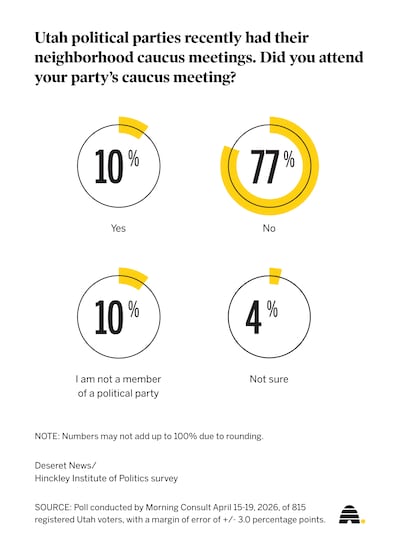
- A Deseret News-Hinckley Institute poll found that 10% of Utah voters participated in party caucus meetings.
- But a new congressional map has contributed to record turnout for the Democratic caucus in Salt Lake County.
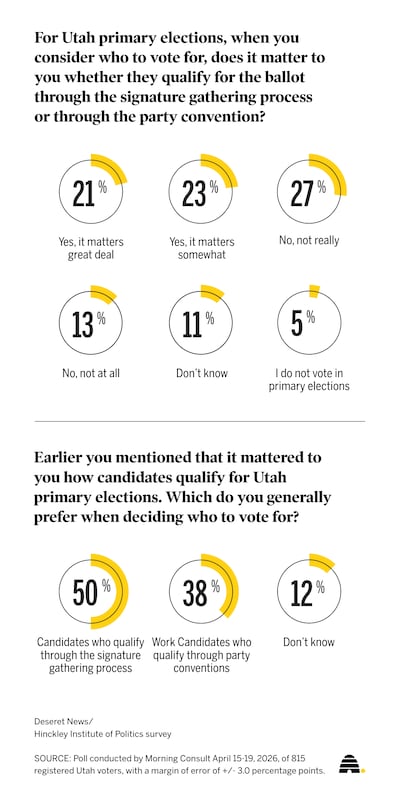
- More than 60% of Utah voters don't care how a candidate qualifies for the ballot or prefer signature gathering.
A new political landscape in Utah, triggered by a series of bombshell court rulings, has reenergized party activism and reignited debate over the state’s unique caucus system ahead of Saturday’s convention.
Around 1 in 10 Utah voters participated in party caucus meetings last month to elect precinct representatives known as delegates, according to a new Deseret News-Hinckley Institute of Politics poll.
This share of voters will have an outsized role in determining which candidates appear on the June primary ballot after a new court-ordered congressional map set the stage for multiple contentious showdowns.
Following a dramatic confrontation between delegates and Utah Gov. Spencer Cox in 2024, Utahns continue to feel split on whether the caucus-convention process adds to, or disrupts how candidates are chosen.
Caucus attendance by the numbers
On Tuesday, March 17, thousands of Utah voters met in public spaces like schools to elect precinct leaders, including county and state delegates, to help nominate a party-endorsed candidate for the primary.
Of the 2 million registered voters in the state, 10% said they attended their neighborhood caucus meetings, according to the Deseret News-Hinckley Institute poll conducted by Morning Consult from April 15-19.
This share held constant across party affiliation.
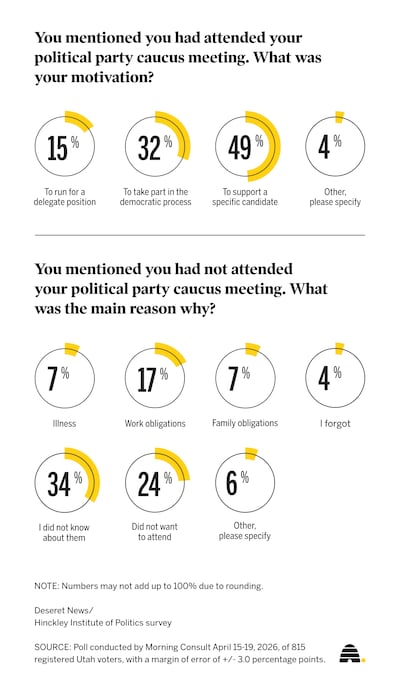
Nearly half, 49%, who attended caucus night said they were motivated to support a specific candidate. Another 32% said they wanted to take part in the democratic process and 15% wanted to run for a delegate position.
Among the 77% who said they did not attend caucus night, a plurality of 34% said they did not know about it. Another 24% said they did not want to attend. Smaller percentages of voters cited work, family or illness as obstacles.
After waves of reforms during the Progressive Era a hundred years ago and after the tumultuous 1968 national convention, Utah was left as one of the only states where delegates play a strong role in state ballot access.
Even with the signature path to the primary established in 2014, delegates continue to have “a huge amount of say” in Utah elections, according to Jason Perry, director of the University of Utah’s Hinckley Institute of Politics.
“Not just do they get to pick a candidate, but they also get to, as part of that, start giving party resources to those candidates,” Perry said. “So it’s a significant event, even though there’s very small participation.”
As the number of caucus participants ebbs and flows, the “outsized influence” belonging to the most engaged party volunteers is made even greater when less people participate in caucus night, Perry said.
An energized year
Party leaders on both sides believe caucus continues to be a valuable resource that cannot be replicated elsewhere.
Democrats rejoiced in November when a state district judge replaced electoral boundaries drawn by the Utah Legislature with ones submitted by advocacy groups, giving Democrats a chance at federal representation in the new 1st District.
This appears to have translated directly to greater grassroots involvement among Democrats.
In Salt Lake County, the party saw its best caucus turnout since the 2016 presidential primary, and by-far its best showing in a non-presidential year, according to Salt Lake County Democratic Party executive director Nick Glenn.
At least three-quarters of the caucus attendees were first-timers, often driven to caucus because of the new map, Glenn said. Compared to the amount of voters overall, 10% attendance is “actually a really good number,” Glenn said.
“There’s a lot of people who live their lives and don’t engage directly in the political system,” Glenn said. “What caucus and convention brings is an opportunity for community and an opportunity for building momentum.”
GOP caucus participation in presidential years has declined sharply over the past decade to less than 10% in 2024. But it may be significant that that number remained constant, according to the new poll, in an off-year like 2026.
In the events following caucus night, Utah County GOP chair Cristy Henshaw has observed record attendance, with 1,300 delegates — around 60% of whom were serving as delegates for the first time — attending a recent training.
But the value of the caucus-convention system shouldn’t be judged by the turnout rate, according to Henshaw. It’s a process that provides unmatched access for party volunteers to candidates, debates and education, she said.
“I get so annoyed when I hear people say this is this archaic system,” Henshaw said. “It’s literally how our whole country was built and humans are still pretty much the same so at what point are we saying we’ve outgrown it?”
The way Henshaw sees it, the alternative, of expensive signature gathering and advertising campaigns, is worse for candidates, voters and “small r” republicanism.
What is the value of the caucus?
For years, Republicans have fought to return to the convention-only system before the passage of SB54 in 2014.
But the new poll found that more than 60% of voters either do not care about how a candidate qualifies for the primary, or prefer that a candidate qualifies through signatures. Only 17% preferred that a candidate qualified through convention.
Overall, 40% said it didn’t matter to them how a candidate qualified. And of the 44% that said it did matter, 50% said they preferred the signature path and 38% preferred the convention path. But this varied widely by party affiliation.
Among Democrats, 63% preferred signature candidates when deciding who to vote for and 35% preferred convention candidates. That flipped among Republicans, with 38% preferring signature and 48% preferring convention.
This is likely mostly a reflection of preferred voting methods, not candidates themselves, according to Perry. But the results also go to show that “there is a place for (the caucus-convention system)” in contributing to Utah’s primary process.
The traditional argument in favor of the caucus-convention system is that it allows candidates to win based on their adherence to the party platform and their ability to persuade voters — and not solely on the size of their pocketbook.
But, according to Taylor Morgan, the executive director of Count My Vote — the group behind Utah’s signature path to the primary — the caucus-convention system is “structurally exclusive” because of its inconvenience and outdated processes
“Meetings are incredibly poorly attended just because it is not how voters engage in politics in modern times,” Morgan said. “The caucus convention system is a relic of the early 19th century when voters were not able to participate in elections via modern means.”
Since Utah established the signature path to the primary in 2014, the number of primary elections has exploded, and the share of voters engaging in the primary process has grown from the fifth worst in the nation, to the second highest increase, Morgan said.
There is value in people coming together in person to vet candidates, Morgan said. But unless the parties can find ways to make their processes more accessible, he predicts that caucus and convention will become increasingly irrelevant.
This is exactly what the party is doing, Henshaw said, pointing to increased advertising and a “babysitting fund” to help pay for childcare so parents can attend. The most important role of the caucus-convention, however, is not turnout, Henshaw said — it’s influence on the ballot.
“Our role is to influence the primary,” Henshaw said. “So the process works.”