

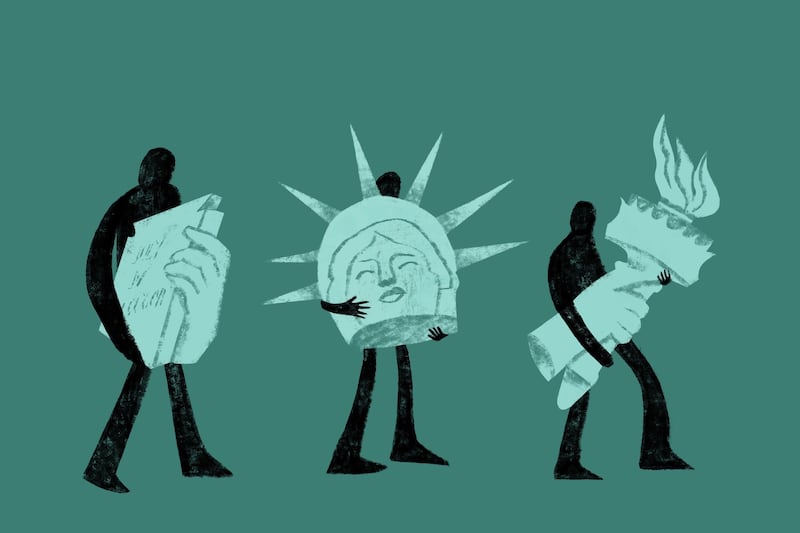

The New York Times hosted a podcast-style opinion piece on Wednesday, discussing a moral case for theft.
In the piece, titled “The Rich Don’t Play by the Rules. So Why Should I?” reporter Nadja Spiegelman spoke with political commentator Hasan Piker and journalist Jia Tolentino.
Piker, 34, has a more than 3.1 million following on Twitch, where he records a daily seven-hour show. Tolentino, 37, has written for a series of magazines, including Jezebel and The Hairpin. She currently writes for The New Yorker.
In the 35-minute interview, Piker and Tolentino debated when and from whom theft is morally acceptable.
What would and wouldn’t you feel fine stealing?
Spiegelman began by proposing a new term for stealing: “microlooting.” She defined it as a “phenomenon of people stealing small things from big corporations like Whole Foods.” The Free Press added onto the definition, Thursday. Microlooting is “a made-up word that just means committing theft but feeling good about it,” they wrote.
Then Spiegelman played a series of social media clips where grocery shoppers justified stealing from stores.
In one clip, a woman asked, “You’re going to pay for that, right?”
The man loaded up his crossover satchel with oranges. “No, babe, food is a human right,” he responded.
Then Spiegelman asked what Piker and Tolentino would feel comfortable stealing. They agreed that pirating music, television and media was acceptable, and stealing from Whole Foods was not a moral qualm.
Piker said he would steal a car if he could get away with it and if it was “as easy as pirating intellectual property.”
But the pair agreed they wouldn’t dine-and-dash, and they swore off stealing library books.
Would they steal from the Louvre? “Yes,” Piker said, and Tolentino agreed.
“I think it’s cool. We’ve got to get back to cool crimes like that: bank robberies, stealing priceless artifacts, things of that nature,” Piker explained. “I feel like that’s way cooler than the 7,000th new cryptocurrency scheme that people are engaging in.”
Tolentino described several occasions when she’d stolen groceries from Whole Foods. “I didn’t feel bad about it at all,” she said.
“I already felt like I was in the hole (morally), even by shopping there. And it certainly felt, in a utilitarian sense, I was like, this is not a big deal. Right, guys?” she said.
How would Piker and Tolentino change ethics around stealing?
When asked what he thought should be OK but currently isn’t, Piker said, “I.P. theft. Stealing movies, things like that.”
To answer the same question, Tolentino referenced the difficulty of teaching her young daughter about right and wrong.
“There are so many perfectly legal things I do regularly that I find mildly immoral,” she said. “Like getting iced coffee in a plastic cup. I find that to be a profoundly selfish, immoral, collectively destructive action.”
She continued, “I have taken so many planes for so many pleasure reasons; I have acted in so many selfish ways that are not only legal, but they’re sanctioned and they’re unbelievably valorized, culturally.”
Then she said she would make it OK to “blow up a pipeline, let’s say that.”
New York Times interviewer Spiegelman intervened here: “I can relate to what you were saying, Jia. It is so hard to live ethically in an unethical society.”
“There are so many moral compromises I make every day. I’m constantly acting in ways that don’t align with my belief system. And constantly having to justify that, like ordering in food when it’s raining out,” Spiegelman said.
What makes it OK to steal?
When asked what is currently morally acceptable but shouldn’t be, Piker said, “Extraction of surplus labor value.”
This phrase was coined by German philosopher Karl Marx in 1867. The idea is that under capitalism, workers sell their labor and don’t receive the full value they produce. Any surplus goes to the employer.
“Wage theft (the extraction of surplus labor value) is the most consequential amount of theft that takes place in the United States of America,” Piker said.
He continued, “If you steal from the poor, you become rich; if you steal from the wealthy, you go to prison.”
Piker said that the wage system in the U.S. amounts to a form of theft. Thus, taking a few items from Whole Foods is negligible, he explained.
As for what Tolentino believes shouldn’t be morally acceptable, she said private schools should be “mostly illegal,” and New York City should charge for street parking.
Luigi Mangione and whether Americans justify murder
Spiegelman referenced a poll from late 2024, which found that 41% of Gen Zers felt the murder of United Healthcare CEO Brian Thompson was morally justified. She asked Piker and Tolentino how they would “thread that line.”
“Friedrich Engels (co-author of the ‘Communist Manifesto’) wrote about the concept of social murder,” Piker responded. “And Brian Thompson, as the United Healthcare CEO, was engaging in a tremendous amount of social murder.”
He described the U.S. health care system as a “systematized form of violence” and said its consequence has been “tremendous amounts of pain, tremendous amounts of violence, tremendous amounts of death.”
After news broke of Thompson’s murder, Piker said, “I saw so many people immediately understand why this death had taken place.”
Tolentino then described health care CEOs as “merchants of social murder (and) structural violence upon people.”
However, she added, “I don’t think we’ve turned into a culture where murder is sanctioned. I think that we have turned into a culture where private health care is so profoundly immoral that people had a very particular reaction to Brian Thompson’s murder.”
Piker disagreed.
“I do think we are a profoundly violent culture,” he said. “In some ways, Charlie Kirk’s assassination was not unique. School shootings are happening all the time, and we have actually decided, almost collectively, that it’s just another byproduct of American existence.”
Tolentino then described how Thompson’s murder could have been an opportunity “for someone to just spike that ball over the other side” and push the country toward universal health care.
“I find that is one of the most egregious missed opportunities that we have seen in recent political history,” Tolentino said.
The internet responds
The Wall Street Journal published an opinion piece in response, describing The New York Times‘ piece as an attempt to “legitimize theft and excuse murder.”
“If there’s to be any silver lining in this story of an appalling surrender of editorial standards to the post-morality Marxist mob, perhaps it will motivate some liberal journalists to decide they’ve had enough of the idea that there is no such thing as too far left,” the Journal wrote.
American attorney Jill Filipovic similarly responded to the piece on X. “This whole interview just makes me incredibly sad. Total breakdown of any moral code / sense of personal integrity / commitment to the public good,” she wrote.
An economist and former member of the EU, Luis Garicano, added, “The NYT just gave three commentators a page to agree theft is fun and cool. One wants bank robberies back because crypto is boring. Another cheers on Louvre thieves (a public museum!) and steals on Whole Foods. Surprised the toothpaste is locked up?”
Praises of the piece were sparse; an editor at The New Inquiry, Malcolm Harris, wrote, “They handled themselves pretty well all things considered I thought.”