

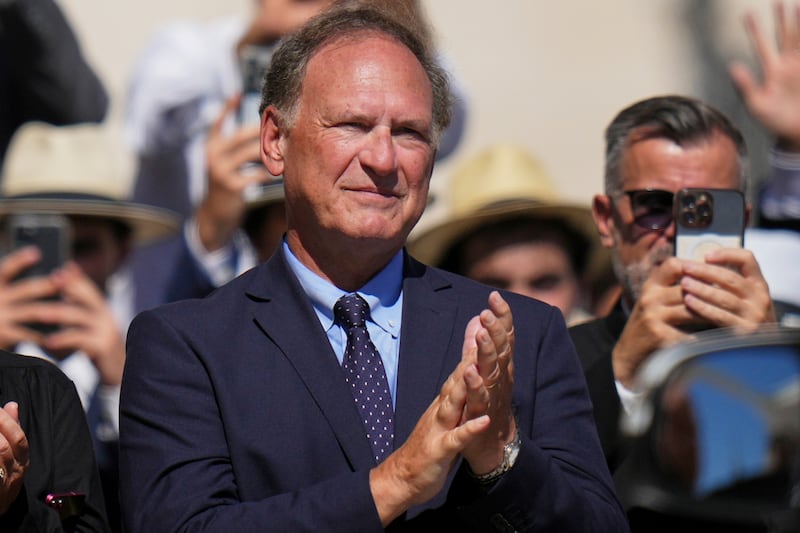

The U.S. Supreme Court issued a temporary stay Monday on a lower-court ruling that barred the ability to seek an abortion via a mailed prescription.
The order was signed by Justice Samuel Alito.
Statistics show that abortion numbers have continued to rise since the 2022 overturning of Roe V. Wade, and despite 28 states restricting access to abortion, chemical abortions administered via telehealth in pill form have only expanded access.
The Society of Family Planning’s #WeCount Study reported over half a million abortions — both in-person procedural and pill medication and telehealth mailed medication — from January to June of 2025. In 2022, the national average for monthly abortions was 80,000. In the first half of 2025, it was 99,000, per the report.
There are currently 13 states with a complete abortion ban at all stages of pregnancy.
Makers of the abortion drug Mifeprex, better known as mifepristone, came to the Supreme Court on Saturday after a three-judge panel for the 5th U.S. Circuit Court of Appeals unanimously ruled that prescriptions could only be given in person. The companies, Danco Laboratories and GenBioPro, called the lower court ruling “unprecedented,” per SCOTUSblog.
Louisiana Attorney General Liz Murrill posted on X following Alito’s stay:
The 5th Circuit judges concluded that telehealth-administered abortions disregard certain states, like Louisiana, in this case, specifically, that have abortion laws in place. In-person visits were a previous requirement of the Food and Drug Administration, but were dismissed in 2021 during COVID-19.
“Every abortion facilitated by FDA’s action cancels Louisiana’s ban on medical abortions and undermines its policy that ‘every unborn child is human being from the moment of conception and is, therefore, a legal person,’” the lower court’s ruling said.
The judges also found that Louisiana had a legitimate case due to the fact that it had paid $92,000 in “Medicaid costs from two women who needed emergency care in 2025 from complications caused by out-of-state mifepristone. Such costs will almost certainly continue because nearly 1,000 women monthly — many of whom are on Medicaid — have mifepristone-induced abortions in Louisiana.” Allowing online abortion prescriptions via telehealth “injures Louisiana by undermining its laws protecting unborn human life and also by causing it to spend Medicaid funds on emergency care for women harmed by mifepristone.”
Alito’s order will only hold up until 5 p.m. on May 11, giving time to the justices to decide if they will accept the drug company’s request to take up the case. His order also gave a response deadline to the FDA and the state of Louisiana for the evening of May 7.