

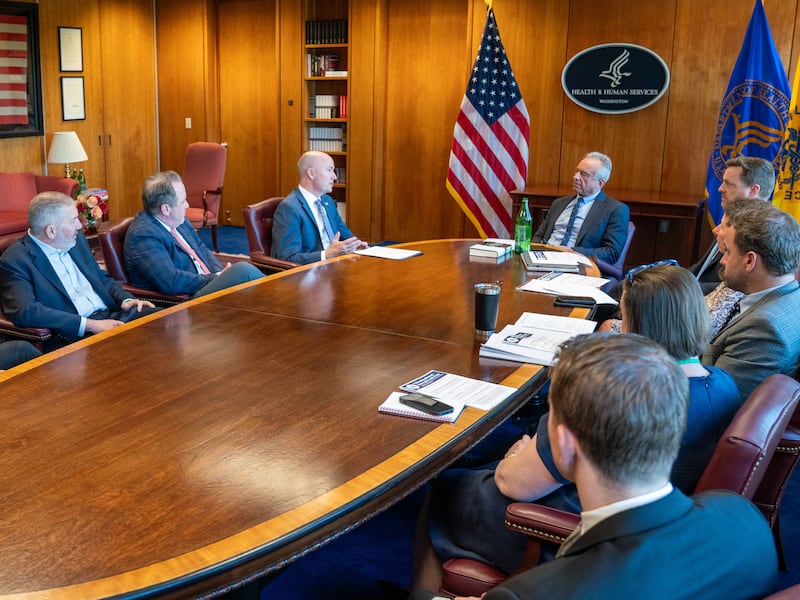

- Utah Gov. Spencer Cox met with Health and Human Services Secretary Robert F. Kennedy Jr. on Monday.
- They discussed Utah's slate of "MAHA" legislation and how the state is leading out in medical innovation.
- Utah has banned fluoride from public drinking water, soda for SNAP benefits and dyes in school foods.
President Donald Trump’s top healthcare officials met with Utah Gov. Spencer Cox on Monday to congratulate the state for leading on policies to “Make America Healthy Again.”
Health and Human Services Secretary Robert F. Kennedy Jr. praised Utah’s action on “MAHA priorities,” like becoming the first state to ban fluoride in public drinking water.
“Utah is setting the standard for the nation,” Kennedy told the Deseret News in a statement. “This is the kind of leadership that will Make America Healthy Again.”
As Trump’s MAGA coalition has expanded to include Kennedy’s skepticism about whether Big Pharma, Big Tech and Big Food prioritize Americans’ health, Utah has found itself at the forefront of a Republican policy shift.
During the meeting, Kennedy and his chief counselor, Utahn Chris Klomp — who oversees all HHS operations — highlighted several Utah laws that were passed in the 2025 and 2026 legislative sessions.
In 2025, lawmakers banned fluoride in water while making it easier for pharmacists to prescribe, prohibited SNAP benefits being used on soda and removed synthetic dyes in school foods.

In 2026, lawmakers passed bills to make raw milk easier to buy, banned cellphones in public schools during classroom hours and limited educational technologies being used in younger grades.
Proposals to further restrict school food ingredients and to block SNAP purchases for “ultra-processed foods” were viewed favorably by the Republican majority but held for technical reasons.
“We wanted to express our gratitude to the state of Utah for the tremendous support on those dimensions, all aligned with President Trump’s MAHA agenda,” Klomp told the Deseret News.
Before he was asked to manage the nation’s healthcare system, Klomp, who also serves as the director of the Centers for Medicare and Medicaid Services, was a Utah-based entrepreneur.
The Brigham Young University alumnus founded Collective Medical in 2014 to enable hospital data sharing to eliminate wasteful spending in Emergency Departments. He sold it in 2020 for $650 million.
In an interview with the Deseret News on Monday, Klomp said the meeting between Cox and Kennedy, which he attended, was focused on how Utah’s innovation-friendly environment can help the nation.
They discussed One Utah Health Collaborative, which aims to make healthcare more cost-efficient; Utah’s AI sandbox model, encouraging smart regulations; and its world-class AI drug discovery industry.
During the 45-minute conversation, Kennedy also brought up the Great Salt Lake, which could have an impact on Utahns’ health if falling water levels expose toxic dust on the lake bed, according to Klomp.
Kennedy’s background is in water conservation litigation. He asked Cox how the Trump administration can help with environmental sustainability after Trump earmarked $1 billion for the lake, Klomp said.
Utah Republicans embrace MAHA
In a statement to the Deseret News, Cox expressed appreciation for the meeting, which he said was focused on medical innovation, rural healthcare access and artificial intelligence applications.
“We look forward to continuing to work with the administration to advance commonsense solutions that improve affordability, increase transparency, and ensure patients benefit from the next generation of medical breakthroughs,” Cox said.
Utah House Speaker Mike Schultz, R-Hooper, shepherded most of Utah’s “MAHA” legislation across the finish line. In an interview with the Deseret News, he said it is just another area where Utah leads.
“But really I don’t think we can just stop there,” Schultz said. “This is where we’re going to be laser-focused moving into the future: part of the MAHA movement is getting food sourced more locally.”
The next subject for MAHA legislators is food supply, according to Schultz, who said he is working with the Trump administration on policies to support locally grown food through local food processing grants.
But the whole state is not on board with Utah’s MAHA turn.
House Minority Whip Jennifer Dailey-Provost, D-Salt Lake City, who holds a Ph.D. in public health, told the Deseret News in a statement that she worries not all MAHA initiatives serve to improve public health.
“We have to be honest about the full picture,” Dailey-Provost said. “Some of the policies associated with the so-called ‘MAHA agenda’ have not yet demonstrated clear benefits for Utahns and, in some cases, risk undermining public health.”
The outbreak of measles in Utah — which recently hit 428 new cases this year — is by far the largest in the nation, representing nearly a quarter of the total, despite Utahns making up just over 1% of the nation.
Of the 638 Utahns who tested positive for measles in 2025 and 2026, 540, or 85%, were not vaccinated, 35 had unknown vaccination status and 63 were vaccinated, according to the Utah Measles Dashboard.
Part of the MAHA movement revolves around vaccine hesitancy, stemming in many cases from the unique circumstances surrounding the COVID-19 vaccine, but often extending to all vaccines.
Kennedy has been a leading voice in seeding doubt about vaccine effectiveness and side effects. However, the Trump administration has recently taken steps to sideline this portion of Kennedy’s agenda.
On Monday, Reuters reported that the White House had encouraged Kennedy to retreat from his controversial campaign to change the government vaccine recommendations for children.
Last week, Trump announced his next nomination for surgeon general will be Nicole Saphier, a radiologist who has publicly supported vaccines and has criticized Kennedy’s changes to the vaccine schedule.