

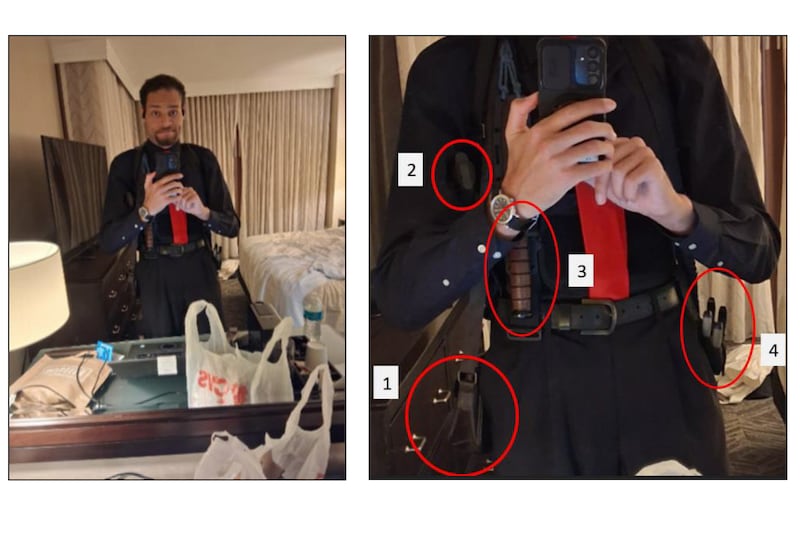

Cole Allen, the man accused of targeting President Donald Trump and other administration officials at the White House Correspondents’ Association dinner last month, pleaded not guilty on Monday to all charges against him.
Allen, 31, was indicted by a grand jury on several charges, including attempting to assassinate the president. His defense attorneys objected to his jail conditions, including the suicide-prevention measures that they said limited his ability to participate with his defense team.
On Monday, Allen’s legal team asked the court to disqualify U.S. Attorney Jeanine Pirro and acting Attorney General Todd Blanche from the case since they both were at the event where the shooting took place.
In court on Monday, Eugene Ohm, a public defender representing Allen, said the team would need more information concerning whether Pirro and Blanche would argue that they were also victims of Allen’s actions and if so, it would be “wholly inappropriate” for them to lead the prosecution, CBS News reported.
Monday, District Court Judge Trevor N. McFadden directed the Justice Department to respond to the defense’s motion by June 22 and Allen’s legal team will then have five days to respond.
A federal magistrate judge, Zia Faruqui, apologized to Allen as he raised concerns about how he was being treated in jail, including being repeatedly strip-searched and kept in isolation. Allen was reportedly being held in a “safe cell,” or a highly restrictive cell that limits communication with others and is constantly monitored.
Pirro criticized Faruqui for apologizing to Allen, saying online that the judge believes a defendant “armed to the teeth and attempting to assassinate the president” is entitled to “preferential treatment.”
Allen’s public defenders informed the judge in his initial hearing that he would not be seeking to challenge the government’s action to keep him detained before trial, but could reserve the right to request release at a later date.
Allen, who is from California, has been charged with attempted assassination of the president, which carries a maximum sentence of life in prison. He was also charged with transportation of a firearm and ammunition in interstate commerce with the intent to commit a felony. The government alleged Allen left his home near Los Angeles and traveled to Chicago and then to Washington, D.C., via train.
He checked into the Washington Hilton hotel, where the event is held annually, the day before the dinner. On Saturday evening, shortly after the event began, Allen stormed past a security checkpoint and exchanged fire with Secret Service agents, according to the charging documents.
One agent was shot in the chest but was recovering well thanks to a bulletproof vest, per the documents.
According to a manifesto sent to Allen’s family members, the man allegedly said he was mainly targeting administration officials, but was willing to “go through most everyone” at the event to get to them.
It’s a point the government is leaning on in its argument, noting that had Allen been successful in breaching security, he could have killed many people, but he could also have “destabilized” the entire federal government since several top administration officials were in attendance.
Security at the event has been scrutinized and Trump pointed to the need for the White House ballroom to be built to host events like these. The administration is also examining its security protocols for high-profile events going forward since so many in the line of succession were at the dinner.