

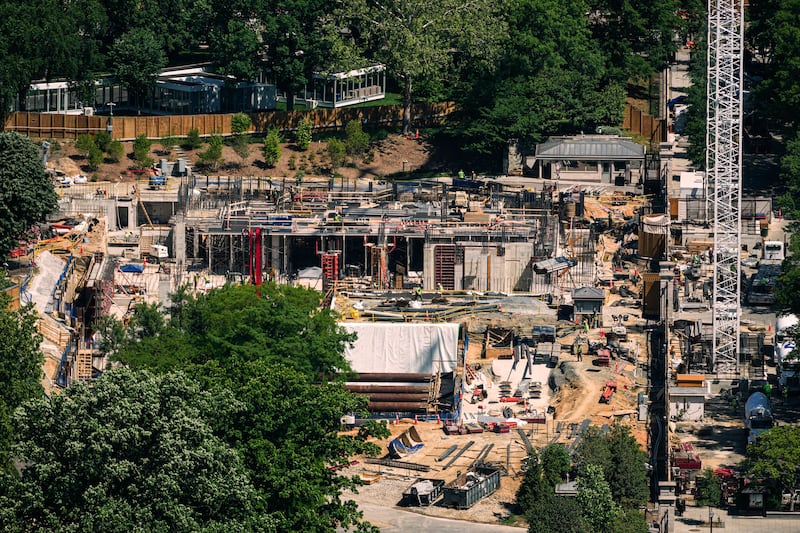

A number of Senate Republicans remain skeptical about the $1 billion requested by the Secret Service for security adjustments to the East Wing Modernization Project, the ongoing construction of the White House ballroom to establish a secure event space.
Senators met with Secret Service Director Sean Curran on Tuesday to discuss the budgetary request, with some Republicans emerging with unanswered questions about the scope of the project. Most questions are related to the price tag — and the justification for such a high sticker price.
“I don’t have the details I need to support it,” Utah Sen. John Curtis said walking into the meeting. “If you’re asking me for a billion dollars, I have some really hard questions. If I were a businessman and an employee came and said, ‘I have a project and it’s a billion dollars,’ I’d say, ‘You made that number up. Where did the number come from?’ I want to see data if it’s really for extra security.”
Curtis acknowledged the project does warrant some security measures, particularly after the assassination attempt against President Donald Trump at last month’s White House Correspondents’ Dinner. However, the Utah senator said he would need a detailed explanation of where the funds are going.
“I think we all know from that event, we cannot afford an event that would put our president or our leaders in jeopardy,” Curtis said. “So I’m receptive to that conversation, but I want to know specifically what they are requesting, and why, and how it will help the situation. I’m very, very worried about the debt and a billion here and a billion there makes a difference.”
Curtis said after the meeting he still needs more specifics from the White House.
The proposed ballroom security adjustments are part of the larger $72 billion package for federal immigration enforcement. However, that line in particular has raised eyebrows about whether it’s related to the underlying spending bill — and whether it walks back promises from the president last year that the ballroom would be paid for with private donations.
“I think part of what we have to do is be clear on what the $1 billion is for,” Sen. Thom Tillis, R-N.C., said on Tuesday. “Because otherwise, it just looks like a billion dollars going into something that we all thought was going to cost around $400 million that was paid for by private contributions.”
Senate Majority Leader John Thune, R-S.D., sought to ease concerns by clarifying that only 20% of the money would go toward the East Wing Modernization Project, and that the rest would cover “other Secret Service priorities.” Those priorities would include training for Secret Service agents, technology updates, visitor screening, and more.
“Most of it’s going to be used for other purposes,” Thune said. “Obviously we had a lot of questions that were asked by our colleagues, just to get the details and precision as much as possible about how dollars are going to be used. And I think the director did a very good job of laying it out and developing the case for why these resources need to be used to update, modernize and make sure the Secret Service is capable of doing its job.”
But the money is not a done deal yet. The budgetary line will first need to survive a decision from the Senate parliamentarian, who rules what provisions comply with the strict rules of the reconciliation process.
That procedure, which allows senators to avoid the 60-vote filibuster, requires the legislation to advance budget-related legislation such as taxes, spending and the debt limit. If it does not adhere to those rules, it must go through regular consideration.
The Senate parliamentarian is going through the language with senators this week.
Even then, Republicans will need to make sure they are in near-unanimity to get the provision across the finish line. Thune can only afford to lose four Senate Republicans if the provision comes up for an amendment vote — and some senators, including Curtis, are not yet sold.
“Obviously, there have been three or four attempts on the president’s life, and that’s extremely serious, and we’re in a heightened era of political violence,” Sen. Susan Collins, R-Maine, said on Monday. “But the ballroom itself should be paid for by private donations, as the president had indicated.”