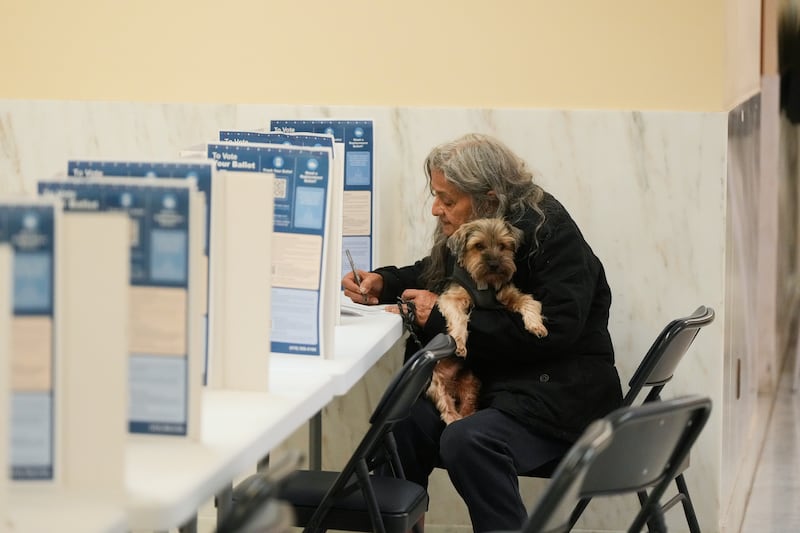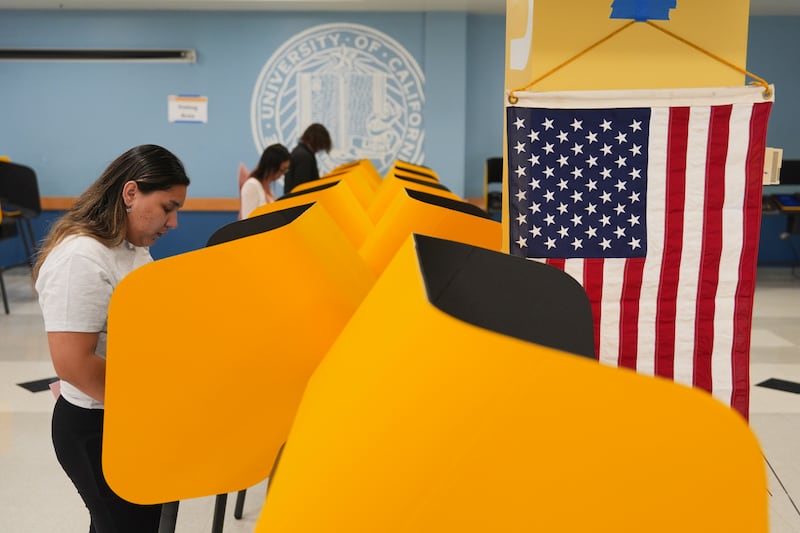

Early results so far show that California’s Democrats found success through their redistricting efforts, meant to help the party gain five seats.
The Golden State’s “jungle primary system” allows two candidates with the most votes to advance to the general election regardless of their party affiliation, so Republicans are already feeling the effects of redistricting after the primary election on June 2.
For Republicans, “Prop 50 was pretty detrimental,” said Victor Lopez, the co-founder and managing partner at Imperio Chaos, a New York-based PR firm. “It did do damage to the landscape for this competitive congressional seat.”
Conservative-leaning places in the state like San Diego are “on the verge of potentially losing all congressional seats to Democrats within the county.”
“Republicans this cycle are in huge trouble in California,” said Lopez.
California’s historically conservative regions, like San Diego and Orange County, have become more purple in recent years.
“Being a Republican in California is worse now than it was in 2020 and 2024, when they got wiped out significantly,” said Lopez. At the time, he witnessed a campaign “slap a Trump picture or logo” on their campaign and “lose significantly” for that.
“Registration is king,” Lopez said. California is home to about 10 million registered Democratic voters and 5.8 million Republican voters. Independents also make up a large chunk of the electorate with 5.23 million voters.
“We’re starting to have more names shift toward running as independents rather than Republican candidates, just because of the baggage that’s affiliated with that, and more importantly, because of the registration going against it.”
Republicans are doing what they can to close the gap.
U.S. Rep. Kevin Kiley, who represents California’s 3rd Congressional District, switched his party affiliation from Republican to independent. “Partisanship has absolutely run amok,” he told CBS News.
This isn’t a one-off.
Los Angeles mayoral candidate Spencer Pratt also ran as an independent despite being a registered Republican. He ended up losing out to two Democratic candidates.
Richard Bailey opted to reregister as an Independent when he launched his bid for San Diego City Council earlier this year. Bailey also moved away from his party-line issues and is more focused on quality-of-life problems in his city, like Pratt.
“Californians are still … fiscally conservative. People don’t want rising costs,” said Lopez. But they care about social issues, with three in four adults disapproving of the U.S. Immigration and Customs Enforcement’s deportation policies.
Here is a look at five races that were impacted by redistricting.
District 1
Republican state Rep. James Gallagher won the special election for the 1st Congressional District with 62% of the vote. He will fill the seat left vacant by Republican Doug LaMalfa, who died earlier this year.

As NBC News reported, this special election used the map in effect during 2024 that led to President Donald Trump winning by 25% of the vote and LaMalfa winning by 30%.
When Gallagher runs again in November, he will face the impact of the newly drawn map. He acknowledged this in a statement following the results, saying he “will be running in a new district, drawn not by an independent citizens commission, but in a backroom by my opponent Mike McGuire and other Sacramento politicians.”
District 3 and District 6
Republican Kevin Kiley, who represents California’s 3rd Congressional District, not only changed his party affiliation to independent, he also decided not to run for reelection for his district after the passage of Prop 50. Instead, he ran for the 6th Congressional District, which is Democratic-leaning.
Kiley advanced to the runoff election in November against Richard Pan, a Democrat and a former California state senator.
As for the 3rd District, rated “solidly Democratic” by the Cook Political Report, Ami Bera, a seven-term Democratic incumbent, and Robb Tucker, a local business owner, advanced to the runoff.
District 22
College professor Randy Villegas, a progressive backed by Sen. Bernie Sanders, advanced to the runoff. He will face incumbent Rep. David Valadao, a Republican, in November.
If Valadao wins in November, he will be the last House Republican remaining in the House who voted to impeach Trump in 2021 over Jan. 6. This race is a toss-up according to the Cook Political Report.
District 40 and 41
Because of the limited opportunities for the GOP in California, the race for the 40th District, which includes parts of Los Angeles County and Orange County, attracted two elected Republicans vying for the same seat.
Rep. Ken Calvert decided to run for the 40th Congressional District after the district he currently represents was gerrymandered to be more Democratic.
He is up against Rep. Young Kim, another Republican who currently represents a part of the newly drawn 40th Congressional District.
District 48
San Diego County Supervisor Jim Desmond, a Republican and Trump-endorsed, and San Diego City Councilmember Marni von Wilpert, a Democrat, have advanced to the runoff election. This race has been added to the Democratic Congressional Campaign Committee’s Red to Blue program, focused on flipping Republican seats this year.