

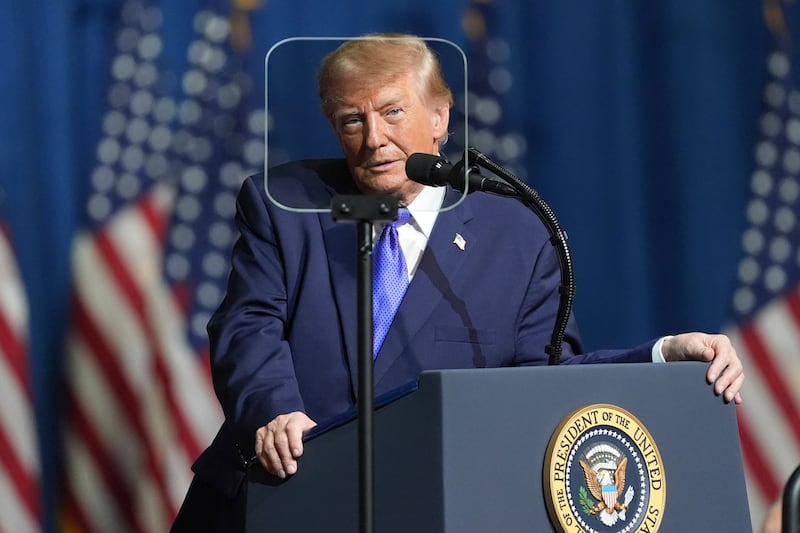
- President Donald Trump announced Wednesday that imported robotics and industrial machinery pose a threat to U.S. national security, citing concerns about foreign dependence, cybersecurity and military production.
- U.S. reliance on foreign machinery presents a national security dilemma, as restricting imports could disrupt defense manufacturing in the short term while continued dependence could leave the military vulnerable in the long term.
- Rather than immediately imposing tariffs, Trump directed federal officials to negotiate with foreign trading partners and report on their progress within 180 days.
The machines that help keep America’s military running could also be one of its vulnerabilities, according to the president.
President Donald Trump said Wednesday that imported robotics and industrial machinery threaten U.S. national security, citing concerns about foreign dependence, cybersecurity and military production. Rather than immediately imposing tariffs, Trump ordered trade negotiations aimed at addressing those risks, with a progress report due in 180 days.
The move comes as the United States faces a difficult balancing act: reducing potential foreign influence over critical machinery while ensuring American defense manufacturers can still obtain the equipment they need.
A new national security concern
In a proclamation issued Wednesday, Trump agreed with the findings of a Commerce Department investigation that raised concerns about U.S. reliance on foreign suppliers for most types of robots and industrial machinery.
The investigation, which began in early September 2025, examined how that dependence could threaten the nation’s industrial base, long-term competitiveness and national security.
The Commerce Department presented its findings to the president within the past 90 days, concluding that the volume and circumstances of these imports pose a threat to U.S. national security.
“Based on the facts considered in that investigation ... robotics, industrial machinery, and their components are being imported into the United States in such quantities and under such circumstances as to threaten or impair the national security of the United States,” Trump said in the proclamation.
From potential cyberattacks and foreign surveillance to disruptions in military production, the White House says America’s reliance on imported robotics and industrial machinery could give foreign adversaries opportunities to interfere with systems critical to U.S. national security.
Instead of imposing immediate tariffs on imported robotics and machinery, Trump directed Commerce and the trade representative to “jointly pursue negotiations of agreements or continue any current negotiations” with whichever trading partners they consider appropriate.
The proclamation is the legal basis for future tariffs or quotas if the talks don’t produce results.
The machines behind America’s military
“Robotics and industrial machinery” refers to the tools used to build America’s military. This includes computer-controlled cutting and milling machines, welding robots, grinders and heavy presses.
The proclamation calls this equipment essential for making aircraft, ships, missiles and munitions. They shape, join and finish the metal parts that go into jets, missile bodies, ship hulls and artillery shells.
A fighter jet or destroyer, for example, can’t be built without this equipment, yet much of it is imported.
U.S. factories also run on machines, and the Trump administration says the country can’t build enough of them. Commerce Secretary Howard Lutnick concluded that U.S. manufacturers don’t produce enough robots, industrial machinery and parts to meet the nation’s economic and security needs, and demand is only projected to grow. This has created what the proclamation calls a reliance on foreign imports to close the gap.
The national security catch
The administration’s own findings create a problem. While the Trump administration warns that reliance on imported robotics could leave the nation’s defense industry vulnerable, restricting those imports could disrupt the very same defense contractors and industrial buildup that the policy is meant to protect.
The U.S. currently relies on foreign suppliers for critical machinery, and domestic manufacturers do not have the capacity to immediately replace it.
If imports become more expensive or difficult to obtain before American production catches up, defense manufacturers could face delays in producing weapons, aircraft and other military equipment, leaving the U.S. more vulnerable in the short-term.
This could explain why Trump chose negotiations and a possible investment program for now instead of immediate tariffs.
In the long term, continuing to rely heavily on foreign machinery carries its own national security risks. If the United States enters a military conflict, foreign governments could restrict exports or disrupt access to the equipment and parts that American manufacturers need.
This dependence could leave the military vulnerable at a time when weapons production is especially critical. Expanding domestic manufacturing could help reduce those risks, but building that capacity would take time and investment.
For now, the 180-day deadline gives officials roughly six months to pursue agreements before reporting back to the president. From there, Trump could consider additional measures such as tariffs or other import restrictions.