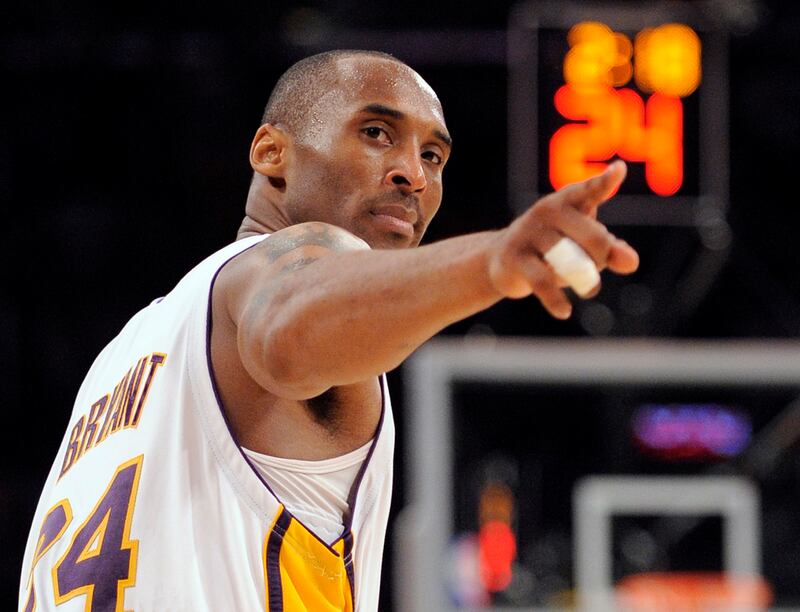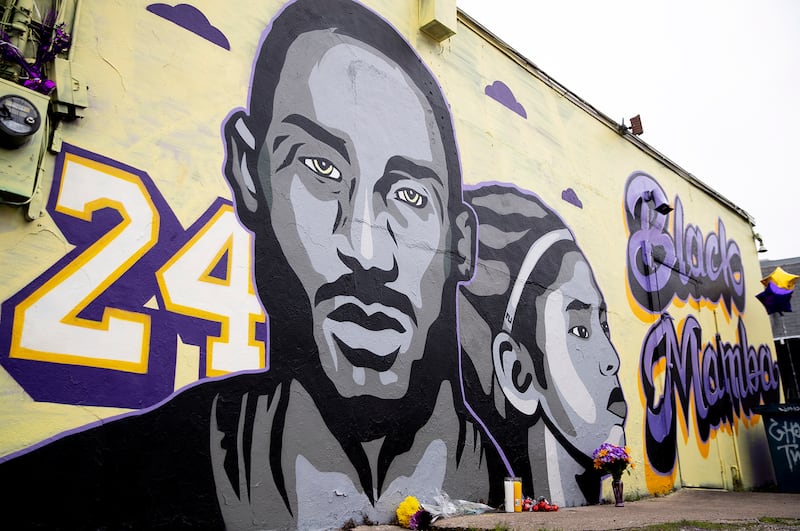

SALT LAKE CITY — At the end of the day, Kobe Bryant was a basketball player, at least for the vast majority of people, yet somehow his premature death has sent the country — even the world — into deep mourning. That says as much about us as him.
Kobe Bryant was little more than a well-known stranger, as James Taylor once described his own celebrity in song, yet people grieved his death as if they lost a close friend or someone they knew.
Jimmy Fallon did a bit on him during the “Tonight Show.” Fans across the country built shrines at the local NBA arena. In Boston — home of the Lakers’ dreaded rival Celtics — a towering building was lit in Laker purple and gold, as was the Empire State Building. Fans petitioned the NBA to change the NBA logo from the Jerry West silhouette to Kobe Bryant.
NBA players started their games by taking intentional 24-second shot-clock violations and 8-second backcourt violations in honor of the two jersey numbers Bryant wore. It was reported that his loss cast a pall over the opening day of the Super Bowl festivities. NBA players took seemingly opposite paths to honor Bryant. Some abandoned their usual number to wear Bryant’s number, while others who normally wear No. 8 or No. 24 said they will wear them no more. The Pistons wore No. 8 and No. 24 jerseys in warmups. No one will ever wear those numbers for the Lakers. Bryant became the first player ever to have two jerseys retired by the same team.
Across the world, Bryant was honored as if he were a head of state. President Obama weighed in on his passing. There is an official weeklong mourning period in Italy, where Bryant lived for seven years while his father played for Italian basketball teams. The Chinese honored him on the internet with photos and well-wishes. Israeli Prime Minister Benjamin Netanyahu posted his regrets on Twitter, as did France’s sports minister, Roxana Maracineanu.
Australia’s Nick Kyrgios showed up for his match in the Australian Open wearing a Bryant jersey, and during an on-court interview his opponent, Rafael Nadal, wiped away tears and donned a Lakers hat. Last Sunday Portuguese soccer star Cristiano Ronaldo posted a tribute to his 82 million followers on Twitter, and by Monday morning it had been retweeted almost 100,000 times.
It was a remarkable display of affection for Bryant. His transformation from basketball star and sometime villain to beloved icon was complete — one that was well underway before his life was cut short.
He was not always embraced by the public, especially outside L.A., where he played his entire 20-year career. He was flawed off and, yes, even on the court. He finished his career as the third-leading scorer in NBA history, but he scored a lot of points because he took a lot of shots. He missed more shots than anyone in history — 14,481 of them to be exact, more than 1,000 more than anyone else. He was perhaps the most physically gifted player ever (or tied with Michael Jordan), but he was also selfish on the court and tended to take bad, low-percentage shots.
Like most driven, highly successful people, he could be surly and hard on teammates. In his playing days he carried a Tiger Woods-like edgy persona. He called himself “Black Mamba,” and later revealed that he borrowed the nickname from the movie “Kill Bill,” in which an assassin uses a black mamba snake to murder a man. “The length, the snake, the bite, the strike, the temperament,” Bryant said in a 2018 Washington Post interview. “ I looked it up — yeah, that’s me. That’s me!’”
“Kobe wasn’t the most dominant player of his generation (Shaquille O’Neal) or the most consistently successful (Tim Duncan) or even the coolest (Allen Iverson). But of all his peers, he turned winning into his brand, even when he wasn’t winning all that much.” — Jeremy Long
So Bryant was all of those things. Writer Jeremy Long got it right when he wrote in The Outline, “Kobe wasn’t the most dominant player of his generation (Shaquille O’Neal) or the most consistently successful (Tim Duncan) or even the coolest (Allen Iverson). But of all his peers, he turned winning into his brand, even when he wasn’t winning all that much.”
Bryant was a hard-working, aggressive force of nature when it came to the game (and, we later found out, anything else he put his mind to).
And then there was the darker stuff off the court, specifically the infamous rape case in Colorado, which made him public enemy No. 1 for a time. The woman refused to testify and charges were dismissed (and a settlement paid), but after hearing months of testimony, Bryant made a remarkable admission: “Although I truly believe this encounter between us was consensual, I recognize now that she did not and does not view this incident the same way I did. After months of reviewing discovery, listening to her attorney, and even her testimony in person, I now understand how she feels that she did not consent to this encounter.”
Maybe his struggles shouldn’t have been so shocking. Bryant entered the league at 18 years old and his prodigy came with a price; he had to grow up on the fly in a man’s world with millions of dollars and temptations at his disposal. Others in that situation failed where he eventually matured and thrived.
There is a long, distinguished list of athletes who died too young and caused the public to pause. Roberto Clemente, Joe Delaney and Pat Tillman died heroically — Clemente while flying supplies to earthquake victims in Central America; Delaney while trying to save three drowning children in a pond even though he couldn’t swim; and Tillman while fighting in the Middle East after giving up football and millions of dollars.
Steve Prefontaine was cut down just as he was going to become the greatest distance runner in the world. Payne Stewart, Thurman Munson and Clemente died in air crashes (and now Bryant), and Drazen Petrovic and Dale Earnhardt died in car accidents, the latter during a professional race. Closer to home, Utah State’s Wayne Estes, just months before the Lakers planned to make him their first pick, died at the scene of an auto accident. Ernie Davis and Lou Gehrig died of disease and Hank Gathers and Reggie Lewis collapsed and died on the basketball court with heart problems. Andre the Giant died for the same reason, in his sleep. Len Bias and Ken Caminiti died of drug overdoses.
The death of these elite athletes is always shocking, as if their feats on the field had led fans to believe they were above things that took down the rest of us — illness, auto wrecks, drowning. So they were mortal after all. Tyrann Mathieu, the Kansas City Chiefs’ strong safety, wrote, “You know, it’s unimaginable. I thought that guys like (Bryant) would live forever.”
Bryant’s death seems to have reached further into the world’s collective pathos like no other, at least since perhaps Tillman, and then Clemente and Gehrig before that, but it might have even exceeded those. His death was jarring, especially for the generation that grew up with him. It cut a hole out of the culture. It leaves a void. He never got the chance to grow into the role of senior statesman a la Bill Russell and Jordan.

Many were saddened that Bryant, who was 41, perished just as he was hitting his stride as a man. By many accounts, he had become a dedicated father, one who coached his daughter’s AAU team, and the rough edges had been worn off. He warmed up to people and reached out to help many, especially young, aspiring players. He was no longer the cold-blooded assassin, the Black Mamba. He was involved in philanthropy. He was a savvy investor and businessman. He wrote a series of children’s books. He produced an animated movie, “Dear Basketball,” which earned Bryant an Academy Award in 2018.
He stayed above the fray that follows the NBA — for one thing, he refused to be drawn into the silly GOAT talk that obsesses LeBron James and the media; he did not care. He wanted to move beyond basketball. It was old news for him. He was pursuing other things with the same passion he brought to the game, rising before dawn just as he once did for his morning basketball workouts. He said he wanted to do more off the court in his post-basketball career than he did as a player.
Bryant was maturing nicely and now he’s gone. He, and we, never got a chance to see where he could take it.