
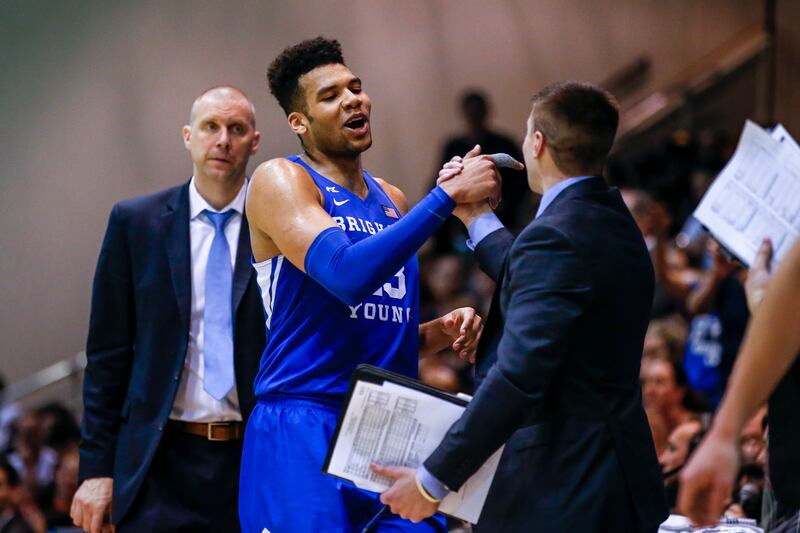

LAS VEGAS — It took mere months for Mark Pope to get BYU into the NCAA Tournament. Now, can he fix BYU’s very average traditional success at league tournaments?
And, does it matter?
No. 2 seed BYU will take on No. 3 seed Saint Mary’s Monday night in the West Coast Conference semifinals in the Orleans Arena. The Cougars are already a lock to play in the NCAA Tournament for the first time in five years and some bracketologists have 24-7 BYU as high as a No. 5 seed.
“Pope has the elements a team needs in postseason tournament play. He has the guards in all-league performers Jake Toolson and TJ Haws, and he has the scoring big in Yoeli Childs.” — Dick Harmon
So, what’s all this about Monday?
It is about sustained momentum, keeping a nine-game win streak alive, and climbing to a possible No. 4 or 3 seed with a tournament championship. It is about confirming that Pope and his team remain on fire.
It is also about doing something the Cougars have really struggled with in these postseason league events the past two decades, be it the WCC, Mountain West or WAC.
Last year here in the Orleans, BYU showed up and was quickly embarrassed by the University of San Diego. BYU fell behind by 40 points faster than fans settled into their seats with candy boxes. It was a humiliating defeat to a team the Cougars had defeated twice during the regular season. The loss left the program reeling, like victims blinking in the corner.
The WCC Tournament has been a unique challenge because Gonzaga owns it.
The Zags routinely come to this event as a top-10, if not top-5 ranked team loaded with lottery picks and simply gobble up foes.
Zag fans buy cheap fellow WCC member season tickets so they have a priority seating for the tournament, a trick that makes this event a significant home-court advantage. Gonzaga has no football team; this is their bowl game and they play like it.
Since joining the WCC in 2011-12, BYU has a 9-8 tournament record — that’s about breaking even. The Cougars were hindered big-time in 2014 when Kyle Collinsworth suffered an ACL tear here at the Orleans in the championship game against the Zags.
In the Mountain West, an event Utah State just won back-to-back, the Cougars had a 15-11 record, much of that work led by Steve Cleveland and Dave Rose. The one and only MWC basketball tournament championship won by the Cougars was in 2001 with Cleveland at the helm. A strong Jimmer Fredette team had a chance in 2011 before Brandon Davies was suspended and the Cougars struggled against San Diego State in the championship at the Thomas & Mack Center after beating New Mexico with a record-breaking 52-point scoring night from Fredette in the semifinals.
In the WAC, the Cougars had a losing record at the league championship event at 12-13 but Roger Reid did something no other BYU coach has ever done — he coached two tournament championship teams to the title in 1991 and 1992. Those teams had talent with ties to this current team in Kevin Nixon.
What was it about those Reid teams that worked?
Well, these BYU squads were very deliberate on offense with a premium on executing set plays. They had great out-of-bounds sets and played with bigs inside and shooters on the outside. And they played defense. Reid is one of the only coaches to have a winning record over Rick Majerus, who had a similar philosophy.
Key players on those teams in back-to-back seasons included combos of Shawn Bradley, Ken Roberts, Nixon, Russell Larsen, Steve Schreiner, Jared Miller, Gary Trost and Shane Knight in the paint, with Nathan Call, Mark Heslop and Nick Sanderson on the outside.
Postseason tournament play is all about getting easy buckets with an inside power game and the best way for that to happen is with screens, picks, motion, rebounding and elite passers.
But the biggest key is guard play. When you get to this stage, teams with outstanding guard play usually go far. They tend to take over games and make big plays with the shot clock winding down, or in crunch time. The 3-point play has become the dagger tool in tournament games. Ask Utah State, Saint Mary’s and Pepperdine after Saturday’s thrilling games.
In the Orleans Arena Saturday night, SMC’s Jordan Ford’s twisting fall-away 3-pointer prevented a third overtime against Pepperdine, who had guard Colbey Ross go off for 43 points. Ford had 42. In USU’s upset of San Diego State and throughout the week of the MWC affair, Sam Merrill ruled supreme. Those guards took over the games.

Pope has the elements a team needs in postseason tournament play. He has the guards in all-league performers Jake Toolson and TJ Haws, and he has the scoring big in Yoeli Childs, fresh off a career-high 38 points and 14 rebounds, albeit more than a week ago.
SMC and Gonzaga both deploy the same keys to the puzzle, which make both very dangerous.
The Gaels will likely double-team Childs and force BYU’s guards to make buckets from the outside and adjust if they do. SMC coach Randy Bennett will try to take Haws out of the game by applying pressure, even trapping him like he tried to do with Ross.
The Gaels were able to have a shoot-around and walk-through team exercise Sunday. BYU, by school policy, may have met as a team in a meeting, but did not practice or shoot Sunday.
If anything, Monday’s rematch between Pope and Bennett will be a chess match, just like we saw back in the day with Reid and Majerus.
If Pope pulls off one or two wins here, what he would have accomplished in his first year would not only be remarkable, it would be historic.