


SALT LAKE CITY — To get your jersey number retired by your university or sports franchise is a big deal. It means you were an all-time great for the team you played for and usually means no one else can ever wear your particular number. You are immortalized by having your jersey number hanging from the rafters of your team’s arena or stadium.
Major League Baseball has retired 221 numbers followed closely by the NBA with 219 players or administrators, while the NFL has had 156. Thousands of college basketball players have had their numbers retired, although the practice isn’t as common in college football (with as many as 100 players on a team, it’s hard to put away too many numbers).
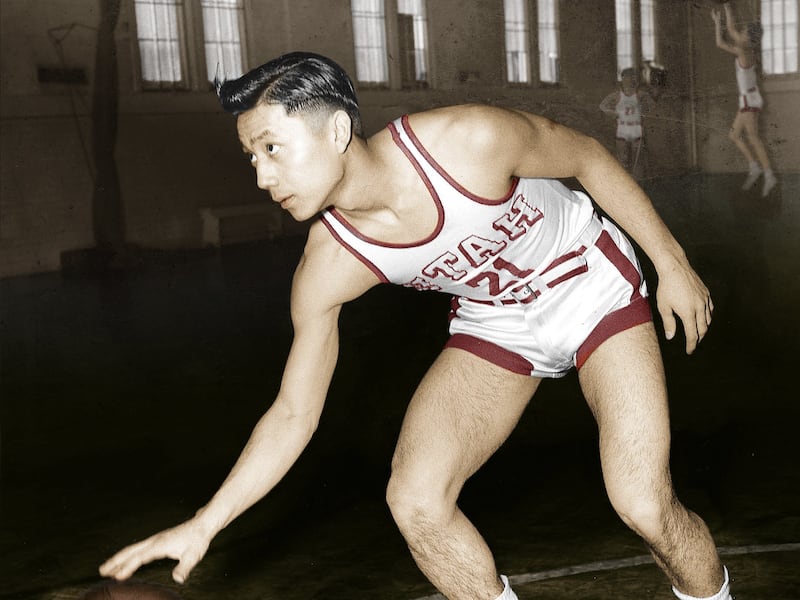
The reason I bring this up is that the University of Utah recently announced that in conjunction with a resolution made during this year’s session of the Utah Legislature, the number of former basketball player Wat Misaka would be retired.
“Wat Misaka’s legacy is that of a champion,” Utah athletics director Mark Harlan said in a prepared statement. “He won championships as a student and was a champion in this country, whose dignity shined through as a trailblazer and a pioneer. The profound impact he made leaves a legacy of great pride for his family, for the state of Utah and all who benefited from the opportunities he created.”
I have no problem with Utah adding Misaka’s No. 21 to the other numbers hanging from the rafters of the Huntsman Center. Misaka played for both of Utah’s national champion teams of the 1940s, the 1944 NCAA championship team and 1947 NIT-winning team. As a Japanese-American, he made an impact as the first nonwhite player to play in the NBA when he briefly played for the New York Knicks.
However, Misaka’s accomplishments don’t come close to the criteria the university established for retired numbers and opens the floodgates to others who could be deemed worthy of their numbers being retired.
The criteria for the men’s basketball players was set years ago and includes the following:
— First-team All-American.
— A two-time all-conference player or conference player of the year.
— Play for your country in an international competition.
— A statistical leader in school and conference records.
— Play for four years.
Right now there are 11 banners hanging from the ceiling on the east side of the Utes’ arena. You’ve got Andrew Bogut (4), Billy McGill (12), Arnie Ferrin (22), Danny Vranes (23), Andre Miller (24), Vern Gardner (33) and Keith Van Horn (44). There’s also one honoring coach Rick Majerus, one for women’s basketball player Kim Smith, one for women’s volleyball player Kim Turner and one that was added earlier this year, for longtime athletic director Chris Hill.
The Utes had a bit of a conundrum when Bogut was named the consensus national player of the year in 2005. He fulfilled the first four criteria, but not the fifth, because he only played two years at the U. But the school wasn’t going to keep the Wooden Award winner from getting his number retired just because he was good enough to turn professional, (the No. 1 overall pick by the way) after two years. His number went up the following year.
So after that precedent was broken, the U. was able to retire Misaka’s number even though he didn’t fulfill any of the five requirements for jersey retirement.
The question is, are there other Ute players who deserve to have their number retired, who may not have met all five criteria set up decades ago?
Two players who quickly come to mind are Mike Newlin and Tom Chambers.
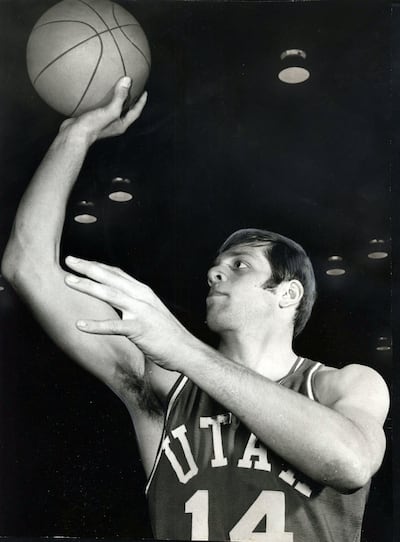
Newlin was a three-time all-WAC player who ranks fifth on the all-time Utah scoring list with 1,849 points, but more impressively is No. 3 in points per game average at 23.1, seeing as he played before freshmen were eligible. He was also a three-time academic All-American, which ought to count for something in these days when players are referred to as “student-athletes.” Newlin went on to have a successful 11-year NBA career, mostly with the Houston Rockets, scoring over 12,500 points and finishing with one of the top free-throw percentages of all time at 87%.
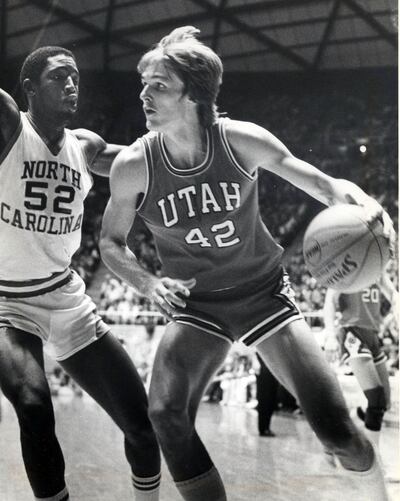
Chambers is ninth on the all-time Ute scoring list, just three points behind Vranes and not far behind him in career rebounds. But Vranes got all the attention and accolades in college, although Chambers went on to become a much better professional where he scored 20,049 points, which ranks 45th all-time in the NBA. In fact, Chambers had his number retired in Phoenix, where he was a three-time All-Star.
Some Ute followers may say, “What about Josh Grant, Jeff Judkins and Ticky Burden?” All great players, for sure, but the line has to be drawn somewhere and the superb pro careers Newlin and Chambers both had should be a factor since they were so close in the other criteria.
Utah already has more retired numbers than any school in the state, in fact more than the other three major college programs in the state combined.
BYU has five retired numbers — Danny Ainge, Kresimir Cosic, Roland Minson and Mel Hutchins, as well as coach Stan Watts.
Weber State has three — Damian Lillard, Bruce Collins and Willie Sojourner — while Utah State has just two — Wayne Estes and Bert Cook.
What about the pros?
The Boston Celtics lead everyone with 23 numbers retired, including longtime coach and general manager Red Auerbach and original owner Walter Brown (no, Ainge is not one of the 23). The New York Yankees are close behind with 22.
The Utah Jazz have 11 retired numbers, seven of which are players, along with owner Larry Miller, coach Jerry Sloan, president/coach Frank Layden and announcer Hot Rod Hundley.
I’m usually in the “less is more” camp when it comes to things like retired numbers and Hall of Fame selections. But now that the U. has opened the door by putting Wat Misaka’s number in the Huntsman Center rafters, it should bend the rules a bit and do the same for Mike Newlin and Tom Chambers.