

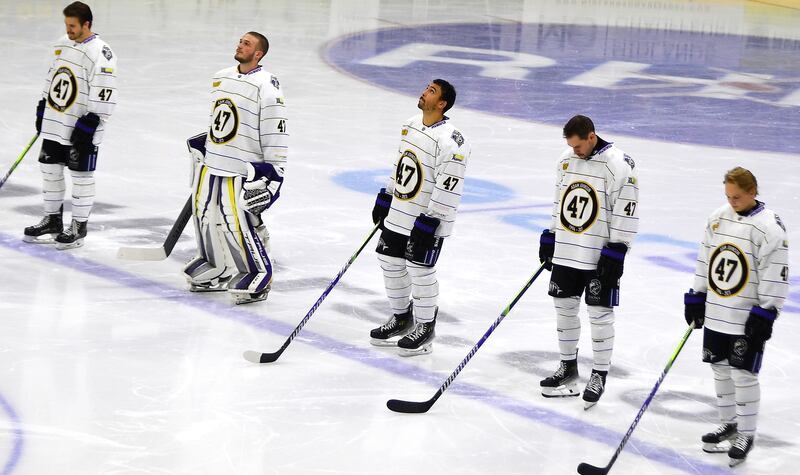

The International Ice Hockey Federation has made neck guards mandatory at the Olympics and all of the federation’s levels of international hockey, The Associated Press reported Monday.
The decision comes after the death of Elite Ice Hockey League player Adam Johnson, who also spent time in the NHL. In October, Johnson’s throat was slashed by the skate of another player, Matt Petgrave, as the two collided.
Johnson received immediate medical attention but later died at the hospital, as the Deseret News previously reported.
Police in England are investigating Johnson’s death and arrested a man on “suspicion of manslaughter” on Nov. 14. The man was released on bail the next day.
Do professional hockey leagues require neck guards?
The IIHF’s new neck guard mandate applies to the Olympics and men’s and women’s world championships but not to professional leagues such as the NHL and the Professional Women’s Hockey League.
The Elite Ice Hockey League in England, where Johnson played, will make the use of neck guards mandatory on Jan. 1, 2024.
The NHL has yet to issue a neck guard mandate. An NHL mandate would require the league to come to an agreement with the NHL players association.
The league is currently in the process of approving more neck guard options for players, according to the AP.
The North American PWHL kicks off its inaugural season on Jan 4. and is looking into requiring neck guards, CBC reported.
Have NHL players started wearing neck guards?
Johnson’s death has placed a greater emphasis on safety in the sport of hockey. A couple of NHL players have now started wearing neck guards following the tragic accident and the NHL’s strong recommendation to wear the additional protective equipment.
The Washington Capitals’ T.J. Oshie was one of the first players to wear a neck guard during an NHL game this season, according to The Athletic.
Tyler Bertuzzi and Simon Benoit of the Toronto Maple Leafs have also started wearing neck guards while playing, the Deseret News previously reported.
“Once that happened, I feel like you won’t get chirped on the ice for wearing a neck guard anymore,” Benoit said of his decision to wear a neck guard. “Everybody’s more conscious. Like, it’s not just about style. It’s for your own protection, right?”
When are the next Winter Olympics and Ice Hockey World Championships?
The implementation of the new neck guard rule will likely be under the public spotlight for the first time at the Ice Hockey Women’s World Championship in April 2024 and then at the men’s Ice Hockey World Championships in May 2024.
The next Winter Olympics will be held in Italy in 2026.