The hockey world at large got a proper introduction to Dylan Guenther in 2023 when he scored the game-winning goal in overtime of the World Junior Championship, bringing Team Canada its second consecutive gold medal.
Ever since then, he’s done nothing but score big goals: He’s logged the game-winner in 10% of his NHL games to date. The World Juniors, hockey’s closest equivalent to basketball’s March Madness tournament, can set players down the path to success.
The Utah Mammoth sent seven prospects to the World Juniors this year, and five of them walked away with medals around their necks.
Silver: Max Pšenička and Štěpán Hoch
Team Czechia has pulled off a lot of upsets over the last few years, and they’ve all involved Team Canada. This year was no exception, beating them in the semifinal and punching their ticket to the gold medal game.
They lost 4-2 to Team Sweden, defaulting to silver medals for Utah’s Czech prospects.
Max Pšenička, a 6-foot-5 defenseman whom the Mammoth drafted in the second round, 46th overall this past draft, was a major part of that team. He finished the tournament with three points, a game-winning goal and a +6 rating.
The 18-year-old has operated at a half-a-point-per-game clip with the Western Hockey League’s Portland Winterhawks so far this season.
Štěpán Hoch played a depth role as Czechia’s third-line center, scoring one goal along the way. He’s more of a defensive specialist than an offensive weapon, and that’s the role he filled for his team at the tournament. At 6-foot-4 and 192 pounds, Utah’s 2025 third-round pick has some of the unteachable assets of a bottom-six player, which could potentially land him in the NHL someday.
Bronze: Tij Iginla, Cole Beaudoin and Caleb Desnoyers
Anytime Team Canada gets anything less than a gold medal, the entire country is left wondering what went wrong. They captured bronze this time around, meaning they improved from last year, but they still weren’t satisfied.
Canada had an astounding six guys who had already played NHL games, and their only forward that wasn’t a first-round draft pick is the projected first-overall pick for the upcoming draft. The general consensus is that they got outworked.
That conclusion didn’t apply to any of Utah’s prospects, though.
Tij Iginla, who was named one of Canada’s top three players of the tournament, introduced himself to the hockey world at this tournament, showing off his wicked release and his elite puck protection. Everyone had always known his last name — his father, Jarome Iginla, is a first-ballot Hall of Famer — but now everyone knows his first name and what he brings.
Iginla scored four goals and eight points in Canada’s seven games.
Cole Beaudoin’s entire game is based on hard work — both on the ice and in the gym. He packs 212 pounds onto a 6-foot-2 frame, and it’s all muscle. Looking at him, you’d never guess he’s still two birthdays away from being able to order a drink in the United States.
Beaudoin was Canada’s safety guy. In every key defensive situation, he was on the ice. And despite defense being his primary responsibility, he still managed to chalk up three goals and seven points in seven games.
Caleb Desnoyers, the fourth-overall pick from this past draft, was Canada’s second-youngest forward. Although he plays center with his regular team, he flanked Beaudoin in this tournament, accompanying him in many of those defensive situations.
Desnoyers describes himself as a Jonathan Toews type of player: He can score with the best of ‘em while also being a steady defensive force. That’s what he did in this tournament, with six assists through seven games, while primarily playing shutdown hockey.
He even showed a fiery side when he tackled Slovakia’s Andreas Straka for bumping Canada’s goalie, Jack Ivankovic.
No medals: Veeti Väisänen and Ludvig Johnson
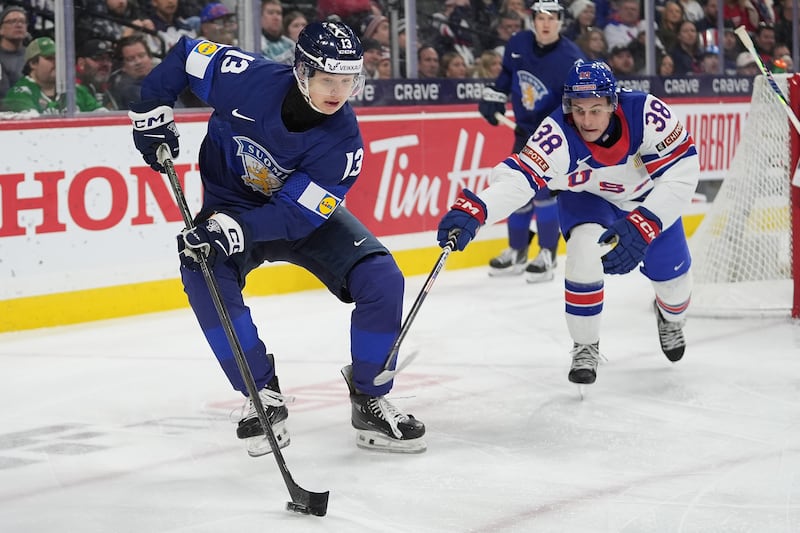
Veeti Väisänen, a two-way defenseman whom Utah selected in the third round of the 2024 draft, won a silver medal with Team Finland at last year’s tournament. This year, he and his team finished in fourth place.
Ludvig Johnson, a sixth-rounder from this past draft, finished the tournament with a goal and two points through five games. Switzerland isn’t heralded as the world’s strongest hockey country, so simply avoiding relegation is often viewed as a success. They did that and more this year, with two wins and a sixth-place finish.