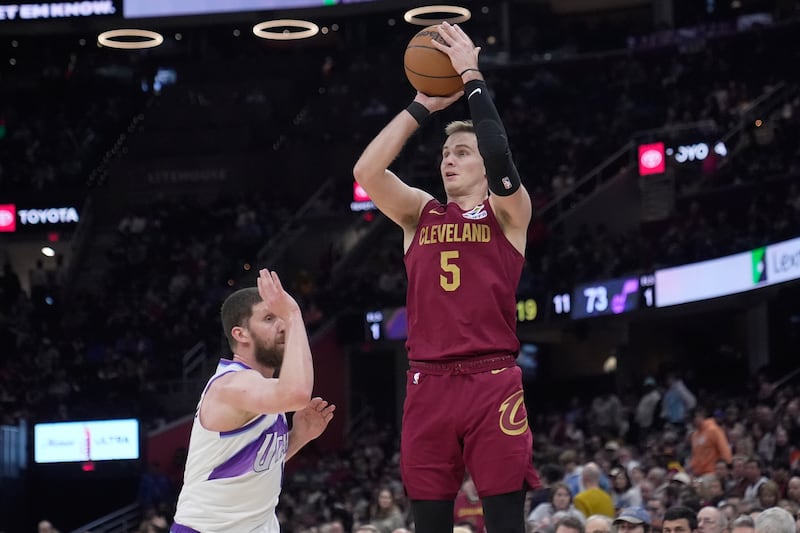

By all measures, Bountiful, Utah, native and Cleveland Cavaliers guard Sam Merrill had an unexpected journey to the NBA.
NBA teams generally prefer younger prospects when analyzing a draft. The average age of draft picks in the 2025 draft was 19.3 in the first round and slightly older at 21.7 in the second round, according to Spotrac.
Merrill entered the 2020 NBA draft at 24 and was selected dead last, taken in the second round with the 60th pick by the New Orleans Pelicans before being immediately traded to the Milwaukee Bucks.
Ever since the NBA changed the draft to two rounds in 1989, which made the 60th pick the final selection, very few 60th picks have achieved anything meaningful in the league. The biggest exception is two-time All-Star Isaiah Thomas.
In the NFL, the last pick in the draft has its own nickname: Mr. Irrelevant.
It makes sense why second-round picks often don’t pan out in the NBA. Making a roster is a herculean task. The NBA allows only 15 standard roster spots, and with the Association having just 30 teams, it means you have to be among the 450 best players in the world to earn a spot.
If you include two-way contracts that number reaches only 540 spot, making an NBA roster of any variety a major accomplishment.
Despite the odds, Merrill has carved out a place in the NBA.
Merrill entered the starting lineup for the Cleveland Cavaliers at the start of the 2024–25 season, as All-Star guard Darius Garland was out with a big-toe injury from the spring.
Through the first three-and-a-half months of the 2025 season, Merrill has played in 24 games and averaged 13.8 points per game while shooting 45.5% from 3, which is currently sixth best in the league. His 3.5 3-pointers made per game ties Charlotte Hornets’ guard LaMelo Ball for fifth best in the league.
So, how did Merrill go from a kid from Bountiful to a legit NBA player?
Hometown hero
It’s not often a varsity coach has to convince a freshman kid to come up and play for the varsity team. It’s even less often that kid says no.
That was the situation longtime Bountiful coach Mike Maxwell found himself in 2011.
Merrill had been on Maxwell’s radar since he was in the sixth grade, after he saw Merrill at summer basketball camps. Merrill’s reason for the refusal was simple: He had a goal to win a championship with his junior high team.
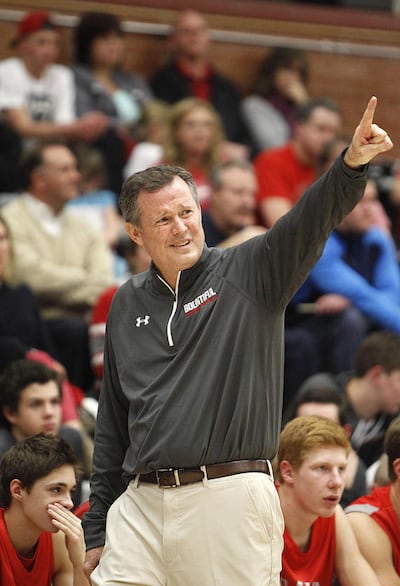
“We thought, ‘Well, I can’t argue with that. Go ahead.’ And he did,” Maxwell said, “and they won.”
That attitude is something Merrill has carried with him throughout his basketball career — his sheer commitment.
He finally joined the Bountiful varsity squad when he was a sophomore. At the time, Bountiful had experienced a brutal string of playoff losses, especially the year prior.
The then-Bountiful Braves (renamed to Redhawks in 2021) were looking for their first state championship since 1997. They had a chance to break the drought in 2011, but hope was ripped away in a 48-42 loss to Highland in the 4A championship game.
The following year, as a sophomore, Merrill appeared on the varsity roster and averaged 6.5 points, 2.3 assists, and 2.9 rebounds a game. Bountiful again reached the 4A semis that year but was rejected from another championship appearance by Orem.
It was during Merrill’s junior season that he really started to become a star.
Merrill’s averages jumped up to 18.3 points per game, 5.4 assists, 6.8 rebounds and 2.2 steals, while leading his team to a semifinal appearance and earning all-state first team honors.
He garnered enough attention to earn a scholarship offer from legendary Utah State coach Stew Morrill.
“When they’re young and growing, it’s kind of awkward. You just don’t move as you should. He just took time to mature,” Maxwell said of Merrill’s junior year jump.
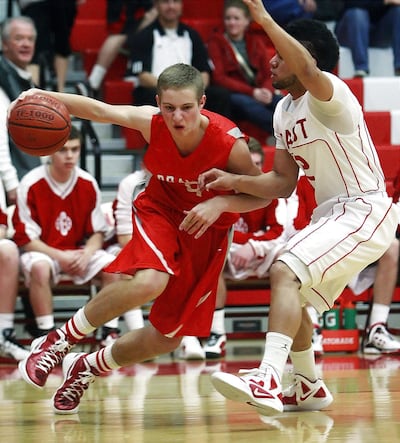
“You can see those kinds of kids developing all the time in high school, and he was just one of those kids who was going to be great. Frankly, a lot of it I attribute to Sam and what he thought he needed to do for the team to win.”
The 2012–13 season was a standout one for Bountiful. It went 21-4, with its only losses coming from bigger schools or good out-of-state talent.
Well, all except one.
Of all the tough postseason losses the school experienced, Merrill’s semifinal loss that year was the most heartbreaking.
It was a tight game with Smithfield’s Sky View in the 2013 4A semifinal, and nobody was playing as well as Merrill.
A 52-52 tie at the end of regulation meant Bountiful had just four minutes of overtime to make its case for the state championship game, and what a case Merrill made.
He finished on an and-one, and then hit a big 3 with 45 seconds left to give Bountiful a 58-54 lead. But a foul on a Sky View 3-pointer then made it a one-point game.
Following the free throws, Merrill went back down court, got fouled, and sank both shots of his own to give Bountiful a 60-57 lead with just 20 seconds left.
He was the big man of the court. He had a high school career-high 35 points alongside four rebounds, five assists, and it seemed like he just willed his team to a state championship appearance.
Unfortunately for Merrill, his future Utah State teammate Jalen Moore had one of the most unbelievable finishes in Utah high school basketball history.
Down three with only 20 seconds left, Sky View worked fast to get Moore the ball in the corner to tie it 60-60.
Only 10 seconds left, all Merrill had to do was bring it down court and get a shot for a win. At best, they win the game. At worst, they go to a second overtime.
He brought the ball down the court but lost his handle and turned it over. Sky View dove on the ball and took a timeout.
With less than three seconds left, Sky View inbounded the ball to Moore. He then sank a half-court heave over Merrill as time expired for the 63-60 win.
Moore’s shot was featured on ESPN SportsCenter’s Top 10.
“He just felt so bad,” Maxwell said. “We went to him because he was our guy. In that situation, it’s probably the only time I ever remember him failing at something, because he just never failed much.
“It probably was good for him, just to have that experience of, ‘You really do have to work hard and things don’t always go your way. It’s OK to face some adversity.”
Things eventually did go his way, but in that moment, it stung.
“I did turn the ball over right before that possession,” Merrill told the Deseret News. “Jalen (Moore) hit a crazy shot, and I just remember thinking the world was over. It was just so tragic that we had lost that way.”
That next summer, Merrill and his teammates were ready to work. Bountiful went to Los Angeles for a summer league in 2013. This particular league had different divisions, generally split between teams that brought only their high school players and teams that brought the best players from their respective states.
At first, Bountiful played down with the other high schools. But it quickly became apparent that it was too good to play in the lower division.
“We were stomping everyone, and they said, ‘OK, do you want to play up?’” Maxwell recalled. “I said, ‘Yeah, put us up.’”
In its first game in the higher division, Bountiful and Merrill made a big statement.
“He would always defer to his buddies and make sure everybody was part of the team. To his credit, the team was winning. He never made it just about Sam.”
— Bountiful High coach Mike Maxwell on Sam Merrill
“Sam went down the lane, a couple of these kids are kids that he’s seen in college, and maybe one or two in the NBA,” Maxwell said. “He went right down the middle of them, jumped over the top of them, and dunked it. Everybody in the crowd just went, ‘What? What just happened?’
“Sam was just making a statement that we’re here and we can play with you. We’re not afraid, we’re going to come after you, and we ended up winning the game. It was just a total Sam moment to me. He was not afraid of the moment, not afraid to work hard, and not afraid to take the challenge and go out with the win.”
That winning mentality persisted throughout the 2013-14 year.
It wasn’t just Merrill; the entire Bountiful roster was talented and confident, particularly Merrill’s teammate Zac Seljaas, who went on to play at BYU and is currently playing professional basketball in France.
All year, Bountiful just burned through its opponents, and outside of a single 3-point loss to a good California team, Bountiful didn’t lose.
Merrill’s game evolved to meet the needs of his team. He didn’t need to score more; the Braves needed him to facilitate. That’s exactly what he did.
His points per game dipped a little from his junior year, but it mattered little since he was now dishing out 7.4 assists per game while also stepping into a leadership position. Despite being the star player, he knew it would be foolish to do it all alone.
“He would always defer to his buddies and make sure everybody was part of the team,” Maxwell said. “To his credit, the team was winning. He never made it just about Sam.”
Merrill’s mentality and that of the team’s proved fruitful as a combined effort from him and Seljaas in the 2014 semifinal against Olympus, which finally propelled them to a championship appearance. This time, they didn’t let the opportunity slip away.

It was a defensive 4A championship against Orem and future BYU Cougar Dalton Nixon. Merrill had a typical star performance with 21 points and four assists, and Bountiful did a good job containing Nixon and held him to just 13 points.
Still, Bountiful needed just a little luck.
Orem trailed 44-43, but Bountiful made a crucial mistake, fouling Nixon with just two seconds left. Luckily for Bountiful, both free throws bounced off the rim, and it finally won its first state championship since 1997.
“Our one loss was in an out-of-state tournament,” Merrill said. “(We) basically dominated everybody until the state championship game. We played Orem, and they had Dalton Nixon, who played on our AAU team, good buddy of ours, and (they had) a couple other good players. ... And that was really one of our only stressful games of the year, to be honest. But it was super fun to be able to come out and win a state championship.”
Cache Valley legend
After graduation, Merrill served a mission for The Church of Jesus Christ of Latter-day Saints.
While not an unusual decision for high school Latter-day Saint athletes, it is a little more unusual for those with dreams of making basketball a career. Taking a two-year hiatus from the game can be a risky one. Still, he leaped in and spent two years in Nicaragua.
Merrill recently appeared on Jimmer Fredette’s “From the Logo with Jimmer Fredette” podcast and spoke about how he believed his mission prepared him for his basketball career.
“There are ups and downs on a mission, and I had to learn how to be resilient on my mission,” Merrill said. “I had to learn in the NBA how to be resilient, being traded, being waived twice, having an ankle surgery, playing in the G League, like all that stuff.”
Once Merrill returned home, he took his next step by joining Utah State in Logan. The coach who recruited him, Stew Morrill, retired after the 2014–15 season. Morrill’s assistant coach, Tim Duryea, stepped in as the new head coach.
It wasn’t smooth sailing for the Aggies. Utah State finished eighth in the Mountain West in Merrill’s freshman year and seventh his sophomore year. Still, he proved himself a contributor from the beginning.
As a freshman, Merrill averaged 9.4 points, 3.1 rebounds and 3.3 assists. He jumped up to the team’s leading scorer his sophomore year, averaging 16.3 points per game.
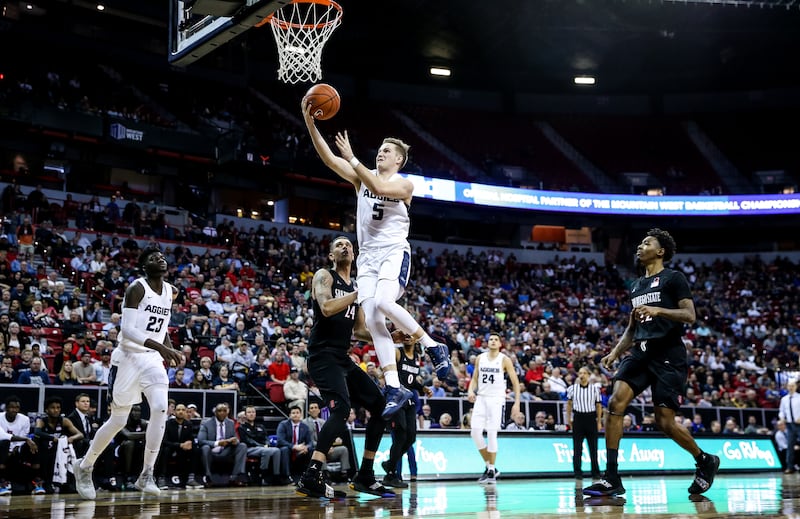
Similar to his high school career, it was Merrill’s junior year that he jumped firmly into star territory. Utah State also hired a new coach in Craig Smith, and the Aggies took off.
Merrill firmly became one of the Mountain West’s finest and was one of the best scorers in the country. Merrill’s point average leaped to 20.9 points per game.
The Aggies took off for what has become a staple the past eight years for Utah State. It had its best season in the Mountain West to that point and took home its first-ever regular-season title with a 15-3 record, which it shared with Nevada.
Utah State then followed that up with its first-ever Mountain West tournament title with a win over San Diego State in the championship game. The Aggies earned an autobid to the NCAA Tournament and ended a seven-year appearance drought.
Merrill was named the Mountain West Player of the Year, and Utah State earned a No. 8 seed at the NCAA Tournament, which ties the 2023–24 team for the highest in program history.
It was the season of dreams for many Utah State fans, but it ended on a sour note in the first round of the tournament.
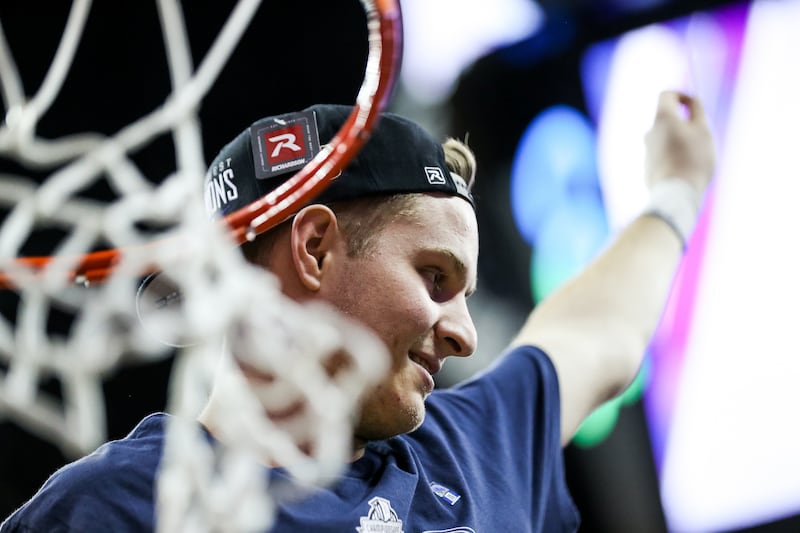
The Aggies were up against Washington for the scary 8-9 seed matchup. Utah State and Merrill didn’t have their best game. Washington controlled it from start to finish and got a convincing 78-61 win. Merrill was held to just 10 points and 2-of-9 shooting.
“We were an eight seed, felt really good about our team going into the NCAA Tournament, and just ran into a terrible matchup for us, a good Washington team,” Merrill said. “Every team’s good in the NCAA Tournament, obviously, but they played that funky Syracuse zone and we just really struggled with it.”
Just like the shot from Moore in high school, the brutal loss to Washington lived in Merrill’s head during his senior year. The Aggie program knew it had the talent to get back and redeem that first-round performance.
Merrill wasn’t scared to be the leader of Utah State the following year, and he took a big role in the defense.
“He just took on that leadership role,” said Utah State director of player personnel and analytics Curran Walsh. Walsh was also the director of player development at the time. “He was guarding everyone’s best player, and impacted winning, leading them to wins.”
The Aggies played well in nonconference play, but a close game against North Texas in November showed Merrill’s commitment to winning.
It was a tight game with the Mean Green, and Merrill went down with an ankle injury with about eight minutes left of the second half. North Texas led 53-51.
Merrill went to the locker room to be evaluated. A team trainer determined he shouldn’t play and went to the coaching staff to tell them he couldn’t return. Before anyone knew it, Merrill took it upon himself to check back into the game with 2:41 left and the game tied 59-59.
The Aggies then went on a 9-0 run to close out the game.
“Our trainer comes back to the bench with about four minutes to go and says, ‘Hey, Sam’s done,’” Walsh said. “(North Texas) kind of went on a run ... and then up to this point, we still hadn’t seen Sam yet, and all of a sudden he’s walking onto the court.”
“He checked himself into the game, literally checked himself into the game, finished the game, hit some big shots, and made some big plays after the trainer basically said he was unable to go. He subbed himself in the game, and finished the game, and led us to a victory.”
After nonconference play wrapped up, the Aggies had a huge task to accomplish in the Mountain West.
“He checked himself into the game, literally checked himself into the game, finished the game, hit some big shots, and made some big plays after the trainer basically said he was unable to go.”
— Utah State director of player personnel and analytics Curran Walsh
The conference was much tougher in 2019–20, and San Diego State in particular was a buzzsaw. The Aztecs were a top-10 team after January. They opened the season with a 26-0 record and dominated the Mountain West.
San Diego State had a handful of future NBA talent on its roster and a clear star in future first-round pick Malachi Flynn, who was named named Mountain West Player of the Year, averaging 17.6 points and 5.1 assists.
Even beyond the Aztecs, the Mountain West wasn’t easy. Utah State, Nevada, UNLV, Boise State and Colorado State were all tough teams, and each finished either 12-6 or 11-7.
Utah State had a good year, but a tough string of games in January took the Aggies out of Mountain West regular-season contention. The Aggies lost consecutive games to UNLV, San Diego State, and also had a tough loss to Air Force.
It got some redemption in a home win over Nevada, but then lost in overtime on the road against Boise State. Utah State suffered four conference losses in just five games.
Still, the Aggies played well enough to clinch a second-seed for the Mountain West Tournament. It beat New Mexico and Wyoming for a return trip to the Mountain West championship game. But, No. 5-ranked San Diego State sat waiting for the Aggies.
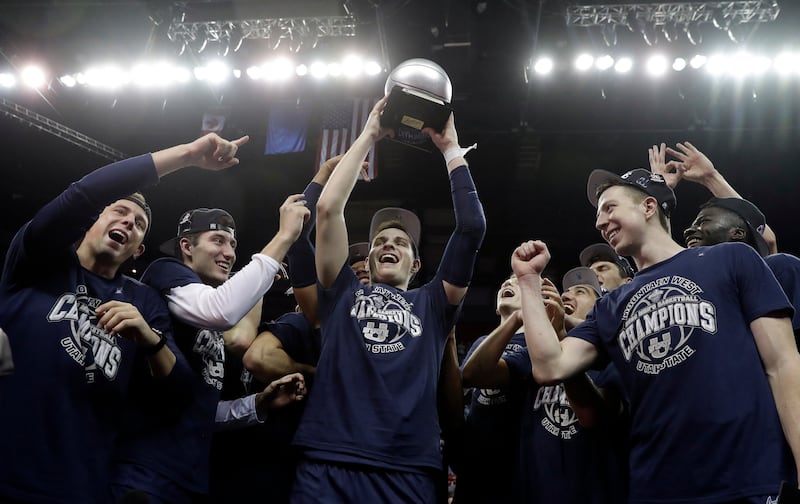
Luckily for Utah State, the arguably single greatest moment in program history occurred during the championship game.
It was close throughout, but San Diego State had built an eight-point edge at halftime. The defensive reputation of the Aztecs was on full display as the Aggies scored only 21 points during the first 20 minutes, 10 of which were scored by Merrill.
Merrill continued to lead the offense after the break and scored 17 points in the second half, including going 4 of 7 from beyond the arc. But something uncharacteristic happened to Merrill with just under 40 seconds left.
San Diego State led 56-55, but Merrill earned a trip to the free-throw line. He rarely missed his free throws in these situations, but he made only one to tie it 56-56.
When that happened, Merrill knew he had to make up for it.
“That was actually the only time in my career I missed a free throw with less than a minute in a game or in overtime,” said Merrill. “I was like 53 of 54 or something like that. So, I made the second one and went back into the timeout, was just like, ‘Hey, my bad guys. Let’s get a stop, and I’ll go win this for us.”
Flynn missed a 3-pointer on the following possession, and Merrill made good on his promise and connected on the most iconic shot of his basketball career.
With three seconds left, Merrill cashed a deep 3-pointer to put the top-5-ranked San Diego State away and earn back-to-back Mountain West tournament wins.
Ironically, after the shot, the only thing going through his mind was flashbacks of the shot Moore hit against him in high school.
“The Jalen thing was kind of the first thing that came to my mind,” Merrill said. “I’d been a part of something crazy, like (when) Jalen Moore hit a half-court shot in a big game, and wanting to get back to the NCAA Tournament because we had lost the year before ... Pretty cool way to end my career.”
Merrill’s shot would’ve normally guaranteed the Aggies a chance to redeem their first-round loss to Washington a year prior. That was one of the major motivating factors behind Merrill’s senior year, and generational bad timing barred him from accomplishing his goal.
Just over a week after Utah State beat San Diego State, the NCAA announced that it canceled the men’s and women’s tournaments due to concerns about COVID-19.
“It was tough,” Merrill said. “(Losing to Washington) was a big motivation for us all year. It was like, we really want to get back and put forth a better showing than we did the year before and it gets taken away from you so quickly.
“Within the span of really just a couple days, we had a couple practices, and all these other leagues were starting their conference tournaments because ours had been early, and one day it’s, ‘There’s not going to be fans.’ And the next day it’s like, ‘Hey, this thing could be canceled here pretty quickly.’ Then, within a few hours, it was done.
“It was wild. It was sad, obviously, knowing that’s how my career and our season had ended in a weird way like that. But at the same time, I was excited for the future, and I was hoping that I’d get a chance. So, pretty quickly, I got back to work and focusing on the draft.”
While his college career didn’t end the way he dreamed, it’s undeniable that he jumpstarted what has become a renaissance of sorts for the Utah State men’s basketball program. The Aggies have qualified for the NCAA Tournament each of the past three years, despite having three different head coaches.
The past two years, it was named to the AP Top 25 at some point in the season. Utah State cracked the AP Top 25 last week, before a loss at Grand Canyon bumped it out this week.
“(Playing in Logan) was something that was really, really important to me growing up a Utah State fan,” Merrill said. “Those first two years were tough, and I’d seen all these great Utah State teams and wanted to be a part of it. Fortunately, those last two years we were able to get Utah State back going, and it’s been cool to see how no matter who the coach is, that continues.”
NBA newcomer
Merrill’s time in Logan attracted the eyes of NBA scouts. It was clear that Merrill could shoot the ball, but there were two big questions for him before the 2020 draft: How early is it worth it to use a pick on a 24-year old player? And can he defend at an NBA level?
It wasn’t just time in the gym that helped Merrill during the pre-draft process; it was also how he was able to advocate for himself. He knew some teams had interest in him, and Merrill chose to model himself after guys like Duncan Robinson, Fred VanVleet and other guys who became successful after going undrafted or taken late in the second round.
“I always felt like I was good enough,” Merrill said. “Going through the pre-draft process and knowing where all these teams saw me, there were teams that were clearly higher on me than others. They’d all ask, ‘What do you think about yourself?’
“I told them all it seems like every year there’s one or two guys, and it’s probably even more common now because guys are older and coming out of college. But I told them there’s the Duncan Robinsons, there’s the Fred VanVleets, every year there’s one or two guys that are either late second-round picks or undrafted guys that find a way to make it.
“Those guys usually have a lot of toughness. They have a lot of grit. They’ve played a lot of basketball. They do things the right way. They’re professionals, and I just told them, ‘I am so confident that I’m going to be one of those guys.’”
On draft night, Merrill had to wait until the very end to hear his name called. He was picked 60th by the New Orleans Pelicans but traded to the Milwaukee Bucks. It was the first time since 1986 that a player was drafted out of Utah State.
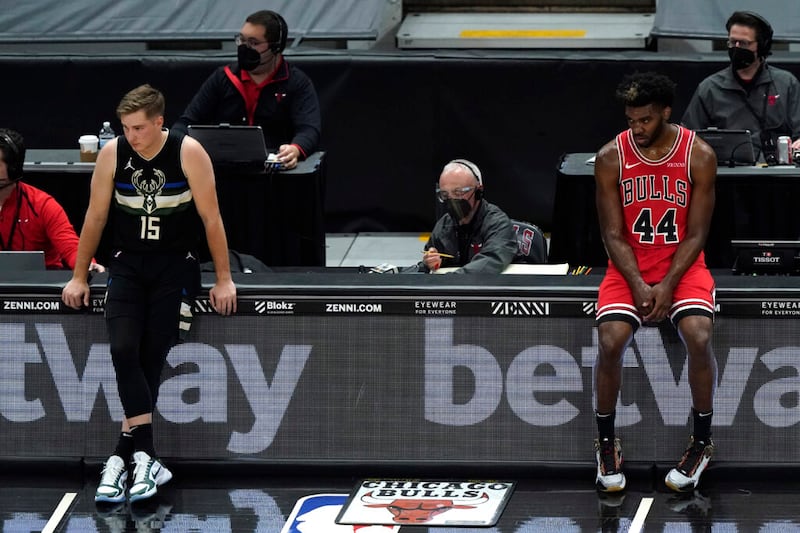
Merrill’s first few years in the league were far from perfect. While he did get traded to the team that became the NBA champion, it meant there was less time available for Merrill to be on the court. It also didn’t help that he had a nagging ankle injury after January.
He only played in 30 games his rookie year, averaging just three points per game on 7.8 minutes per game.
The summer between his rookie and sophomore seasons, Merrill was traded yet again. He was a part of a trade with the Memphis Grizzlies that swapped Grayson Allen for Merrill and draft picks.
The following two years, Merrill’s NBA career was really put into question.
He got similar playing time when he moved to Memphis, and he was treated as a deep-bench guy. He played in only six games for the Grizzlies before the injury bug bit him again. This time was much worse.
Merrill didn’t play for nearly two months and eventually had to undergo surgery to address his ankle. The news of the surgery caused the Grizzlies to waive him, a reminder of the brutal reality of the NBA.
After his ankle rehabilitation, he got another chance the following summer with the Sacramento Kings. It didn’t last long, and Merrill wasn’t selected for the final roster.
The only logical place to go next was the NBA G League. He was taken by the Cleveland Charge and had another path to the NBA. This one he didn’t let slip by.
“I get traded in Memphis, and finally I had a full preseason,” said Merrill. “I got to do September pickup runs and play, and felt like I was getting better and starting to make some progress, and then I got hurt.
“I have to get surgery on my ankle, so I get waived and I had to work my way back up through the G league. It took some time, but I always felt confident in who I was and the skill set that I had.”
Merrill played in 22 games for the Charge and averaged 19.1 points with incredible efficiency. He shot 44% from 3 and 51% from the field.
Finally, in March, Merrill signed a 10-day contract with the Cavaliers. The Cavs decided to convert Merrill’s contract to a multi-year deal. Since then, it seems like Cleveland was just the place he needed.
The following year, he became a bigger part of the rotation. Merrill played in 61 games for the Cavaliers in 2023–24, and his minutes increased from 11.8 minutes per game to 17.5 per game.
The year after that was even more significant, jumping up to 19.7 minutes per game. A two-game stretch in December 2023, in particular, showed the NBA world what type of player Merrill could be.
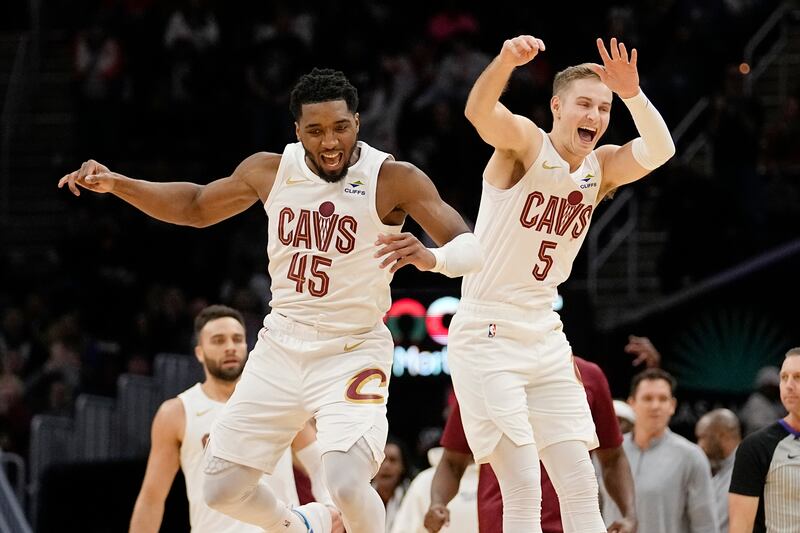
First, it was a game against the Houston Rockets. Merrill hit five 3-pointers scoring a total of 19 points off the bench. It was a career high, and the Cavs won 135-130 in overtime.
The very next game was against none other than the team just 10 miles south of his hometown, the Utah Jazz. Somehow, he one-upped his previous career high.
In that game, Merrill went 8 of 14 from 3 for 27 points and already set a new career high.
“That game playing against the Jazz, anytime I play against the Jazz, it’s fun,” Merrill said. “Just with all the memories of myself growing up watching and going to games. That was the first game where it was like, ‘Wow.’
“I had 26 or 27 points. I had a bunch of threes and felt like I was a big part of us winning that game. That was definitely the time I was like, ‘OK, we got a real shot here to stick around.’”
From there, it’s mostly been only up for the star from Bountiful.
The following year he became an even bigger member of the Cleveland rotation and proved to be a player that the Cavs wanted to keep around.
Cleveland put its money where its mouth was and signed Merrill to a four-year, $38 million contract.
“You have to be tough to survive the ups and downs of this business and this sport and this league,” said Merrill. “I’ve had a bunch of people that have helped me develop toughness, both physical and mental toughness. Whether it’s my family, my siblings, my parents, or some great high school coaches.”
This season especially proved that the gamble on Merrill was worth it. Cleveland started the season without All-Star guard Darius Garland, and Merrill stepped up to the plate.
He’s been in and out with injuries and missed about a month in November and December. However, he’s started 15 of his first 24 games. He totaled only seven total starts in every prior season combined.
His point-per-game average has jumped up from 7.2 to 13.8. His minutes per game skyrocketed from 19.7 to 25.8, and just as always, his 3-point shooting percentage has stayed pristine at 45.5%.
The entirety of Merrill’s career is proof that if immense talent is met with immense work, then greatness is achievable.
“Growing up, I don’t know if there’s anyone that loved basketball or loved sports just as much as me,” Merrill said. “It’s all I’ve ever really cared about from a hobby standpoint.
“That love for the game, I think, is what allowed me to develop a really, really high basketball IQ just from constantly watching games and watching basketball. That’s certainly helped me.”