



Longtime college football fans in the state of Utah will never forget what transpired in December 2004, a crazy month that altered the landscape of the sport in the Beehive State forever, as it were.
A series of decisions, most notably Urban Meyer’s choice to leave Utah for Florida after two seasons in Salt Lake City and BYU’s desire to part ways with Gary Crowton after four seasons in Provo, triggered a chain of events that left the Utes and Cougars fighting over Kyle Whittingham and eventually brought notable names such as Gary Andersen, Kalani Sitake, Bronco Mendenhall, Jay Hill and Aaron Roderick into one of the most intense and intertwined rivalries in the country.
Flash forward to late December 2025 and early January 2026. Has history repeated itself?
Another couple of crazy weeks have shaken the foundation of college football throughout Utah, and once again, Whittingham was in the middle of it.
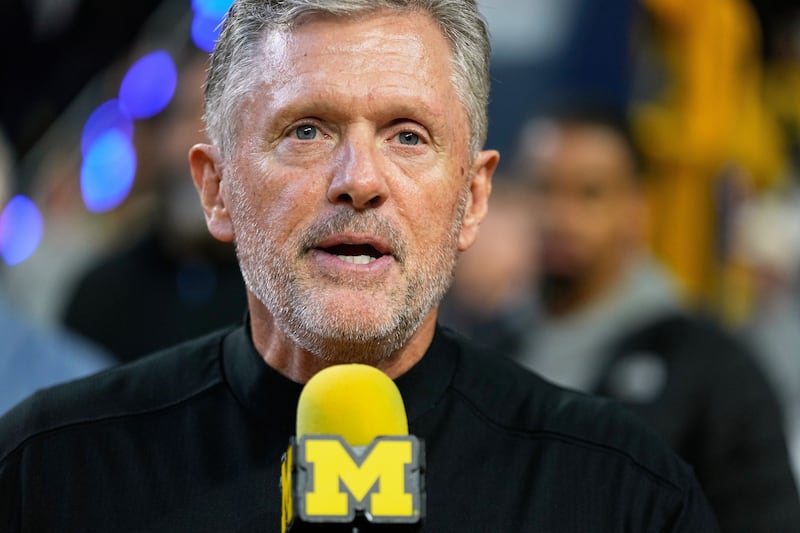
After announcing he was stepping down after 21 years at Utah, Whittingham, 66, shook the college football world by taking the vacant Michigan job the day after Christmas, and dramatic changes have followed — even more than in 2004, if that is possible.
To those seemingly unrepeatable weeks a little more than 21 years ago, new Michigan man Whittingham has told everyone to hold his dirty soda — to put a Utah-flavored spin on the situation.
Then holy heck broke loose.
It immediately got messy at Utah and BYU, and then reached into the coaching staffs at Utah State and Weber State, as Whittingham turned to his coaching tree to build his staff at the Big Ten school with more financial resources than the Utes and Cougars.
Utah’s “head-coach-in-waiting” plan was originally established so there would be a smooth transition from Whittingham, who won two Pac-12 championships over his 21 years, to his understudy — 10-year defensive coordinator Morgan Scalley. The plan was for Whittingham to transition into an athletic department advisory role that would have paid him $3.45 million per year for two years for being “a special assistant to the athletic director,” according to the most recent contract amendment he signed in 2024.

It turned out to be anything but smooth, partly because Whittingham not only lured coaches away from Scalley’s staff, but valuable players, as well, in this day and age of the transfer portal and NIL, factors that didn’t exist back in 2004.
Scalley, who was promised he would one day become head coach at his alma mater, turned down defensive coordinator jobs from some of the country’s most storied programs — including Texas, Oregon, Florida and USC, per ESPN’s Pete Thamel — to continue calling Utah’s defense.
When the time came for Whittingham to retire, the Utes believed there would be a seamless changeover, a passing of the torch from the greatest coach in the program’s history to a younger coach who had patiently waited for more than two decades for his chance.
For years, the plan seemed like it would work. Then Whittingham made the decision to continue coaching, a decision that will rock the state’s college football picture for years to come. It was a decision that nobody outside of Whittingham’s circle, and few inside it, saw coming.
Enter Michigan
Whittingham did not say the word “retire” when he announced he was stepping down, nor did he mention publicly that he had the desire to continue coaching. Whether he informed the university that he wanted to continue coaching at that time is unclear. A Deseret News request via GRAMA for communication between the parties had not been fulfilled by the university as of Friday. The school has indicated that they won’t be available until February.
At his introductory news conference in Orlando on Dec. 28, after he had publicly acknowledged accepting the Michigan job the day before, Whittingham said that he “wasn’t sure” if he was finished coaching football when he announced on Dec. 12 that he was stepping down at Utah.
“I knew there was a lot left in the tank. You could count on one hand the number of schools that I would be receptive to. Michigan was one of those schools,” he said. “Definitely a top-five job in the country, without a doubt. When the ball started rolling and the more I learned about Michigan, the more excited I got. I am elated to be here.”
Suddenly, all that happened way back in 2004 pales in comparison to Whittingham’s move some 1,600 miles away from the place where he was seemingly on his way to putting his likeness on the state’s coaching Mount Rushmore alongside the likes of LaVell Edwards, Rick Majerus, Jennifer Rockwood and Jerry Sloan.
BYU’s staff is affected, but nothing like Utah’s
Obviously, the school most affected by Whittingham’s decision was Utah. Instead of seamlessly handing off the baton to Scalley and triumphantly riding off into the sunset, perhaps posing for a statue to adorn the outside of Rice-Eccles Stadium along the way, Whittingham has become a pariah in some circles, an astounding turn of events for the onetime BYU linebacker who had been involved in Utah’s program since 1994, working under Ron McBride.
Not only did Whittingham take six Utah assistants, four Utah players and a Utah recruit (Salesi Moa) with him, he reached into his former hometown of Provo and took BYU defensive coordinator Jay Hill (see above) and cornerbacks coach Jernaro Gilford with him to Ann Arbor. Regarding players, Whittingham said in Orlando that he wouldn’t “tamper with anybody,” because “that’s not my style.”
However, he noted, “If a player that we have interest in enters the portal, that is a whole different ball game. ... So why not Michigan, if it is a good fit?” Unless they have added a “do not contact” tag to their transfer portal profile, players in the portal are fair game.
It was feared by BYU fans that several BYU defensive stars such as safety Faletau Satuala, cornerback Evan Johnson and linebacker Isaiah Glasker would follow the BYU assistants to Ann Arbor, but it simply didn’t happen, probably because of the culture that head coach Kalani Sitake has established in Provo. It should also be noted that BYU has shown the ability to financially compete favorably for top prospects as well.
One BYU player, reserve linebacker Max Alford, did hit the transfer portal and headed out to Michigan, but his uncle was already on the staff, retained UM running backs coach Tony Alford.
The Utes have been weakened by the move, obviously. Intended, or not, Whittingham has drained Utah of talent and experience more than any other school from which his Michigan program has drawn players.
Hill and Gilford definitely made their marks on BYU’s defense the past few years, but whether BYU has been considerably weakened probably remains to be seen. Sitake replaced Hill with special teams coordinator and edge rushers coach Kelly Poppinga, and brought in former SUU head coach Demario Warren from Boise State to replace Gilford.
A quick perusal of message boards and social media sites shows that Utah fans are collectively angrier about what Whittingham did than BYU fans, not surprisingly.
For the past few years, it was believed that Utah’s culture of toughness and family and the program’s propensity for finding under-the-radar players and developing them would continue under Scalley, who had planned to keep almost all of Utah’s staff intact, and keep almost all of its best players.

Whittingham’s decision muddied the waters
For years prior to Whittingham’s departure, recruits and incoming transfers were informed that it would be Scalley’s show whenever Whittingham decided to hang up his whistle.
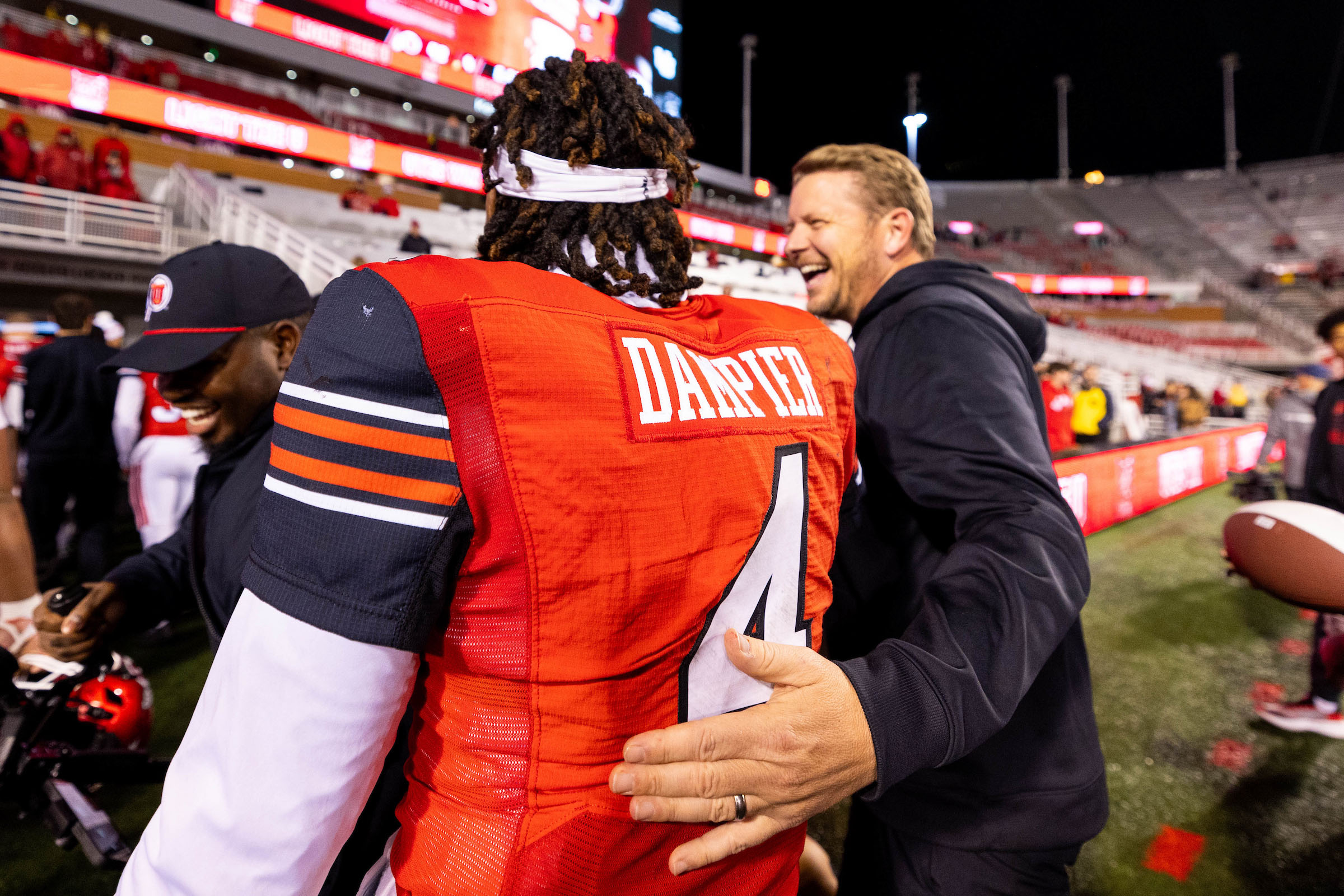
“Man, I am very confident in Scalley. When I came here on my visit, that was someone I talked to and he let me know the rundown when the time comes,” said Utah quarterback Devon Dampier. “He had his full belief in me and my talent, and so I am perfectly fine where I’m at.”
“As I’ve said many times after last season, it just didn’t sit right with anybody, particularly me, and so I came back and fortunately we were able to get the ship right and everything’s on track. Program, like I said, is in a good spot. Got good coaches, coach (Morgan) Scalley will come in and do a great job. Got good players, so now is the time (to step down).”
— former Utah coach Kyle Whittingham
On Dec. 13, Scalley was officially named the school’s next head coach, with Whittingham still scheduled to lead the Utes into the Las Vegas Bowl on Dec. 31. Then Whittingham was supposed to transition into a well-paid two-year athletic department advisory role.
“Well, the program is in a good place right now,” Whittingham said in what would be his final media availability as Utah’s coach.
“As I’ve said many times after last season, it just didn’t sit right with anybody, particularly me, and so I came back and fortunately we were able to get the ship right and everything’s on track. Program, like I said, is in a good spot. Got good coaches, coach (Morgan) Scalley will come in and do a great job. Got good players, so now is the time (to step down).”
In that same interview, however, Whittingham kept the coaching door open. Shortly after that, Michigan fired coach Sherrone Moore, and after striking out on a couple other candidates, the Wolverines turned to Whittingham.
Seven days later, the coach who many believed would retire as a Utah Man was hired to be Michigan’s Man, triggering dramatic changes throughout the state and draining Scalley of plenty of talent.
Utah, BYU fans have mixed emotions
Naturally, the move and subsequent fallout sparked a firestorm online, as Utah, BYU, Utah State and other college football fans rushed to the internet to express their opinions.
Here’s a sampling:
- “Who would have thought Kyle Whittingham would be the one to bring BYU and Utah fans together (in shared animosity), even just for a few weeks?” wrote BYU fan Nello Pesci of Alpine on X.
- Noted Utah fan Eric T. Lund on X: “Change is inevitable. Whitt lit the fuse that started this whole chain of events in motion. It is finally here now. It will be interesting to finally see Utah with more of a passing dimension to its offense. The Las Vegas Bowl gave us a sneak peek of what’s coming.”
- BYU fan Aaron Palmer, of Idaho, perhaps summed up the feelings of most BYU fans, saying he understands why Hill, in particular, made the move. “I think the principles/theory Hill installed defense-wise can be carried on by the coaches who learned under him,” Palmer wrote on X. “I am not too worried. … With Kalani signing a long-term deal, his path to being (head coach) is much better from Michigan.”
- Then there was this unique perspective from a fan with the handle @chuggachoo33 on X: “Our fam has been Michigan fans first and BYU fans second. Never in a million years did we think we’d see Whittingham/Hill taking over (in Ann Arbor). We are so sad about Hill leaving. Hill completely changed BYU the last two years! Kalani is great, but let’s be honest, the defense was the game-changer.”
- Noted Chadwick Bowen: “Everything that has happened, I blame squarely on Mark Harlan.”
Michigan lucks out in more ways than one
Landing the well-accomplished Whittingham was a stroke of luck for Michigan, which has experienced more than its share of scandals the past decade, most notably in the Jim Harbaugh and Moore eras.
Stunningly, the coach who hadn’t had a job outside of Utah since 1993 was suddenly a Michigan Man.
Harlan said that Whittingham’s decision to step down was “a mutual understanding that now was just a good time for him to step down.” Harlan also said that Whittingham, whose contract at Utah ran through 2027, didn’t ask for a contract extension.
For his part, Whittingham said multiple times after stepping down that he didn’t want to “overstay his welcome” at the school.
But he wasn’t done coaching, and signed a five-year deal with Michigan.
“Well, I signed a five-year contract (at Michigan). What I made (as) a mistake at Utah is when they started asking me about retirement, and I started answering questions and giving my own thing,” Whittingham said. “I am not that old. I am 66. It is not that old. I feel like I got enough energy and juice to see this through.”
Back in Utah, instead of the planned smooth transition, Scalley was immediately in a tug-of-war with his former boss.
As most coaches moving on to new jobs do, Whittingham wanted to take the people that had been an integral part of his success at Utah, while Scalley fought to keep those that helped with an 11-2 season in Salt Lake City.
In the end, the allure of coaching at Michigan — not to mention increased pay — won out for six of Utah’s former coaches.
Scalley scrambles to keep his staff, players
On New Year’s Day, after Utah defeated Nebraska 44-22 in Scalley’s debut as head coach, offensive coordinator Jason Beck, offensive line coach Jim Harding, tight ends coach Freddie Whittingham, receivers coach Micah Simon, quarterbacks coach Koy Detmer Jr. and defensive ends coach Lewis Powell left for Ann Arbor.

In particular, the loss of Beck — a rising star in the coaching world — was a blow.
Beck helped transform Utah’s offense into one of the best in the country, guiding the Utes to 41.2 points per game (No. 5 in the nation) and 266.3 rushing yards per game (No. 2 in the nation).
On the offensive side of the ball, every coach except running backs coach Mark Atuaia left to join Michigan. On defense, Utah was able to retain defensive tackles coach Luther Elliss and cornerbacks/special teams coach Sharrieff Shah, while promoting linebackers coach Colton Swan to defensive coordinator.
Instead of continuity, Scalley was handed more of a rebuild.
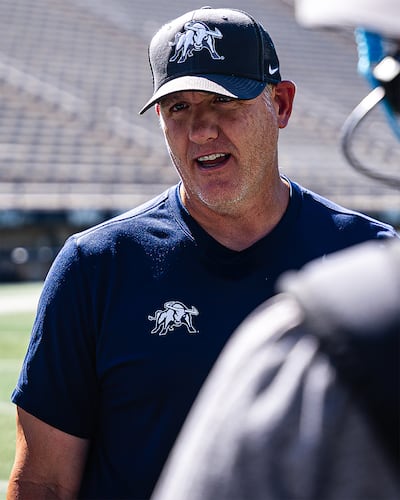
Scalley swiftly put together his coaching staff.
He hired Utah State’s Kevin McGiven as his new offensive coordinator, with the selling point being that it will be a similar offense to Beck’s.
Scalley also inked Baylor’s Inoke Breckterfield to coach defensive ends, Mississippi State’s Chad Bumphis to coach receivers, former Ute star Jordan Gross to coach the offensive line, San Jose State’s Derrick Odum to coach safeties, Kansas State’s Luke Wells to coach tight ends and Oregon State’s Ryan Gunderson to coach quarterbacks.
Why Whittingham plundered Utah for players
When the dust settled, four Utah starters decided to leave for Michigan — cornerback Smith Snowden, tight end/wide receiver JJ Buchanan, defensive tackle Jonah Lea’ea and defensive end John Henry Daley, who began his college career at BYU.
Just when the Utes thought that was the extent of the damage, four-star receiver/safety Salesi Moa — the second-highest-rated commit in Utah history, according to 247Sports — bolted to Michigan.
Moa had enrolled at Utah earlier in January, leading Utah to believe he was locked in, but changed his mind and entered the transfer portal to join Whittingham’s new team.
For Utah fans — and even athletics leadership — that appeared to be the boiling point.
In a since-deleted post on X responding to the Moa news, Harlan said, “Well, he was with us in class for a (last) week. Public announcement … seen it all now (probably not).”
Five players isn’t a particularly large number, especially compared to other coaches that have changed jobs, but each of those were impact players that Utah will have to replace.
Longtime college football scribes weigh in
Several longtime newspaper sportswriters and columnists — Dick Harmon of the Deseret News, the retired Kurt Kragthorpe of The Salt Lake Tribune and the retired Mike Sorensen of the Deseret News — agreed recently to give some context and perspective to the happenings of the past month. All three lifelong Utah residents agreed that we have never witnessed this kind of earthshaking movement of the state’s college football scene, although the 2004 happenings are a close second.
“In my six decades of following college football in the state, along with nearly four decades as a sportswriter, I’ve never seen such far-reaching repercussions from one person’s decision,” noted Sorensen. “Kyle Whittingham’s decision affected all four major programs in the state, not only with the coaches and players leaving Utah, but Utah State and Weber State as well. Are there any others I missed?”
Indeed, after losing offensive coordinator McGiven to Utah, second-year Utah State coach Mendenhall replaced him with a familiar name — former BYU offensive coordinator Robert Anae. The Aggies then plucked receivers coach Skyler Ridley from Weber State, and the dominoes kept falling. Another new Weber State assistant, former BYU and Wildcats cornerback Eddie Heckard, left rookie college coach Eric Kjar’s staff to reunite with Hill and Gilford in Michigan.
It goes on and on.
Sorensen: Surprised by Whittingham’s move
“I can still remember (Whittingham) saying something like, ‘Shoot me if I’m still coaching in my 60s’ early in his Utah career,” Sorensen said. “Of course, after getting older myself, I can understand how one’s feelings can change when one doesn’t feel as old as the number on the birth certificate. But I really thought he was ready to kick back and spend more time golfing, riding his Harley and shopping at Costco.”
Sorensen believes Whittingham was seriously planning to retire from coaching altogether after the season, but had such a good year and had such a strong team coming back that he reconsidered “and felt like he had at least another year” in him.
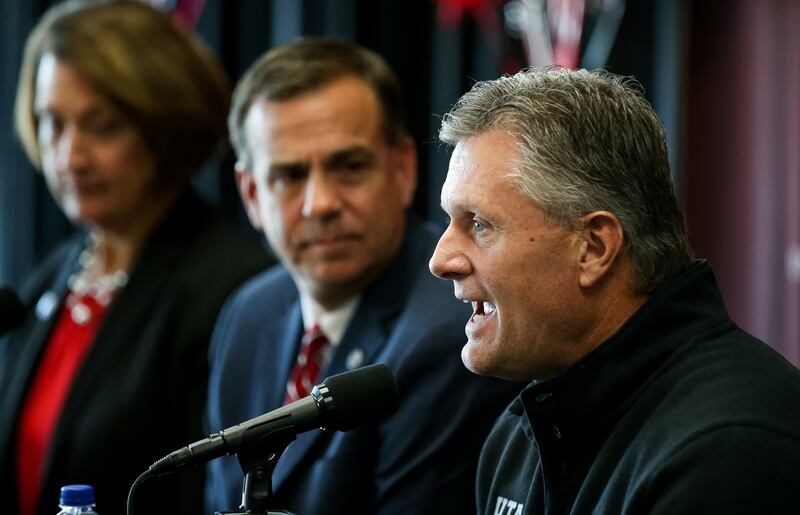
“But the Utah administrators were apparently ready for a change and nudged him out the door,” Sorensen said. “Some Utah fans are bitter about Whittingham leaving Utah and taking several coaches and players with him and believe he is trying to hurt the Ute program. He might be upset with Mark Harlan, but I think he’s simply looking out for himself and his new job at Michigan. Do you really expect him to be nice to Morgan Scalley by not raiding his best players?”
Sorensen said due to all the drastic changes in college sports, he finds himself “less interested in college sports, which seems to be entirely run by money now.”
Harmon: Past month’s carnage was significant
Harmon lived through the madness of late 2004, and will never forget that crazy night when BYU was within a whisker of landing Whittingham to replace Crowton. Still, this past month takes the cake.
“That 2004 deal is as close as it has come to this,” Harmon said. “In 2004, Kyle gave a verbal commitment to BYU vice president Fred Skousen to be the (BYU) head coach, and changed his mind after meeting with (Utah) players, and accepted a raise to stay.
“I remember being involved in a published story that (said) he would be at BYU. It changed in four or five hours,” Harmon continued. “As crazy as that was, the upheaval of this deal is unprecedented. So many coaches have moved, from Logan, Salt Lake City and Provo. It was remarkable.”
Immediately after Jason Beck followed Whittingham to Michigan, a Salt Lake City radio personality went on the air for a day projecting BYU offensive coordinator Aaron Roderick would end up at Utah with Morgan Scalley, Harmon recalls.
“Piggybacking off that, a TV sportscaster postulated Roderick would end up at Utah and take (BYU) QB Bear Bachmeier with him,” Harmon said. “Never happened.”
Now that would have really fired up BYU fans. Bachmeier announced on Jan. 7 that he was returning to BYU, which has done a remarkable job with roster retention in the face of so many local and national changes.
How Morgan Scalley has rebuilt the program
For their part, the Utes held onto arguably their three most important offensive players — quarterback Devon Dampier, quarterback Byrd Ficklin and running back Wayshawn Parker. Linebacker Johnathan Hall, cornerback Scooby Davis and safety Jackson Bennee were key pieces retained on the defensive side of the ball.
That gives the Utes a solid foundation going into next season, but between graduation, the NFL draft and the transfer portal, Utah will be replacing 17 starters or heavy rotation players next season.
Between the starting lineup turnover and the amount of coaches leaving, Scalley’s first will be less of a continuation of the Whittingham era and more of a fresh start.
Most Utah fans expected Whittingham to take assistant coaches with him to Michigan. All of those coaches had a choice to stay at Utah, too, but made their own decisions to make the move to Michigan, whether it was for increased pay or the chance to move up the career ladder at one of the preeminent Big Ten programs.
After some of the Utes’ best players began to transfer to Michigan, however, some Utah fans began to sour on Whittingham.
As Michigan’s new head coach, Whittingham has one job, and that’s to put the Wolverines in the best position to win football games. He believes bringing some of his best coaches and players with him will help accomplish his goal.
From Whittingham’s point of view, if his moves hurt Utah — and, in turn, his protégé and former player in Scalley — that’s an unfortunate byproduct of him trying to build a championship team in Ann Arbor. Whittingham was loyal to Utah for 21 years, but now, his allegiance is to Michigan, and Michigan only.
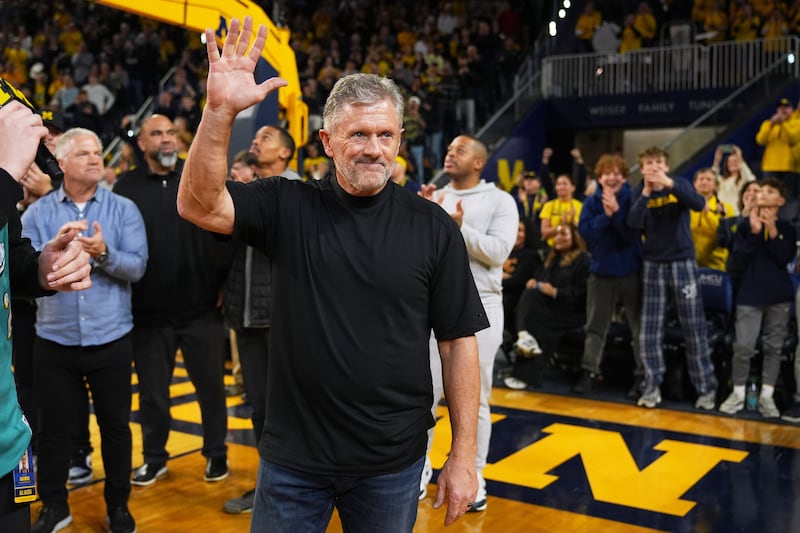
Some Utah fans, however, feel betrayed by Whittingham’s actions — especially in the transfer portal. The coach that promised to leave the program in “a good spot” for Scalley has done anything but that — his new program has actively had a hand in taking talent away from his old program.
That’s college football in the transfer portal era.
Whittingham isn’t doing anything completely out of the norm for coaches moving to a new job, but it’s understandable why Utah fans aren’t exactly clamoring for a statue to be built in his honor in 2026.
If Scalley can find success in his first few seasons at Utah, this latest saga will become water under the bridge at some point, and Whittingham will return to Rice-Eccles Stadium and be honored by the program he helped grow.
“There will be a time and a place to celebrate everything he brought to this university,” Harlan said.
Right now, that day feels far away.
Harmon: Massive roster changes new normal
“I can totally understand how fans would be upset, feel betrayed and express anger on social media,” said Harmon, who outlined many of the changes in this article. “But this is how it goes in college football. It is part of the business. Utah State has gone through so much of this in basketball and football over the years. Utah and BYU have had a luxury of coaching continuity. This is not normal.
“Obviously, this whole ordeal began when Michigan coach Sherrone Moore was fired for having an illicit affair with a staffer, creating a late opening at one of the top jobs in the country. Whittingham told the Deseret News on Dec. 28 that there were only a handful of coaching jobs he would consider once he decided that there was a lot left in the tank.
“I guess if you are looking for who to blame … I would say aside from Michigan’s coach, the Utah administration is to blame because of how Whittingham was dealt with when he decided to keep coaching,” Harmon said. “If he had felt welcomed and supported to continue, none of these shifts with in-state coaching duties would have occurred.”
Harmon, who covered Whittingham when he was an all-conference linebacker at BYU, said he wasn’t surprised that Whittingham raided the staffs at Utah and BYU because “we have a very unusual incestuous coaching situation in the state of Utah (with Whittingham, Sitake and Mendenhall) all employing assistants who are in a very small coaching circle, overlapping experiences at each school. It seems when these guys need help, they look to a very close circle. … But the carnage of this past month was unheard of.”
Harmon says he “feels sorry” for Scalley, but “totally gets why Kyle did what he did.”
Kragthorpe: Coaching succession plans rarely go seamlessly
If anybody knows anything about college football coaching history in Utah, it is Kragthorpe, the son and brother of former head coaches Dave Kragthorpe (South Dakota State, Idaho State, Oregon State) and the late Steve Kragthorpe (Tulsa, Louisville), who died in 2024 from complications of Parkinson’s disease.
“I thrive on this stuff,” says Kurt Kragthorpe. “I love to do ‘Kevin Bacon’ degrees of separation with my brother’s career, especially.”
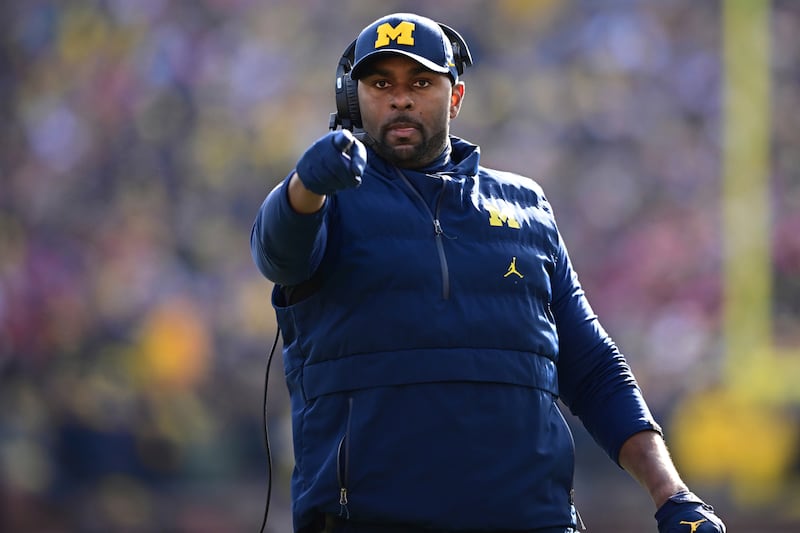
For instance, there’s this little interesting tidbit: Steve Kragthorpe gave the deposed Moore his first college coaching job of any kind back in 2009 when he was at Louisville, making Moore a graduate assistant with the Cardinals. That same year, Steve Kragthorpe started walk-on redshirt freshman quarterback Will Stein in two games. Stein was recently named Kentucky’s head coach.
As a Tribune columnist in 2004, Kurt Kragthorpe provided plenty of commentary when Whittingham chose Utah over BYU. Coincidentally, one of the players who was instrumental in convincing Whittingham to stay at Utah was Scalley, ironically enough.
For BYU and Utah to have job openings at the same time was “crazy enough,” Kragthorpe notes, but it was also unusual that Utah State’s position was vacant as well. The Aggies hired Brent Guy to replace Mick Dennehy. Four years later, USU replaced Guy with Gary Andersen — who is now a defensive analyst under Sitake at BYU.
“Think about the career trajectories of some guys who were affected by that series of hirings (in 2004): Gary Andersen was promoted to defensive coordinator at Utah, while Jay Hill moved into a full-time job (cornerbacks, co-special teams coordinator) with the Utes and Kalani Sitake (inside linebackers) and Aaron Roderick (receivers) moved from Southern Utah to Utah,” Kragthorpe says. “I remember how a lot of people thought Utah shouldn’t be settling for ‘SUU guys.’ But look at them now.”

More fallout from 2004: Whittingham’s choice to stay at Utah enabled Mendenhall to be promoted at BYU. Mendenhall hired Robert Anae from Mike Leach’s staff at Texas Tech as BYU’s offensive coordinator.
“Ironic that Mendenhall and Anae would now have those jobs at USU,” Kragthorpe says.
Kragthorpe notes that also in December 2004, Weber State hired Ron McBride, two years after Utah fired him.
Did anybody see this upheaval coming?
Kragthorpe says the variable that nobody saw coming when Whittingham stepped down was that he would take another job.
“Did anyone, anywhere mention that as a possibility as Utah’s 2025 season wound down? It was always either retiring, or one more year, right? Or I thought he might coach an NFL defensive line or something, if he was that bent on coaching,” Kragthorpe said. “When it came down to that week, all the big-time college jobs were filled, except ... Michigan suddenly became open, thanks to Sherrone Moore’s off-field issues just now being discovered. So the timing of it all was uncanny, to use one of LaVell Edwards’ favorite words.”
One of Kragthorpe’s other takeaways is that all this recent stuff is a reminder that “a succession plan rarely goes seamlessly” and, in this case, it certainly has not.
“Even apart from Morgan Scalley having the ‘coach-in-waiting’ clause taken away and restored again in the past six years, it’s somehow not surprising that this whole thing didn’t play out completely smoothly,” Kragthorpe says. “Also worth noting that in another era, even earlier this decade, Utah would have lost some coaches to Michigan, but not significant players. So the existence of the transfer portal definitely magnifies the impact of Whittingham’s move.”
And amplifies Utah fans’ anger.
