


Remember not so long ago when everyone worried that college athletes were leaving school too early and too young to enter the professional ranks? Not anymore. Now they have to be kicked out the door, kicking and screaming — all the way to their lawyers. They can’t stay long enough. Now they’re suing to stay.
Now everybody wants to be a “student.”
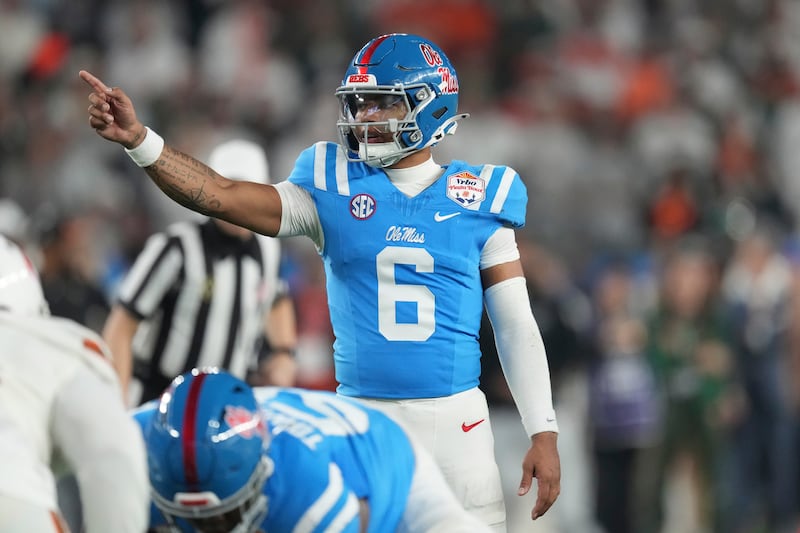
Ole Miss quarterback Trinidad Chambliss is suing the NCAA to win a sixth year of eligibility so he can play another season of college football.
Lots of people take six years to graduate from college — they’re called doctors (to borrow a quote from “Tommy Boy”).
Earlier this month, the NCAA denied his petition for another year because he hadn’t provided enough evidence that he had been suffering from an “incapacitating injury or illness” when he sat out the 2022 season at Division II Ferris State because of a respiratory problem. He is required to produce a doctor’s note — not unlike the one you asked your mom for when you wanted to skip school.
Chambliss would rather stay in school than declare for the NFL draft, where he would likely be taken in the early rounds. He wants to remain in school so he can continue his studies in quantum mechanics.
No, not really. The real reason he wants to remain in school is less sublime. It’s simple economics: He can make more money in college than he could in the NFL. That’s what college sports has come to. Chambliss reportedly was paid $5 million last season through an NIL deal. That’s more than he would make on a rookie contract in the NFL.
Quarterback Jaxson Dart, a late first-round pick by the New York Giants in 2025, signed a four-year, $17 million contract. According to Spotrac, he was paid a little more than $3 million for the 2025 season, counting a prorated signing bonus. Dart won’t reach Chambliss’ level of pay until his fourth season.
See — it pays to stay in school.
The line between professional sports and college sports is blurry at best, if not nonexistent. Not everybody wants to leave, and some who do leave want to return.
They just can’t get enough “school.”
Take quarterback Carson Beck, for example. He played a sixth season in 2025, taking the “University” of Miami to the national championship game. A few days before the game, he revealed that he had not been attending classes and that he had graduated two years ago; he was a full-time football player and was paid millions to do so.
Teammate Mohamed Toure, a linebacker, has been around even longer than Beck. He will return for an eighth year of eligibility next season. He began playing college football in 2019.
Follow the money. Cash is luring a lot of athletes back to school, including a growing line of former professional basketball players.
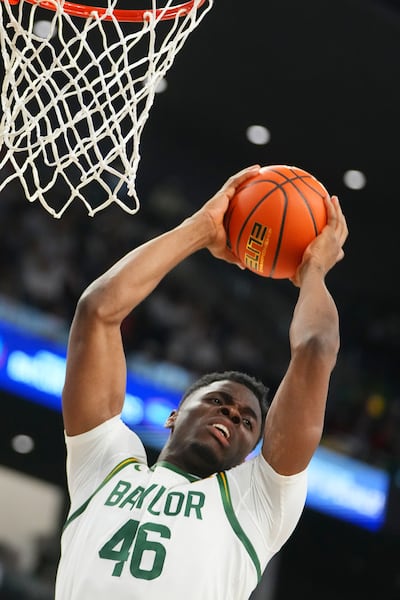
James Nnaji, a 21-year-old Nigerian, is another athlete who suddenly wants to go to school, despite being the 31st player picked in the 2023 NBA draft. He joined the team at Baylor “University” in the middle of the current season after playing four seasons in the European professional leagues.
After failing to catch on with three NBA teams, he made millions of dollars playing in European professional leagues from 2020 until 2025, when he abandoned the last two years of his contract to play for Baylor. So far, he’s played in six games, but his playing time has been declining (he didn’t play at all in Saturday’s game).
Former Alabama center Charles Bediako, a 23-year-old Canadian, wants to be a student too. He is suing the NCAA to return to college basketball after the NCAA denied Alabama’s request to allow Bediako to join the team midseason.
He has been granted a restraining order by the courts, allowing him to play immediately. He’s played in one game so far (13 points). Undrafted in 2023 after playing in 70 games for Alabama, he played for three G League teams — the minor league of the NBA. He signed contracts with the Spurs in 2023, the Nuggets in 2024 and the Pistons in 2025, but was waived by each franchise.
Bediako’s lawyers state in their complaint that when he “elected to enter his name into the 2023 NBA draft, Mr. Bediako could not have imagined the monumental change in the landscape of college athletics that has occurred.”
In other words, he would’ve remained in school if he could have been paid what is offered in today’s world of college basketball.
The NCAA’s efforts to enforce its rules have been thwarted by the courts, and its appeal for help from Congress to restore its authority and create rules to rein in abuses have gone nowhere.
“These attempts to sidestep NCAA rules and recruit individuals who have finished their time in college or signed NBA contracts are taking away opportunities from high school students,” the NCAA said in a statement. “A judge ordering the NCAA let a former NBA player take the court Saturday against actual college student-athletes is exactly why Congress must step in and empower college sports to enforce our eligibility rules.”
Thierry Darlan, a point guard from Central African Republic, chose two years ago to play pro basketball rather than go the college route, but last year — cha-ching — he changed his mind. He plays for Santa Clara University, becoming the first professional athlete to be granted NCAA eligibility. He began his pro career with an Angolan team, then joined the NBA G League in 2023, playing for three teams in three years before deciding to play collegiate ball in 2025.
Abdullah Ahmed and London Johnson — two more G League players — also decided late that they wanted to attend college. Ahmed, an Egyptian who played 54 games for the professional Westchester Knicks, joined BYU in December. Johnson, who passed up scholarship offers coming out of high school, played three seasons in the G League after signing a contract worth more than $1 million. Last fall, he joined the team at the University of Louisville.
The rising generation has seen the importance of a college education. Or something like that.
