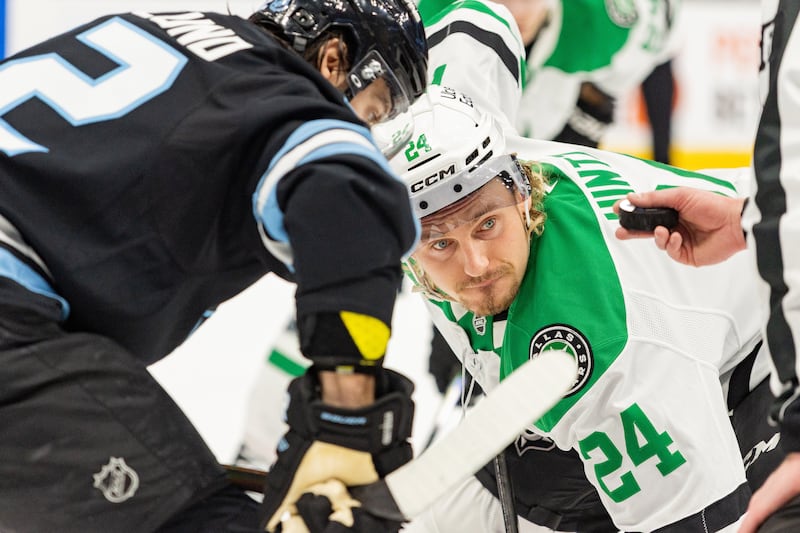
If hockey was always played at 5-on-5, the Utah Mammoth would have just one regulation loss in the month of January.
Unfortunately for the Mammoth, penalties play a major factor in almost every NHL game — and their special teams have been the death of them.
“I don’t think we have any swagger right now,” said head coach André Tourigny in reference to Utah’s power play and penalty kill. “I don’t think we have any kind of execution.
“At some point, (this) league, if you feel sorry for yourself, everybody will step on your throat, and nobody will let you get back up, so there’s no feeling sorry for yourself.”
As was the case in Tampa and Carolina on their recent road trip, the Mammoth allowed two power play goals to the Dallas Stars on Saturday, which was ultimately the difference between a win and a 3-2 loss.
It began early. Less than a minute in, Sean Durzi flipped a puck over the glass from his own zone — an easy delay of game call for the officials to make — and Dallas scored on the ensuing power play.
Six minutes later, Jack McBain took the exact same penalty, and again, the Stars scored on the power play. A 2-0 deficit in the first seven minutes of a game is enough to kill anyone’s confidence.
“Our special teams need to step up, especially in those games,” Tourigny said. “You will not always play your A game. Sometimes you have a B game. Your special teams need to bail you out then. Did not happen.”
“Our approach hasn’t changed, our mentality hasn’t changed, our strategy hasn’t changed,” he said. “The PK’s a very razor-thin-edged margin of error. ... You try the best you can, and, like, inevitably, goals are going to go in.”
Tourigny explained that if there’s a consistent theme to what’s going wrong, it’s a simple fix. But in this stretch, there hasn’t been one consistent factor.
“It’s a misread here, it’s a missed clear here, it’s a bad bounce here,” he said. “Things happen, so how do we clean up what we can handle, which is our pressure, our clears, our reads?”
On the advantaged side of the puck, Utah has been just as ineffective: It has an NHL-worst five power play goals in the month of January.
“Right now, we’re kind of struggling, I think,” said JJ Peterka, a regular member of Utah’s first power play unit. “We’ve got to go back to just making easy plays, more shots on net, maybe scoring one or two greasy goals, and then just moving on from there.”
He said the group is “definitely not” shooting the puck enough.
Tourigny summed it up nicely.
“We win the 5-on-5 game 2-1, even if we didn’t play well. ... Our special teams have to step up — especially in those games."
Kailer Yamamoto: NHL star
Don’t look now, but Kailer Yamamoto is scoring at a half-point-per-game pace.
Before this week, his last two-goal game in the NHL was in 2023. He now has back-to-back two-goal games and he’s totaled seven points in his last five games.
“Pucks are going in the net, I think,” he said when asked what’s been different for him over this stretch. “But yeah, that’s about it.”
In other words, he’s playing his the same game he always has: Battling hard, doing things the right way and staying open in the offensive zone.
He’s always ready for the opportunities that come his way — even though there aren’t as many as he’d like.
“(I’m proving) that I belong here, that I can play with these guys, and stuff like that,” he said. “Taking it day by day and, you know, trying to play the best hockey I can right now.”
Tourigny had high praise for the Spokane, Washington, native ahead of the game.
“His IQ’s through the roof and he’s competitive and he wins battles,” Tourigny said. “The thing about Yammy that tricks everybody is when you look at the sheet before the game, you see his height and weight (5-foot-9, 178 pounds).
“He doesn’t play like that. It’s not what he is.”
Tourigny explained that when the Mammoth signed Yamamoto last season, one of his former general managers told them he’s the guy who wins the most battles.
It surprised Tourigny, but it didn’t take him long to see what the GM was talking about.
“He plays like he’s 6-foot-2,” Tourigny said.
Peterka, who assisted on both of Yamamoto’s goals Saturday, praised him for his ability to find open space, making it simple for his line mates to get him the puck.
Yamamoto has only played 33 games this year, but he’s already achieved his best totals in both goals and points since leaving Edmonton, where he was a consistent half-a-point-per-game player.
At any rate, he’s proving time after time that he still belongs in the NHL — and not as a depth player.
Was it goalie interference?
On the Mammoth’s first goal of the game, the Stars thought they had an easy goaltender interference call, as Barrett Hayton had made contact with goaltender Casey DeSmith in the crease.
Agree with it or not, that’s been the only consistently consistent thing about goalie interference rulings over the past three or four seasons. If the player enters the crease on his own volition and makes contact with the goalie, the goal does not stand.
You can imagine the Stars’ surprise when the officials called it a goal.
“Video review determined that Barrett Hayton’s contact with Casey DeSmith did not constitute goaltender interference prior to Kailer Yamamoto’s goal,” the NHL said as its official explanation.
It can be inferred that Hayton’s contact with DeSmith was minor enough that it didn’t prevent the latter from playing his position. That’s true, but it’s not consistent with dozens of other rulings over the last few years, which have overturned goals for even less contact.
The NHL would be a more fan-friendly league if more calls aired on the side of allowing goals, but if there’s no consistency from one decision to the next, it causes fans to feel like they were cheated.
Pick a lane and stick with it.