

Noteworthy stuff for Sunday’s Super Bowl — also known as clearing the desk of odds and ends before the big game:
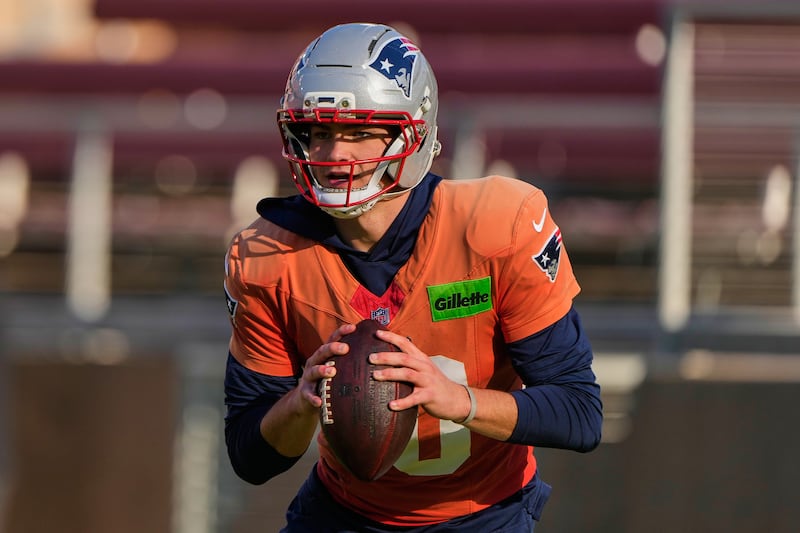
Patriots quarterback Drake Maye has taken a team to the Super Bowl in only his second season in the league, but this is the rule, not the exception.
Ever since the league agreed on a new collective bargaining agreement in 2011 that structured (and effectively lowered) the pay scale for rookie quarterbacks, teams have thrived with quarterbacks who are on their rookie contract.
To state the obvious, that’s because it frees up more money to build the rest of the team.
In 2007, JaMarcus Russell was the first overall pick in the draft and was given a six-year, $61 million deal. In 2011, the year of the new CBA, Cam Newton, also the first overall pick of that draft, signed a four-year deal worth $22 million.
This began a new era. Throwing out the 2011 season — since it was too early to affect the construction of rosters — there have been 14 Super Bowls (including this week’s game). Of those 28 starting quarterbacks, 11 were on their rookie deals — or 39.2%.
It’s 50% if you consider just the last eight Super Bowls. This week’s game marks the eighth straight year a quarterback has taken a team to the Super Bowl on his rookie contract. To wit:
- 2012: Colin Kaepernick
- 2013: Russell Wilson
- 2014: Russell Wilson
- 2018: Jared Goff
- 2019: Patrick Mahomes
- 2020: Patrick Mahomes
- 2021: Joe Burrow
- 2022: Jalen Hurts
- 2023: Brock Purdy
- 2024: Jalen Hurts
- 2025: Drake Maye
Parity party
The NFL welfare system is working. It has promoted parity, the Kansas City Chiefs and New England Patriots notwithstanding.
A year ago, the Patriots were 4-13; the year before that, they were 4-13. They ended the 2025-26 season with a 14-3 mark.
The NFL has taken measures to ensure parity and to help losing teams back on the road to recovery. There’s a hard salary cap; losing teams draft first and the strength of their schedule is dumbed down — the Patriots had one of the easiest schedules in NFL history; their opponents had a combined .391 winning percentage (113-176), the lowest since the Rams in 1999.
They played only two teams with winning records.
Thanks to such measures, 12 teams have advanced to the Super Bowl the year after finishing with a losing record. This is a list of those teams and their record the previous season:
- 1973: Vikings (7-7)
- 1979: Rams (5-10)
- 1981: Bengals (6-10)
- 1981: 49ers (6-10)
- 1988: Bengals (4-11)
- 1999: Rams (4-12)
- 2001: Patriots (5-11)
- 2003: Panthers (7-9)
- 2017: Eagles (7-9)
- 2019: 49ers (4-12)
- 2020: Buccaneers (7-9)
- 2025: Patriots (4-13)
Outliers
There are some teams that defy the parity movement, all of them overseen by some of the best front offices in professional sports (then there are the Jets, who have a gift for losing).
The Chiefs have played in five of the last six Super Bowls. The Patriots are making their 12th Super Bowl appearance this year, their 10th since 2000.
No other team has more than eight. A win Sunday would give New England seven Super Bowl wins, one more than the Steelers.
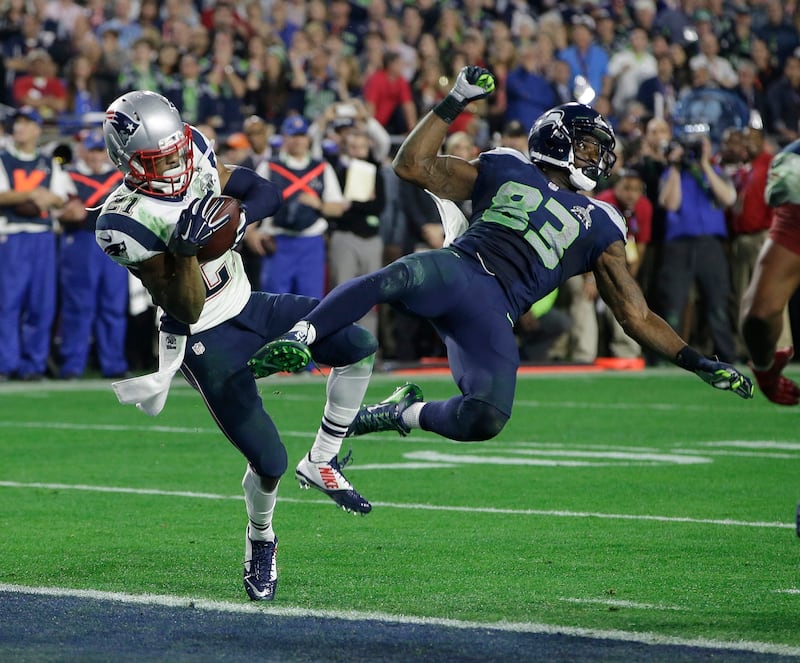
This year’s game is a matchup of the 2015 Super Bowl, which was decided by the Dumbest Play Call in History.
The Seahawks, trailing 28-24, were on the 1-yard line with 20 seconds to go, but instead of handing the ball to the unstoppable Marshawn Lynch, who had rushed for 102 yards in the game, they threw a pass that was intercepted at the goal line.
The Patriots had trailed by 10 with less than eight minutes left in the game.
Vikings’ mistake, Seahawks’ take
How would you like to be the Minnesota Vikings on Super Bowl Sunday, watching Sam Darnold lead the Seattle Seahawks?
During the 2024-25 season, Darnold guided the Vikings to a 14-3 record, and then the Vikings somehow concluded that it would be better to give the quarterback job to inexperienced J.J. McCarthy and let Darnold walk away.
Darnold proceeded to lead the Seattle Seahawks to a 14-3 season — and to the Super Bowl.
Not only did the Vikings let Darnold go, they let Daniel Jones leave as well, and he made a star turn for the Indianapolis Colts before an injury sidelined him in Week 13.
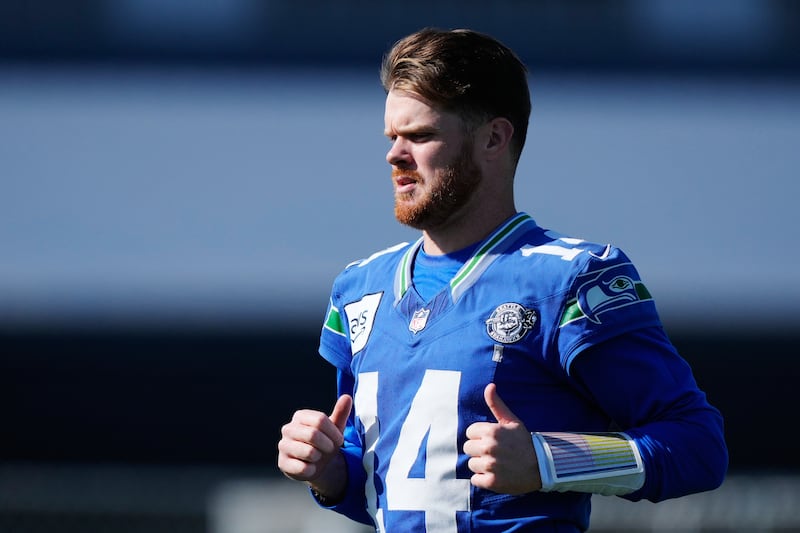
But back to Darnold. He has played for five teams in six years. He had the misfortune of being drafted by the New York Jets. The results were predictable.
Three years later, the Jets traded him to the Carolina Panthers for three draft picks so they could clear the way to draft Zach Wilson, who also lasted three seasons before he was cast off.
Darnold spent two seasons as a part-time starter in Carolina, and then one season with the San Francisco 49ers as a backup, throwing only 46 passes in 2023.
He seemed doomed to spend the rest of his career as one of those anonymous quarterbacks who quietly earns a good paycheck as a backup.
He resuscitated his career with the Vikings last year and played even better for the Seahawks this season, throwing for 4,048 yards, 25 touchdowns against 14 interceptions.
He has a 28-6 regular-season record as a starting quarterback over the last two years.
From Weber State to the NFL
Rashid Shaheed, a wide receiver and kickoff/punt returner, was an undrafted free agent when he left Weber State four years ago.
He played 3½ seasons for the New Orleans Saints and then was traded in the middle of the 2025 season to the Seahawks for a couple of draft picks.
The trade has paid off for the Seahawks. Shaheed returned a kickoff 100 yards for a touchdown against the Atlanta Falcons, a punt 58 yards for a touchdown against the Los Angeles Rams and the opening kickoff of a playoff game against the 49ers for a 95-yard touchdown.
He was slow to work into the receiver rotation but wound up with 15 catches.
During his four seasons in the NFL, Shaheed has 153 catches — 12 for touchdowns — and has returned two kickoffs for touchdowns (counting the playoffs) and four punts for touchdowns.
