



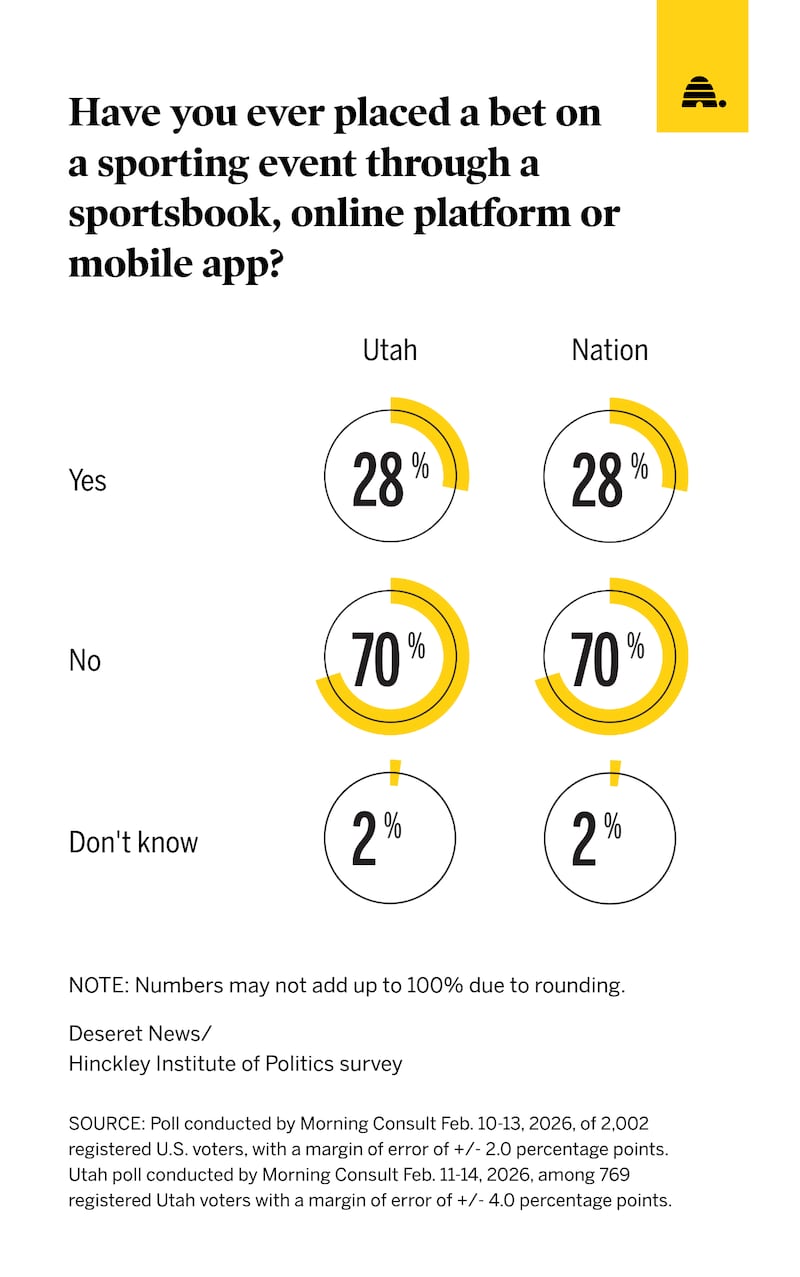
- A new Deseret News/Hinckley Institute of Politics poll shows nearly a third of Americans have placed a bet on a sporting event.
- Sports betting trends show a generational divide in attitudes.
- Utahns wager on sports at the same rate as the rest of the country.
Nearly a third of Americans say they’ve bet money on a sporting event through a sportsbook, online platform or mobile app, and the number is even higher among younger people.
At the same time, half of those surveyed in a new national Deseret News/Hinckley Institute of Politics poll believe current professional athletes often or sometimes alter the way they play to help sports gamblers win bets.
Gambling on sports has exploded in the U.S. since the Supreme Court struck down a federal ban in 2018. At least 40 states, the District of Columbia and Puerto Rico now allow commercial sports betting in some form. Of that total, 32 permit sports betting with smartphone apps or websites.
Televised sporting events — none bigger than the Super Bowl — are rife with sportsbooks ads, mostly from giants DraftKings and FanDuel, both of which have partnerships with pro sports leagues and TV networks.
In 2023, an estimated 30 million American adults placed a traditional sports wager online, at a sportsbook or with a bookie on the Super Bowl, according to the American Gaming Association. A year later, 42.7 million planned to bet on the big game through those means.
The gaming association estimates people wagered $27.6 billion on the NFL alone and nearly $150 billion across all sports in 2024. Numbers for 2025 are expected to be higher.
So-called “prediction market” companies have now also made their way on the scene. A growing number of users are accessing their platforms to buy and sell “contracts” based on the outcome of events, from local elections to major sports contests.
Kalshi, a platform that allows users to buy contracts in politics, pop culture, financial markets and sports, saw more than $1 billion in “trading” volume on Super Bowl Sunday, a record daily high and 2,700% increase year-over-year, according to the company, per CNBC.
And even as millions of people put down more and more money, a plurality of those surveyed in the Deseret News/Hinckley Institute poll say the increased availability of online gambling has been a bad thing for sports.
Overall, 28% of Americans say they’ve placed a bet on a sporting event using a sportsbook, online platform or mobile app, while 70% say they have not. Men were twice as likely to bet on sports than women.
Generation gap
The poll revealed a clear generational divide in attitudes about sports gambling: younger people are much more open to it than older people.
Among millennials and Gen Zers, the poll found 44% and 40%, respectively, had bet on sports. Only 15% of baby boomers say they have done so. Technology could be a factor in that division. Millennials are widely considered the most tech-savvy generation in the U.S. due high smart phone ownership and use of digital services.
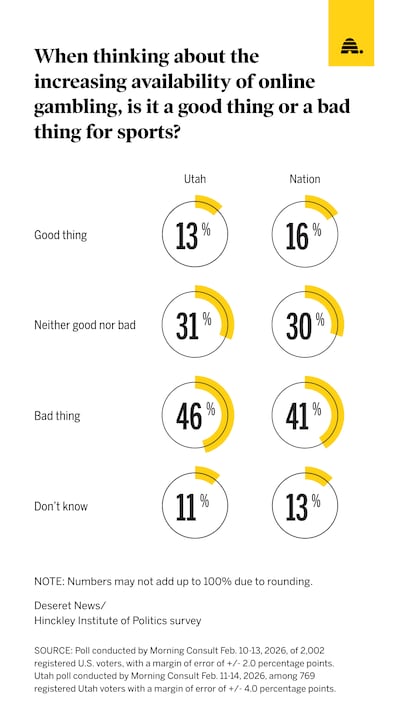
The generation gap also emerged when it comes to whether gambling is a good thing or a bad thing for sports. Less than 1 in 3 millennials and Gen Zers say it’s a bad thing, while nearly 3 in 5 baby boomers say it’s bad.
Overall, a plurality of voters, 41%, say that the increased availability of online betting has been bad for sports, while 30% say it is neither good nor bad, and 16% say it has been good.
Morning Consult conducted the nationwide poll of 2002 registered voters Feb. 10-13. It has a margin of error of plus or minus 2 percentage points.
Betting scandals have rocked college and pro basketball and pro baseball in recent months, with dozens of athletes facing criminal charges for point shaving or altering their play to influence the outcome of a game.
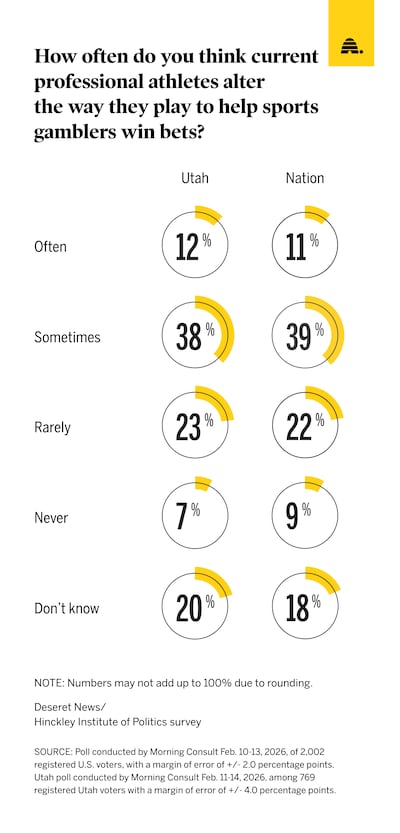
The poll found 50% of Americans believe current pro athletes often or sometimes alter the way they play to help sports gamblers win a bet, while 31% say that rarely or never happens. Another 18% said they don’t know.
Interestingly, while millennials, Gen Zers and Gen Xers are more inclined to bet on games than baby boomers, more than half of them also believe athletes do things on the court or the field to fix games.
How many Utahns bet on sports?
Morning Consult also polled 769 Utah registered voters Feb. 11-14 for the Deseret News and Hinckley Institute of Politics. The results, which have an error margin of plus or minus 4 percentage points, mirror the national data in many ways.
Utah bans gambling in any form. And a bill to add proposition bets, or prop bets, to the list of prohibitions is making it’s way through the Legislature. Prop bets are wagers placed on specific players or events in a game such as who will score the first touchdown or whether the next pitch will be a ball or a strike.
Gov. Spencer Cox also recently said he will go to court to block prediction markets, calling them “gambling — pure and simple."
Still, about 3 in 10 Utahns say they’ve placed a bet on a sporting event using a sports book, online platform or mobile app — the same share as nationwide. Millennials and Gen Zers again were more likely to wager on sports than baby boomers, though in lesser numbers than their peers nationally.
Half of Utah voters believe that current pro athletes often or sometimes alter the way they play to help sports gamblers win bets, while 30% say that rarely or never happens and 20% don’t know. With a little variation, those figures generally held true regardless of age.
Also, a plurality of voters, 46%, say that the increased availability of online gambling has been a bad thing for sports, while 31% say it’s neutral, and 13% say it’s been a good thing.
But the share of Utahns who think it’s bad soars with age. The poll found 65% baby boomers say sports gambling is bad for the game, compared to 35% among Gen Zers.