

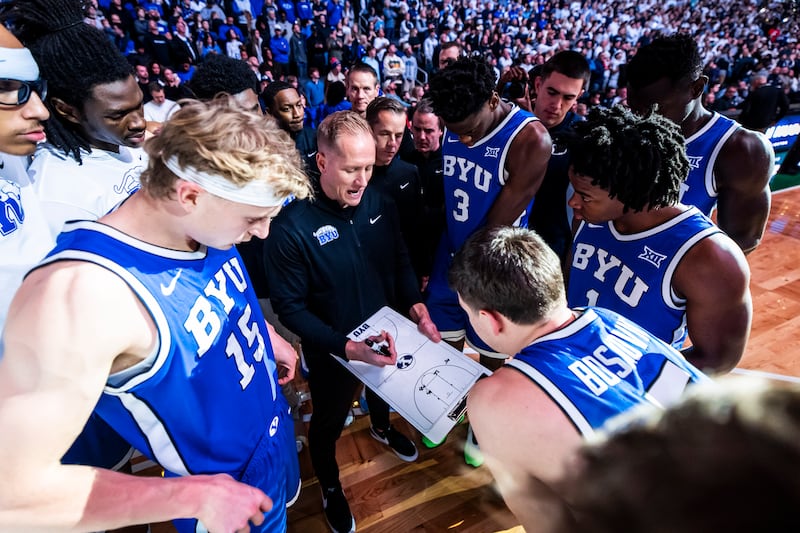

Any review of the 2025–26 BYU basketball season, which ended last Thursday with a discouraging loss to Texas in an NCAA Tournament first-round game, has to begin and end with AJ Dybantsa, the generational talent who led the country in scoring while leading the Cougars further into the national spotlight.
It will be remembered as the Season of AJ, assuming the 6-foot-9 freshman does what he really should do and enters June’s NBA draft. If BYU officials aren’t already planning to retire Dybantsa’s jersey, and hang the No. 3 in the rafters of the Marriott Center, they should start considering it.
The 19-year-old was that impactful in just one season in Provo, as was spelled out in this article last week in the Deseret News before No. 6 seed BYU fell 79-71 to No. 11 seed Texas and was a one-and-done in the Big Dance, just like Dybantsa probably will be in the college ranks.
So that story has been told. But what about the Cougars’ season as a whole? How will the second season of the Kevin Young era go down in history?
The initial word that comes to mind, from this viewpoint, is disappointing.
Calling it a wasted season is harsh, but acknowledging that BYU squandered a golden opportunity to make a deep run in the tournament with a player who will quite likely be remembered as the greatest to ever don a BYU basketball uniform feels fair and accurate.

Earning its highest-ever preseason ranking, No. 8, in the Associated Press preseason Top 25 poll, having Dybantsa coming into the program as the No. 1 recruit in the nation, star forward Richie Saunders returning for one last hurrah, and being picked to finish second in the Big 12 put expectations for BYU at an all-time high.
Heck, even this news outlet joined in, proclaiming it was “Final Four or Bust” for the program that has now made 33 appearances in the NCAA Tournament without having ever made it to the third weekend, the most in the country.
After winning 16 of their first 17 games — the only loss was an 86-84 nailbiter to then-No. 3 UConn in Boston — the Cougars lost 11 of their last 18 games and finished with a 23-12 record. It was more of a bust than a boom.
To be fair, injuries to key players was a big reason why the season nosedived and the Cougars did not live up to expectations. But there were other factors: Several returning players did not improve from last year to this year; several offseason acquisitions simply did not pan out as bonafide power conference-level performers; and coaches did not develop enough quality shooters to take some of the pressure off Dybantsa.
The consensus First Team All-American and National Player of the Year candidate was sensational in almost every way, without a lot of help outside of Saunders — until he sustained a season-ending ACL injury on Feb. 14 — and Baylor transfer Rob Wright.
“It was extremely (disappointing) to have AJ this year and not advance,” Young said after the early ouster. ... “But one guy can only do so much. Other guys have to step up. I thought we rode him and Rob as best we could.”
What might have been — without some key injuries
The 2025-26 season will also be remembered as the one in which the beloved Saunders was further stamping himself as a top-25 player in BYU history, until that fateful Valentine’s Day when he crumpled in a heap under the BYU basket against Colorado.
“He’s been the heart and soul of our program since I took this job,” Young said.
Saunders, a key component of BYU’s 2025 Sweet 16 run, averaged 18.0 points and 5.8 rebounds in 25 games. BYU was 19-6 when he got hurt and went 4-6 without him.

The injury bug bit before the season even started; returning part-time starters Mihailo Boskovic and Keba Keita battled ailments last summer and that slowed their progress, Keita said in a somber BYU locker room after the Texas loss.
Keita and Boskovic were never quite able to duplicate the success they had last year, and in many ways failed to improve in their final seasons in Provo. BYU’s big loss to Texas was proof of that.
Nate Pickens, a UC Riverside transfer brought in to add shooting and replace Virginia-bound Dallin Hall as a reliable backup to Wright, needed season-ending surgery before the season began. Corner Canyon transfer Brody Kozlowski never suited up, either.
Freshman big man Xavier Staton also suffered a season-ending knee injury, and then the biggest early season blow came on Nov. 27 against Miami when Dawson Baker went down with an ACL injury. The Cougars were 5-1, with wins over Villanova and Wisconsin and the close loss to UConn when Baker was lost for the season.
Southern Illinois transfer Kennard Davis Jr. was suspended for two games, including the loss to UConn, then showed some flashes of his potential late in the season and at the Big 12 tournament. Davis finished the season averaging 8.5 points per game and shooting 32.1% from 3-point range, but inconsistency on both ends of the court plagued his first season at BYU.
Dybantsa described the season as “rocky” and “up and down” and one filled with adversity brought on by injuries.
“We lost key components to our team,” he said. “As a freshman, I kind of had to step up into circumstances that I’m not used to, but it made me better. … When adversity hit, I think that we fought super hard, and for us to be a six seed after all that, it shows a lot about our team, about our perseverance.”
Roster construction gets scrutinized
Whether Young and his staff erred in its roster construction as it sought to surround Dybantsa with all the right ingredients from the beginning will be debated forever, but Young defended it after the Texas loss, citing injuries as the main culprit.

“I think it’s unfair in a lot of ways to judge the roster construction of this team just because of, it was literally five season-ending injuries,” he said. “It wasn’t one, it wasn’t two. Four of those five were all guys that can knock shots down.
“We built this roster specifically towards AJ and Richie, and then we went out and got Rob (Wright),” Young continued. “Those guys need shooting around them. Period, end of story. I couldn’t even sometimes bear to watch the film, honestly, offensively, because our spacing was so funky. Just stuff I was not comfortable with. But you’re trying your best to do with what you got, and so that’s what I would say to (critics) of this year’s roster construction.”
Realizing that Staton was not the answer to their desperate need for more inside help, the staff somewhat controversially brought in 6-10 center Abdullah “Bido” Ahmed from the G League, but that slight gamble did not pay dividends. Ahmed showed some shot-blocking skills, but was not much of a threat offensively, averaging just 1.3 points and 2.7 rebounds in 20 games.
Truthfully, the Cougars were backsliding before Saunders left the lineup. A penchant for falling behind by double digits in first halves and then scrambling late to get back in games became more persistent, and more costly, as they dropped games at No. 15 Texas Tech, to No. 1 Arizona at home, and then at lower-level Oklahoma State and No. 14 Kansas as January rolled into February.
An up-and-down February produced some thrilling wins over Iowa State and Texas Tech and a fairly close loss at No. 1 Arizona, but also some clunkers. Most notably, the 97-84 loss to UCF on Feb. 24 — three days after the stirring win over ISU — signaled that a lengthy run in March Madness wasn’t in the cards.
The Cougars finished 9-9 in the Big 12, tied for seventh place, but got the No. 10 seed for the conference tournament.
They finished the year with a NET ranking of 23 and seven Quad 1 wins.
“I mean, this has been a tough year, given the cards that we’ve been dealt,” Young said, calling the season a “mixed bag” and acknowledging some disappointment that some strong rebounding and defensive performances in the Big 12 tournament didn’t carry over into the Big Dance. “But I am proud of the group’s (resilience) and they’re grit. I thought they really came together. It was fun to see. I think they felt themselves coming together, and that was rewarding.
“Any time you’re in this spot at the end of the season, it is a bit of a double-edged sword, with the emotion,” he continued. “It is tough to see it end.”
Was Year 2 just a sophomore slump for Young?
No question about it, Young has elevated the BYU basketball program immensely since taking over for Mark Pope in April 2024. He’s 39-22 against arguably the hardest set of back-to-back schedules in program history. He’s 2-2 in the NCAA Tournament. He was 15-2 at home in each of his two seasons, and the Marriott Center has been packed.
BYU was No. 5 in the country, and No. 1 in the Big 12, in average home attendance, 18,073.
He’s delivered on his promise of making BYU a pipeline to the NBA for some of the nation’s top recruits. He just landed another five-star prospect who some people are saying could be a lottery pick in the 2027 NBA draft, Bruce Branch III.
The 6-foot-7 Branch, originally the top-ranked player in the 2027 class before reclassifying, does not have Dybantsa-type ability, but he’s still the type of guy who probably would never have chosen BYU if it were not for Young’s work in Provo.
So any criticism of Young for BYU’s collapse the past two months has to be taken with a grain of salt. The Cougars are better off than at any point in their basketball history. The future still looks incredibly bright for a team that just three years ago finished with a 7-9 record in the WCC, and 19-15 record overall.
“It is disappointing not to have the team that we put together around AJ be able to showcase what they could do, but that’s life, man,” Young said. “I’m proud of the way AJ put our team on his back. There were moments in that (last) game where he looked incredible. … The guy looked like a stone-cold NBA all star out there.
“But you have to have other guys contribute. We were 4 of 22 from 3,” he continued. “… Bottom line is, it’s a team game, and you need other guys to step up, even if you know it’s guys whose roles are bigger than they should have been.”
Credit Young for making some adjustments to the way he coached as the team faltered in late February, particularly after the 97-84 loss to NCAA Tournament-qualifier UCF and road losses at West Virginia and Cincinnati. He simplified almost everything, especially the way the Cougars guarded people, and the results were encouraging.
“I was like, man, we gotta do something different,” Young said of the “introspection” he put himself through while flying back from Cincinnati. “Things weren’t resonating with the group. That’s kind of what drove us to some of the changes that we’ve made.”
What’s next for Young and the Cougars?
Predicting a future college basketball roster in this day and age of the transfer portal, NIL and additions from overseas and even the NBA’s G League is a fool’s errand, at best.
As of Tuesday, for instance, the Cougars weren’t even 100% sure that Dybantsa is leaving for the NBA. He told reporters at least twice after the Texas loss that he isn’t certain himself.
But for the purposes of this report, let’s take the safe route and assume that he’s gone.
Keita, Boskovic, walk-on Jared McGregor and Saunders are out of eligibility.
In addition to the aforementioned Branch, BYU will add Timpview High’s four-star recruit Dean Rueckert, a 6-foot-7 wing. Returned missionary Brooks Bahr, who signed when Pope was at the helm, will be back, along with KJ Perry, who was the No. 1-ranked junior college prospect last season and spent the season redshirting on the BYU bench.

The transfer portal window for basketball opens on April 7 — the day after the national championship game in Indianapolis — and stays open until April 21. Surely, Young will push some players who were overvalued last year into the portal, or they will see the writing on the wall and go themselves.
In our opinion, the players who should be retained, if possible, are point guards Wright and Pickens, shooting guards Davis, Baker and Aleksej Kostic, athletic wing Khadim Mboup and athletic wing Dominique Diomande.
Idaho transfer Tyler Mrus, former Corner Canyon star Kozlowski, Staton and Ahmed did not do enough to show that they can compete at this level.
Wright told the Deseret News in Kansas City that he will either return to BYU or pursue professional basketball; Pickens and Davis said in Portland that they expect to be back but haven’t discussed their particular situations with the coaches. Kostic said he would love to return, if the coaches will have him back.
Diomande and Mboup showed themselves to be energetic, earnest defenders in March, but both need to work on their offensive skills.
Young said from the dais after the tournament loss that he would like to build the 2026-27 team around Wright — who averaged 18.1 points and 4.6 assists.
“As we fast-forward for next year, trying to get shooting around Rob and have some dynamic spacing like we did our first year is something that will definitely be under heavy consideration,” Young said.
Later, he told reporters that only cover BYU that the Cougars need to get bigger and stronger inside, in addition to upgrading their long-distance shooting.
“Shooting is the holy grail. Bottom line, you got to be able to make shots at a high level, and we didn’t have enough guys that could do that this year,” he said. “So shooting will always be my first question. In the Big 12 specifically, you have to mix that with some rugged guys as well. That’s just how our league is.
“There’s just no substitute for shooting. That’s at the top of the list for me every year, but definitely this year was a double down on how important it is.”
