



- A new Deseret News/Hinckley Institute of Politics poll gauged Utahns' interest in landing an MLB team.
- Those who support bringing a team to Utah cited economic growth among their reasons.
- Those who oppose getting a franchise don't want tax dollars used to build a stadium.
It’s Opening Day. The stands at Larry H. Miller Field at (corporate name) Stadium on Salt Lake City’s west side are packed. The Utah Bees take the field in their home whites trimmed in black and gold. The Chicago Cubs’ leadoff hitter walks to the plate. There’s a buzz in the stadium in anticipation of the first-ever pitch at a Major League Baseball game where Utahns can root, root, root for the home team. The umpire — still a human — shouts “Play ball!”
OK, it’s a made-up scene. But nearly 7 in 10 Utahns would welcome a big league team to the Beehive State, according to a new Deseret News/Hinckley Institute of Politics poll.
American Fork resident Bryant Jenks, a Los Angeles Dodgers fan who grew up listening to Vin Scully on a transistor radio, would be among them.
“We have a fan base that’s loyal to professional teams and loves baseball,” he said.
Sold-out attendance at Utah Jazz and Utah Mammoth games bears that out. Also, the Salt Lake Bees AAA baseball drew nearly 400,000 fans at its new ballpark last year.
And Jenks could even get behind a Utah MLB team playing his Dodgers. “Being a baseball fan, I would be happy for either to win,” he said.
By most accounts, Salt Lake City along with Nashville have emerged as frontrunners to land an MLB expansion team sometime after 2029. Big League Utah, a coalition of prominent Utahns led by the Larry H. Miller Company, publicly launched its pursuit of a team three years ago.
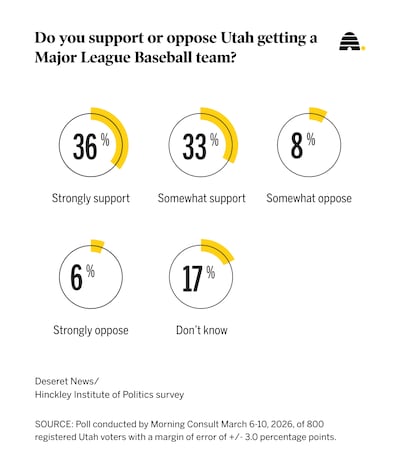
The poll found 69% of Utah voters strongly or somewhat support the state getting a major league team, while 14% are strongly or somewhat opposed and 17% don’t know.
People age 45 to 64 expressed the most support among all age groups in the survey, at 73%. Those 65 and older expressed the least, but still 6 in 10 were supportive. More women than men favor getting a team.
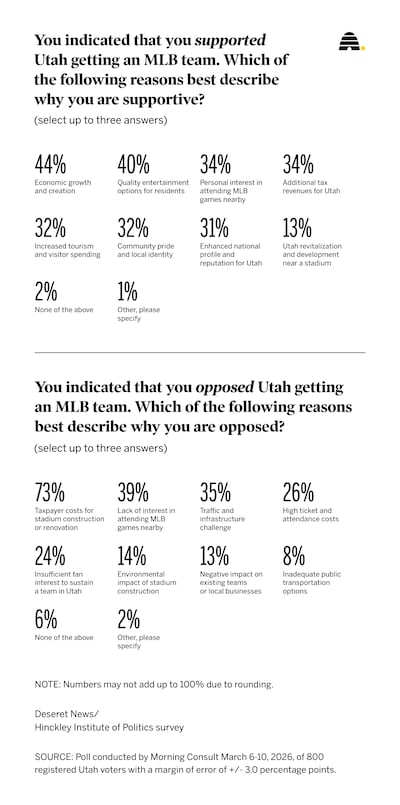
The survey also asked respondents about the reasons they support or oppose a big league team in Utah. Money figured into some of their answers.
Of those who favor having a franchise, the top reason cited for their support was economic growth and job creation, among several choices in the survey. Following that was baseball as a quality entertainment option for residents along with additional tax revenues for Utah and personal interest in attending an MLB game nearby.
Of those who oppose a team coming to the state, taxpayer costs for stadium construction topped the list by far, with lack of personal interest in attending MLB games a distant second and traffic and infrastructure challenges third.
Urban dwellers were less inclined to favor a team in Utah than were people living in suburban and rural communities. Those making more than $50,000 a year were more supportive than those making less than that.
Morning Consult conducted the poll of 800 Utah registered voters March 6-10. It has a margin of error of plus or minus 3 percentage points.
Multibillion investment on Salt Lake City’s west side
The Miller Company intends to invest $3.5 billion in a mixed-use development in the Power District on Salt Lake City’s long-overlooked west side. The 100-acre project includes plans for green space and trails, a riverwalk, office buildings, residential housing, hotel, dining and retail. There’s also an MLB ballpark site, should the city land a team.
In 2024, state lawmakers created the Utah Fairpark Area Investment and Restoration District, covering the area north of I-80 between 1000 West and Redwood Road. A five-member board determines land use, recruits businesses, contracts for public safety services and leverages growth in tax increment and sales within the area to pay for the improvements inside the district.
The stadium would be funded with private dollars, state sales tax revenue and rental car taxes paid for primarily by out-of-state visitors. The district would have the ability to raise the car rental 1.5% for construction of a baseball stadium only if MLB awards Utah a franchise, with a 2032 deadline for that to happen.
The state would own the ballpark and lease it to the team for $150,000 a month for 30 years. If the team leaves the state before 30 years, it would have to repay the district for the taxpayer-generated funds.
Miller Company CEO Steve Starks told the Deseret News last month that the company is working with ballpark architects on site plans for where a stadium would go, how it would be oriented and seating capacity. Generally, it would be located on the west side of the Jordan River facing the Wasatch Mountains. Home run balls leaving the park could land in the water.
Support for landing a team has dropped since an April 2023 Deseret News/Hinckley Institute survey found 81% of Utah favored the effort. Like the latest survey, only 14% opposed getting a franchise, but the number of people saying they don’t know nearly tripled.
MLB Commissioner Rob Manfred favors one new team in the East and one in the West when baseball starts looking at expansion no earlier than 2029. Nashville is the leading contender in the East, while many observers see Salt Lake City as the top prospect in the West, former sports executive Dave Checketts among them.
“The Miller family who I brought into the Jazz in 1985 has sold not only their team but sold all of their auto dealerships. They’re sitting on billions of cash and they’ve bought land just west of downtown Salt Lake. They have a beautiful stadium plan and they’ve got $900 million from the state legislature,” Checketts, a former chief executive of the Utah Jazz, New York Knicks and Madison Square Garden, said last fall.
“They’re by far No. 1 in the West.”
Would baseball help the Utah economy?
A June 2023 Deseret News/Hinckley Institute poll found Utahns almost evenly split over using taxpayer dollars to build a stadium, with 47% supporting use of public funds and 50% opposed.
Community leaders see baseball as a catalyst to lift and connect the west side to Salt Lake City. But the economic benefits of public investment in stadiums is highly debated across the country.
A 2023 analysis of more than 130 studies spanning 30 years concluded that pro sports and new stadiums make little difference to long-term economic growth.
“Though findings have become more nuanced, recent analyses continue to confirm the decades-old consensus of very limited economic impacts of professional sports teams and stadiums,“ according to a report by three leading sports business experts. ”Even with added nonpecuniary social benefits from quality-of-life externalities and civic pride, welfare improvements from hosting teams tend to fall well short of covering public outlays.”
Studies commissioned by Big League Utah paint a different picture of the potential economic impact of bringing an MLB team to Utah. The report shows a new 30,000- seat, $1.8 billion ballpark, along with the associated Power District development, could generate an estimated $10.9 billion in total economic output, create 6,785 jobs and add $3.7 billion in earnings for Utah workers.