



After two down years, the University of Utah’s offense was among the most productive in the country last season.
Led by quarterback Devon Dampier, running back Wayshawn Parker and a stellar offensive line, Utah’s offense scored 41.2 points per game, fourth in the country, and averaged 482.9 yards per game, also fourth in the country.
They set school records for rushing yards (3,462) and rushing touchdowns (41) in a season.
All in all, it was a welcome change from the last two years for Ute fans, but Kyle Whittingham’s move to Michigan put an offensive shakeup in motion.
The architect of Utah’s 2025 offense, coordinator Jason Beck, joined Whittingham at Michigan, so new head coach Morgan Scalley turned to Utah State offensive coordinator Kevin McGiven.
By all accounts, McGiven should run a similar offense to Beck’s, which will feature a lot of RPOs and utilize the rushing talents of Dampier and backup quarterback Byrd Ficklin, though the Utes could pass the ball more this year than in 2025.
The Utes retained a decent chunk of offensive production, most notably the two quarterbacks and Parker, but will need to rebuild an offensive line that lost all five starters to the NFL draft and graduation.
In the transfer portal, the Utes focused on receivers and landed a crop they feel could be a better group than last year.
Below is a position-by-position breakdown of Utah’s offense, plus our stab at a depth chart following spring camp.

Quarterback room in a good spot
Devon Dampier mostly answered the questions he needed to in 2025.
The New Mexico transfer quarterback cleaned up the turnovers and boosted his completion percentage while leading the Utes to an 11-2 record and their first bowl win since 2017.
Dampier threw for 2,490 yards and 24 touchdowns with five interceptions on 63.75% accuracy in 2025, adding 835 rushing yards and 10 touchdowns. Dampier’s success came even as he played through multiple injuries, including an ankle injury and another injury that required offseason surgery.
He saved his best game for last, throwing for 310 yards and two touchdowns while rushing for 148 yards and three scores in the Las Vegas Bowl against Nebraska.
It was an impressive debut season at Utah for Dampier, but there’s more for him to improve on for the Utes to hit the next level — namely reading the defense better and improving his deep ball.
“It’s a goal of his to go to the NFL and so, OK, how do we need to develop you to get you to the next level?” McGiven said. “We need to get you more in tune with protection. We need to get you more in tune with certain types of reads, with certain types of concepts so that you can become more of a complete player.”
Going through full-field and other types of progressions was a major point of emphasis for Utah’s quarterbacks this spring.
“There’s certain guys that are going to count to four or five and they’re going to go boom, boom, they’re going to scan the whole field. We want to give them tools to where they don’t have to count that high every time. They can simplify or cut down the progression,” said Utah quarterbacks coach Ryan Gunderson.
“So the wording that I use for them is you play slow pre-snap, so you can play fast post-snap. So giving them tools to cancel things out pre-snap is what we’ve focused on a lot.”
In 2025, Dampier proved that he could lead Utah to success. This year, it’s all about building on what he did well last season while improving other aspects of his game to make him more of a complete quarterback.
It’s rare in the transfer portal age of college football to have a quality backup quarterback, but that’s what the Utes have in Byrd Ficklin.
Ficklin showed he could lead Utah’s offense when needed, throwing for 140 yards and two touchdowns and rushing for 151 yards and a score in his first-ever collegiate start against Colorado. Ficklin was also key for the Utes at many points in the season, including in wins against Baylor and Kansas State.
Unlike previous years, when an injury to the starting quarterback derailed the season, Utah’s coaches are confident in Ficklin stepping in as the starter if needed.
Obviously, Utah’s hope is that Dampier gets through the season healthy, so consistent, meaningful reps for Ficklin at quarterback could be scarce. That doesn’t mean that he won’t see the field, though.
“I think with Byrd, it’s utilization. How can you contribute and what does that look like?” McGiven said. “He’s like a Swiss army knife and without giving up the ship, there’s a lot of different things that he can do on a play-to-play basis and different places that he can line up. And we need to be able to utilize those and get creative with those packages.”
With Dampier and Ficklin in the fold, Utah’s quarterback room is in a good place for 2026.

Wayshawn Parker leads the running backs
Through the first half of 2025, Wayshawn Parker was splitting carries with NaQuari Rogers, and the arrangement seemed to work well, as Utah was one of the country’s most productive rushing teams.
“Really the bottom line is the overall output and we’ve rushed for nearly 300 yards both games and so we’re getting what we need right now,” Whittingham said in September. “...As long as they’re 1 and 1a, we will continue with it. If one of them separates themselves, then we’ll go that direction.”
In late October, Parker separated himself.
Parker registered his first 100-yard game as a Ute with a 145-yard outing against Colorado, which kicked off a stretch of four straight games with 100 or more yards (he barely missed making it five consecutive games with 95 yards against Kansas). He finished the season with 981 yards and six touchdowns on 149 carries — an impressive 6.6 yards per carry.
This year, there’s a clear lead running back for the Utes as they enter the season.
“Wayshawn to me brings a bell cow, a kid that rushed for almost a thousand yards, is someone that you can really lean on, is someone that can take extended carries. And I think he’s even capable physically of getting more carries than what he got last year,” McGiven said.
With Parker getting the majority of carries this season, who will be No. 2 behind him?
Steve-Chavez Soto, a San Jose State transfer, could fill the Rogers role — more of a power back that can get the necessary yardage in short-yardage situations. He rushed for 448 yards and seven touchdowns on 87 carries last year.
Then there’s Daniel Bray, the speedster that was more sparingly used last season, but rushed for 272 yards and a touchdown on 40 carries for an average of 6.8 yards per carry. Bray, who added some weight this offseason, should be used more this season in creative ways by McGiven.
Much of the running backs’ success will depend on offensive line play, but Utah has a solid group with a clear leader heading into 2026.
“I think the backs are seeing things really well, and Mark (Atuaia), he’s done an awesome job with those guys. I think just the mindset that comes with being a ball carrier in that room, the culture in there,” McGiven said. “So when they have an opportunity to, they’re running hard, they’re running physically. You see Daniel Bray punching up in there being a smaller back. And so I love the mentality that they’re playing with.”
“We’re trying to kind of figure out how versatile they are with their skillsets in terms of putting them in different roles and how many we can utilize at a time. But I think just like last year and previous years, we’re going to need to lean on the run game. We’re going to need to be able to control the line of scrimmage and be able to control football games with the way we run the football and with the different elements that come with that.”

Best wide receiver group in years?
Scalley has high expectations for this year’s wide receiver group.
“Honestly, I feel like this has to be the best wide receiver crew we’ve ever had for the University of Utah,” Scalley said at April’s “22 for U” fan event. “The guys that we had a part of the program already, the development that they had, the guys that we brought in, I’m excited. I think the two quarterbacks are probably the happiest to be able to distribute the ball to some very good pass catchers.”
Similar sentiments have been shared in past seasons without the performances to back it up. Will this season be different?
Utah State receiver Braden Pegan, who caught 60 passes for 926 yards and five touchdowns in McGiven’s offense last season, is the favorite to lead the Ute receivers.
Could he become Utah’s first thousand-yard receiver since Dres Anderson? The 6-foot-3, 210-pound has the necessary tools to do it.
He had a leg up during spring camp due to his knowledge of McGiven’s offense, and quickly established himself as a leader in the wide receiver room. He was voted to the 15-person leadership council, just the second newcomer named.
He’s one of the tallest receivers on Utah’s roster, has sure hands, and is a threat at any level of the field — he had nine catches of 20 or more air yards last season for the Aggies.
“That’s one of those dudes that you wish you had 20 of them,” Scalley said. “I mean, he’s such a good kid, smart football player, athletic, can jump out of the gym, so we’re excited to have him.”
Dampier and Pegan have already established a good connection, one they hope will pay dividends this season.
“I think he’s been a huge help. Even I was asking him questions at the beginning with things I didn’t understand or what the receiver’s thinking. Just as a playing standpoint, he’s a baller,” Dampier said.
Wide receiver was one of the key positions that Scalley targeted in the transfer portal, and so far, it looks like it’s paying off.
Kyri Shoels, who caught 59 passes for 768 yards and two touchdowns last season for San Jose State, has stood out this spring for his speed, especially running after the catch.
“Kyri, man, he’s really electric with the ball in his hand. He’s probably one of our better ball-in-hand guys and just put the ball in his hands in space and let him go,” receivers coach Chad Bumphis said.
In the slot, Creed Whittemore has been impressive in spring camp. Last season, the Mississippi State transfer was in Whittingham’s dog house for ball security issues in practice, but he has upped his play this spring.
“Creed Whittemore, the role that he’s been playing in the slot, a lot of decision-making that comes with that position, and so he’s done a really good job,” McGiven said.
Those three are among the top players, but there’s also some good depth in the receiver room.
Larry Simmons, who came on strong at the end of the season and finished with 15 receptions for 280 yards and six touchdowns, should figure into the rotation.
“I think Larry Simmons has done an awesome job. He showed up right from the get-go and I didn’t know a bunch about Larry, obviously, but he was making plays right from the start,” McGiven said.
Ricky Johnson, another Mississippi State transfer, emerged this spring as another potential target for Dampier.
“Ricky Johnson coming in is a guy that’s a young player, and when he’s playing confident, I think he’s a really dangerous player that has really good speed,” McGiven said.
There’s also Nate Johnson, who has turned heads this spring and has become a viable receiver, and you still have experienced receivers like Tobias Merriweather and Daidren Zipperer in the mix.
It’s a strong group, but as always, they will have to prove it on the field.
“I think it’s been pretty good. Not where we want to be, but I love the direction we’re going in. We got a good group and they’re competing and they’re competing the right way,” Bumphis said.
“Obviously everybody’s competing for playing time, but they’re still really close in how they encourage each other and motivate each other. So love where we are, still a long way to go from a detailed standpoint, but we got playmakers. We have a really good room, so just got to keep bringing them along to get where we want to be.”
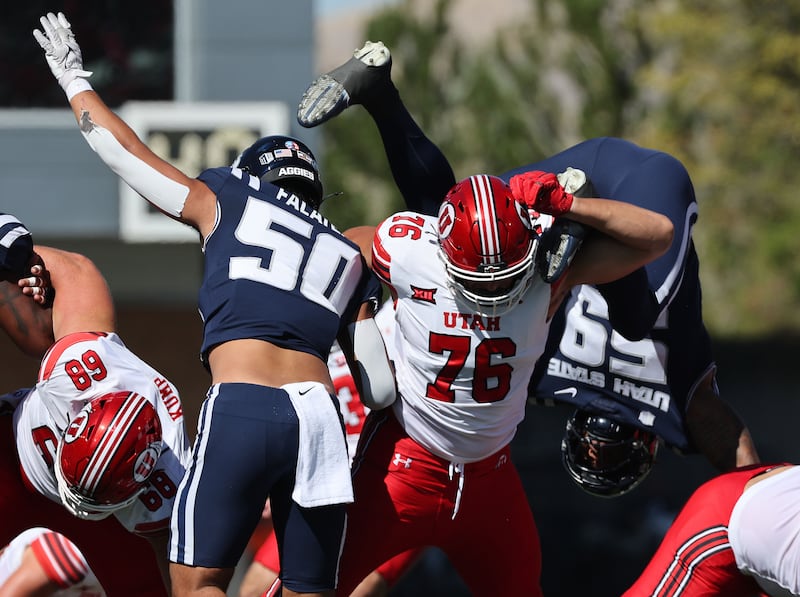
Season could hinge on offensive line play
Last season, Utah’s offensive line was one of the best in the country, paving the way for school records in rushing yards and rushing touchdowns. They also protected Dampier well and were a major reason why the Utes had as much success as they did on offense.
The two anchors of that line, tackles Spencer Fano and Caleb Lomu, were selected in the first round of this year’s NFL draft, and center Jaren Kump and guard Tanoa Togiai signed undrafted free agent deals with NFL teams.
That’s a lot of talent for the Utes to replace under first-year offensive line coach Jordan Gross.
The Utes appear to feel confident in the players they already had on the roster, only adding Montana State tackle Cedric Jefferson and Ohio State center Isaiah Kema from the transfer portal.
Utah will have an entirely new starting five, but that doesn’t mean they lack experience.
Veterans Keith Olson, Alex Harrison, Zereoue Williams, Solatoa Moea’i and Roger Alderman all played at least 130 snaps last season — Utah’s 19.8-point margin of victory last year ensured reps for everyone — while transfer Jefferson started every game for FCS champion Montana State last season.
The Utes’ line could be led by four seniors — Williams, Harrison, Olson and Moea’i — who have played a combined 1,469 career snaps. Jefferson, a junior, adds 1,276 snaps from the FCS level.
It’s unrealistic to expect this group to reach the heights that last year’s line did, but the season hinges on if this group can be at least above average.
Utah’s coaches were pleased with the progress that the offensive line made this spring.
“Incrementally better. I think coach Gross has done a tremendous job with that group. Really have seen it mostly from a technical aspect. Just the fundamentals, pad level and first two steps, hand placement, path placement, all those kind of things you talk about with offensive line play has gotten way better,” McGiven said.
“The defense has thrown a bunch of stuff at them, and so they’re having to protect against a lot of looks. They’re having to implement run schemes against a lot of different looks, whether it be pressures or whether it be base looks or whatever it is. But they’ve done a great job handling that stuff. And so the recognition, application of scheme has gone way up. I think from an improvement standpoint, it’s really just deciding who the starting five are, what their roles are, and then just building that collective chemistry.
In an interview with ESPN 700’s Sean O’Connell in April, McGiven gave some insight as to how the offensive line room is shaking out.
Williams has been “a bonafide guy” at the left tackle position, McGiven said, while Harrison has been solidified as the team’s center and Olson has held down the right guard spot.
The battles to watch for as the Utes enter spring camp are the right tackle and left guard spots. Montana State transfer Cedric Jefferson and Utah redshirt sophomore Isaiah Garcia, who missed all of last year with an injury, will compete for the right tackle spot, while five-star freshman and Gross protégé Kelvin Obot and Moea’i will battle for the left guard spot.
“I’ve been very pleased with the progress thus far. It’s an outstanding group to work with. I inherited a group that had a very high football IQ, and so that makes my job easy,” Gross said. “But a lot of guys enjoying the opportunity to compete for starting spots, which as everybody knows, there’s five of those opened up. So it’s been a lot of fun. Definitely have a long way to go still, but very encouraged by what I see.”
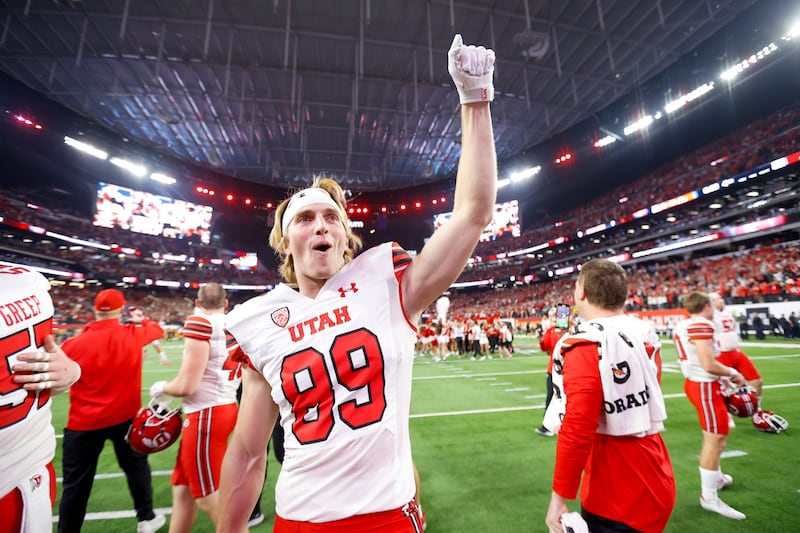
How will the tight ends factor in?
How will McGiven utilize tight ends in Utah’s offense? A lot depends on how talented the room ends up being.
At San Jose State, where he had now-Minnesota Vikings tight end Josh Oliver, McGiven tailored the offense around him. At other stops, like Utah State, the tight ends weren’t as much of a factor.
“It’s just kind of what you feel like you want to feature and who you feel like your best personnel groups are,” McGiven said.
After a strong run of tight ends featuring Brant Kuithe, Dalton Kincaid and Dallen Bentley, there’s as many question marks around the position as there’s been in a while.
One key piece will be Hunter Andrews, who showed promise — especially as an option in the run game — before suffering a season-ending injury. Now healthy, Andrews could be used in a variety of different ways in McGiven’s offense.
“Hunter’s coming off the injury and it’s been good. He has been progressing. We’ve been able to do a lot more with him in the last few weeks,” said tight ends coach Luke Wells. “Been pleased with that. I mean, obviously he’s got good speed and so there’s some things that we can do there to use his talents to help us be explosive on offense.”
Noah Bennee, who started his career at Utah before transferring to Weber State, should fill more of that traditional tight end role. Bennee caught 23 passes for 264 yards last season in Ogden.
“I have seen Noah improve literally every practice we’ve had this spring. He’s very sure-handed and he’s a guy that understands. He picks up things really well. We’re able to do a lot of things with him and been pleased with how he’s progressed as a blocker as well,” Wells said.
Kana’i Lopes converted from linebacker to tight end and looked good at the position in the spring, and the Utes added Oklahoma State transfer Will Monney as well.
Then there’s the “rhinos” — 317-pound Semi Taulanga and 276-pound Sione Motuapuaka, who will primarily block, but, as shown in the spring, can also catch the ball as well.
How much this group is utilized will come down to how much value they provide the offense.
Utah’s projected offensive two-deep
(Note: this two-deep is this reporter’s best guess and is based on coaches comments and past experience, not practice viewing)
QB: Devon Dampier (Sr.); Byrd Ficklin (So.)
RB: Wayshawn Parker (Jr,); Steve Chavez-Soto (So.)
WR: Braden Pegan (Jr,); Larry Simmons (Sr.)
WR: Kyri Shoels (Sr.); Tobias Merriweather (Sr.)
WR: Creed Whittemore (R-Jr.); Ricky Johnson (So.)
TE: Noah Bennee (Sr.); Hunter Andrews (R-So.)
LT: Zereoue Williams (Sr.); Soren Shinofield (So.)
LG: Solatoa Moea’i (Sr.); Kelvin Obot (Fr.)
C: Alex Harrison (Sr.); Isaiah Kema (Fr.)
RG: Keith Olson (Sr.); Roger Alderman (R-Jr.)
RT: Cedric Jefferson (Jr.); Isaiah Garcia (R-So.)