


What would happen if an athlete came along who was so dominant and overpowering that it made it all unfair?
Someone who tipped the scales dramatically in his team’s favor to the extent that he might ruin the game itself. Someone who changed everything, a disrupter, like cell phones and AI.
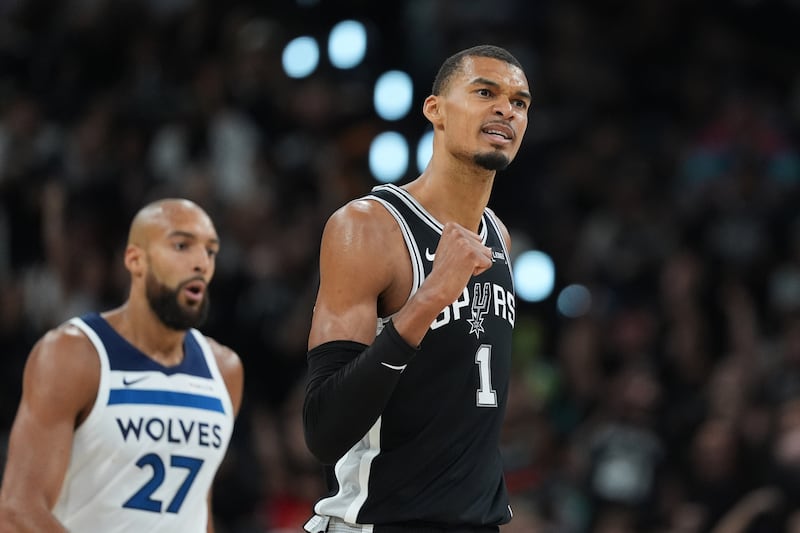
What happens when a Victor Wembanyama comes along?
Wembanyama, the San Antonio Spurs’ rising star, won the genetics lottery. He’s a physiological wonder. He’s listed as 7-foot-4, but other players are convinced he is taller – 7-foot-5 or more. His 7-foot-10 wingspan effectively makes him much taller. He has a standing reach of 9 feet, 8 inches – four inches short of the rim.
He can dunk without jumping. He blocks shots without leaving the ground. If he decides to leave the ground, his block height is in the 12-foot-6 range – six inches short of the top of the backboard. He’s comically taller than his rivals. He makes 6-foot-6 Draymond Green look like a kid. He’s comically big.
His sheer size would be disruptive enough, but Wemby is athletic. He has the hand-eye coordination, agility, shooting touch and coordination of a much smaller man. He can handle the ball like a guard, dribbling through traffic, driving to the rim. He shoots from all over the court (35 percent accuracy from the arc).
He led the Spurs to the second-best record in the NBA, averaging 25 points, 11.5 rebounds and 3.1 assists per game. On Tuesday, he collected 27 points, 17 rebounds, 5 assists and 3 blocked shots to lead the Spurs to a Game 5 win over the Timberwolves, putting them one win away from the conference finals.
What should worry the rest of the league is that he is only 22 years old and finishing up only his second season in the league. What will happen when he matures – when he puts on muscle and strength? Will he simply be too much for the game – for 10-foot baskets and 7-foot rivals.
Wemby is here. Now what? What do they do with this?
Basketball wasn’t made with this guy in mind. James Naismith didn’t contemplate Wembanyama when he nailed the peach basket 10 feet above the YMCA gym floor. He’s an outlier, the guy who could upset the balance.
Michael Jordan was dominant, but not because he was freakishly big – at 6-foot-6, he was within the realm of “normal.” If you look at dominant athletes in other sports – Tiger Woods, Messi, Gretzky, Babe Ruth – they were gifted and ruled their generation, but, like Jordan, they fit in the size norm.
The NBA has faced disruptive players to varying degrees in the past. The goal-tending rule was created in 1944 largely to prevent 6-foot-10 George Mikan from simply plucking opponents’ shots out of the air as the ball descended toward the basket. The NCAA banned dunking to prevent 7-foot-2 Lew Alcindor from scoring at will (he still averaged 26 points and 15 rebounds and his teams won 88 of 91 games during his three college seasons).
The most apt comparison in any discussion of Wemby is Wilt Chamberlain. At 7-foot-1, he played in an era when there were only one or two 7-footers in the league (there are about 40 now). He was the NBA’s Goliath. Chamberlain, a fine high school track and field athlete, was athletic as well as tall, and he put up ridiculous stats.
In 1960, he grabbed 55 rebounds in a single game. In 1962, he scored 100 points in a single game. He holds 72 NBA records (and blocked shots were not counted in his day). He’s the only player to average 30 points and 20 rebounds in a season – which he did nine times.
One season, he averaged 50.4 points and 25.7 rebounds. The next season he averaged 44.8 points and 24.3 rebounds. He has the four highest single-season scoring averages in NBA history, and six of the even highest single-season rebounding averages (including the top three). Notwithstanding, he won only two championships (in six NBA Finals appearances) in a 16-year pro career.
There are differences between Chamberlain and Wembanyama.
The former was not a good shooter and played around the rim, usually with his back to the basket. He was a classic center. Wemby roams the court, without position. Chamberlain’s free-throw percentage was barely over 50 percent (he was so desperate that he used his famous and equally ineffective underhanded shot). Wemby shoots 82.7 percent from the foul line. Chamberlain was a good passer and a decent ball handler, but he was not nearly the dynamic player of his modern counterpart.
In the coming years, Wembanyama could unlevel the playing field. The rest of the league might not stand a chance.