

- A nonprofit and the Forest Service partnered to build affordable homes on public land in Jackson, Wyoming.
- The town's mayor says the project is different than recent public land sale proposals.
- One neighbor has sued the nonprofit and the Forest Service to stop the construction.
The mayor of Jackson is quick to point out that what’s happening between a local nonprofit and the U.S. Forest Service in his small town in northwest Wyoming is very different from other attempts to use public lands for development.
“One of the reasons I called so quickly, is given the strong voice that seems to be emanating out of Utah in ways that I fully don’t understand — particularly out of your senator’s office — about public lands,“ Mayor Arne Jorgensen said less than three hours after the Deseret News contacted his office.
“I have a strong, strong conservation ethic and public lands are near and dear to my heart, and I am just adamantly opposed to the moves that Sen. (Mike) Lee (R-Utah) has been championing for a number of years now.”
Jorgensen is among those who do not agree with those who think that selling public lands is a good idea, like members of Utah’s congressional delegation. And yet, the city of Jackson is participating in something that — at first glance — might look similar.
The nonprofit Jackson Hole Community Housing Trust and the Bridger-Teton National Forest are partnering to build much-needed affordable housing on a parcel of public land. To assist, the town of Jackson is investing $4.1 million raised from a specific purpose excise tax in exchange for the use of six of the 36 units. It’s scheduled to break ground once the snow melts this spring.
The town approved the project under a specific “special-use permit,” which is an administrative tool the Forest Service generally applies towards ski areas or summer cabins. This novel use for it — affordable housing, but also partnering with local nonprofit developers and municipal funding — is potentially the first of its kind.
Building private homes on public land
Despite Jorgensen’s clarification, the overall effort appears to be a tangible example of some of the reasons Lee purportedly gave for wanting to sell public lands.
That is, using public lands to address the housing crisis. Which is something that he’s been attempting to do since at least 2018 with the Homestead Act, then again in 2022 with the HOUSES Act, and again in 2025 during the reconciliation bill debate.
“Supply is not meeting housing demand in Utah, and the federal government’s land ownership is a significant cause of our restricted housing stock,” Lee said in a 2022 statement.
The Jackson project also mirrors, in theory, the announcement of a partnership between the Department of the Interior and the U.S. Department of Housing and Urban Development to tackle the housing deficit. In March 2025, the two agencies signed a memorandum of understanding to facilitate and assist transferring federal public lands to local control.
Yet, what’s happening in Jackson is quite different. Selling or transferring public lands for development is not the same as developing deed-restricted housing on lands that will remain public.
“This land,” Jorgensen said, “it’s not an ownership transfer. It’s not a lease. It is a unique use of a special-use permit, and I think that that nuance is really important.”
That nuance — a collaboration coupled with a unique permit — however, has the potential to be a benchmark for addressing housing shortages in the West.
Of course, discomfort remains about building anything on public lands and regarding the process for gaining that approval. One Nelson Drive neighbor and attorney, Michael Clement, has sued the nonprofit developer and the Forest Service in an effort to stop the project.
But making sure that city and Forest Service employees can live in the community they serve, Jorgensen said, is exactly the kind of civic effort that leaders should be taking to support their communities, regardless of how the politics might appear.
“Yes, we have public lands that are going to be used for a variety of housing. That’s meeting a public good; we’re not privatizing anything,” Jorgensen said. “That’s where I would distinguish myself from Mike Lee or some of my local delegation as well.”

The wealthiest county in America
The entire U.S. housing market is facing an affordability crisis, but small towns in the West are stark examples of it in practice.
Teton County is just one example, but its statistics are hyperbolic.
Only 3% of the county, which includes Jackson and several other towns, is available for development. The remaining 97% of land is owned by the federal government, under conservation easement or zoned for agriculture.
About 24,000 residents live on that limited slice of residential land, with 10,800 of them in the town of Jackson. Yet, local government estimates suggest the area needs at least an additional 2,000 affordable units (as of 2023) just to maintain its population of workers.
If that math’s not daunting enough, consider the price. Teton County was again ranked the wealthiest in America based on income (Summit County, Utah, of Park City fame was a distant second). The average annual income is estimated at around $532,903, which is a figure skewed by billionaires capitalizing on access to world-class recreation and limited taxes.
Even if there were more inventory for people to choose from, it might not help as it’s almost impossible to afford a home. The average sales price in one neighborhood, Teton Village, exceeds $7 million. The overall median price for a single-family home — which makes allowances for outliers — is still greater than $5 million.
This issue of affordable housing in Teton County is so bad that even Clement, the attorney and neighbor who is suing to stop the Nelson Drive project, called it a “huge problem.”
“With respect to affordable housing, I believe it is a problem all over the Intermountain West and in other areas, but especially in the Intermountain West in resort towns,” Clement said.
“I will also say that I have no problem with the Nelson trailhead being used for housing for Forest Service employees... (but) I do have a problem when Forest Service land — or public lands in general — are subject to an attempt to transfer control or management over those lands to third-party-entity, special interests."
How the project would work
In short, the Forest Service has land that can be used for housing, but it cannot afford to develop it itself. So, it needs help with financing and construction. It also needs assistance from the local municipality for the necessary infrastructure — water, sewer, sanitation, roads, etc.
To address these needs, the community of Jackson found a unique solution.
It began with the parcel of land that will become the Nelson Drive project. It was designated for “administrative” use, which is to say it’s not a mission-critical landscape, more than 10 years ago.
In the years since, a series of Forest Service superintendents have been working with the town to use the parcel more productively and various building projects have been proposed and considered. Recently, zoning laws were adapted so that it can be part of the town’s municipal infrastructure.
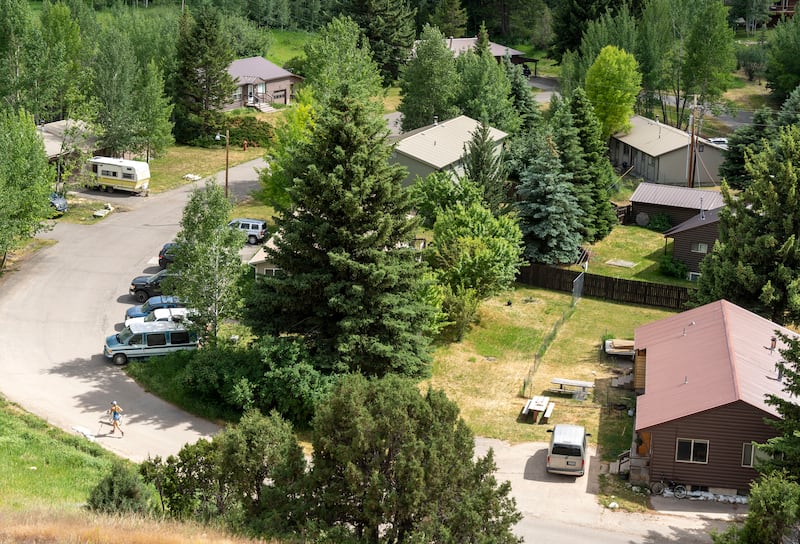
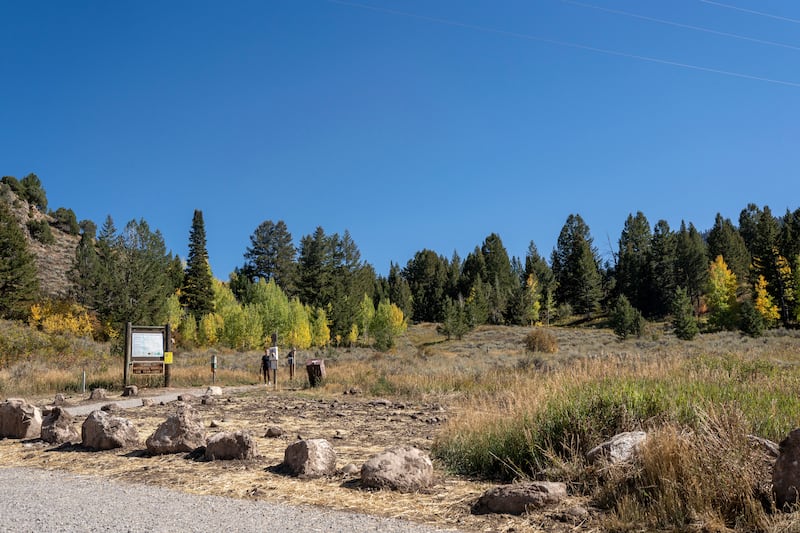
While the land is zoned for development, it remains the site of an often-used trailhead and an entranceway into a beloved trail system. It’s a popular dog-walking or running route, as it sits directly adjacent to a dense residential neighborhood close to Jackson’s center.
But to build anything requires money and folks to build, which is where the Jackson Hole Community Housing Trust comes in. It’s what Clement referred to as a “third-party-entity.”
The nonprofit fundraises for and then develops deed-restricted, affordable housing. Once completed, it then owns and manages the properties.
In its own words, the trust’s vision is to end “the housing crisis in our community,” with an intent on “conserving community in Teton County by developing essential, affordable housing,” that is for “community members who contribute to our quality of life.”
As for how the federal government might allow such a private entity to develop and manage federal lands, that is a good question. Ultimately, the partnering entities needed permission.
The local branch of the Forest Service received a one-time special-use permit, allowing “the forest supervisor to authorize the Jackson Hole Community Housing Trust to construct, renovate, and manage employee housing on existing National Forest System lands on the Bridger-Teton National Forest.”
With that 30-year permit in hand, the project could move forward. Now, the housing trust is the entity raising the bulk of the more than $22 million required for the build. Once it’s finished and the units have been allocated, the nonprofit will then manage the properties — and collect the rent.
Who would live in the housing?
The housing trust’s most recent proposal is for 14 buildings to be built on a 7.5 acre parcel. There will be 36 individual units — both one and two-bedrooms — that are connected as either duplexes or triplexes. The whole property will be able to house up to 70 people.
For the money it is investing, the town of Jackson will receive the right to rent those six units. Even after the special-use permit lapses, the town will retain the right to six units.
For offering the use of the administrative public lands, the Forest Service will retain the use of 13 units.
As for the remaining 17, there are ongoing conversations about how those units will be allocated. But, since the trust is paying for the development and managing the properties, it will likely retain some of the units for its own applicants.
Some have expressed concerns about the nonprofit being allowed to have any of the units, but Jorgensen, who is adamant that Forest Service employees live in the communities they serve, is not concerned.
“The community needs a wide variety of members to function,” he said. “If there may be a handful of more random housing or community members, so be it.”
Why is someone suing over it?
Clement has two major legal issues with how the Nelson Drive project is proceeding. First and foremost is one that is familiar to most of those who argued against public land sales last year: that affordable housing development is not the intended use of public lands.
“The system that’s set up by Congress is that the public has the right to recreate and enjoy public lands unless the use of those lands is mandated for other purposes,” Clement said.
“In this instance, transferring the land to a third-party entity for general housing is not mandated or permitted under the regulations.”
Not only that, by transferring its management to a nongovernmental agency opens up the doors for less altruistic versions of this series of events to transpire. Clement said he is worried about the precedent.
But the other legal issue is procedural — how the Forest Service and the town are conducting the process.
“Not only is the use improper or unlawful, in my opinion, under the Code of Federal Regulations,” Clement said, “but the procedure is appalling. ”
Over the years, Clement said, the size and scope of the Nelson Drive proposals has grown considerably. When it was first introduced in 2009, an environmental review was conducted that allowed for 10 buildings. A few more were added two years later. By last year, without conducting any additional assessments, the number of units is now 36 in 14 buildings.
“Just because it may be a good idea for some to use public lands for affordable housing, owned, controlled, operated by a third-party entity, that is not a permitted use,” he said. “Plain and simple.”
The lawsuit is still pending, and though Clement asked for one, a preliminary injunction has not yet been granted.
There’s another reason this is necessary
Jorgensen, Jackson’s mayor, had another point that he wanted to make before discussing the specifics of the Nelson Drive project. One that he said was more foundational than any current political schism.
In the past, the local branch of the National Forest Service, Bridger-Teton, was forced to sell lands to raise sufficient funds to build an administrative building. It simply did not have enough budget to meet its needs.
Jorgensen sees such requirements as the federal government — which has been cutting staff and budgets for federal agencies since last January — shirking its responsibilities.
“The federal government is failing the stewardship responsibility that they have, so I just need to start with that. The Bridger-Teton (National Forest) should be funded sufficiently,” Jorgensen said. “The fact that they’re not, which I think is political malpractice, doesn’t mean that then we just hold up our hand and say we don’t do anything.”
For him, the discussion and effort to build affordable housing for federal employees — and, in Jackson’s current plan, other low-income people in need — would not be happening in a more ideal world. Each would have its own appropriate funding but, Jorgensen said “that’s not the world we live in.”