

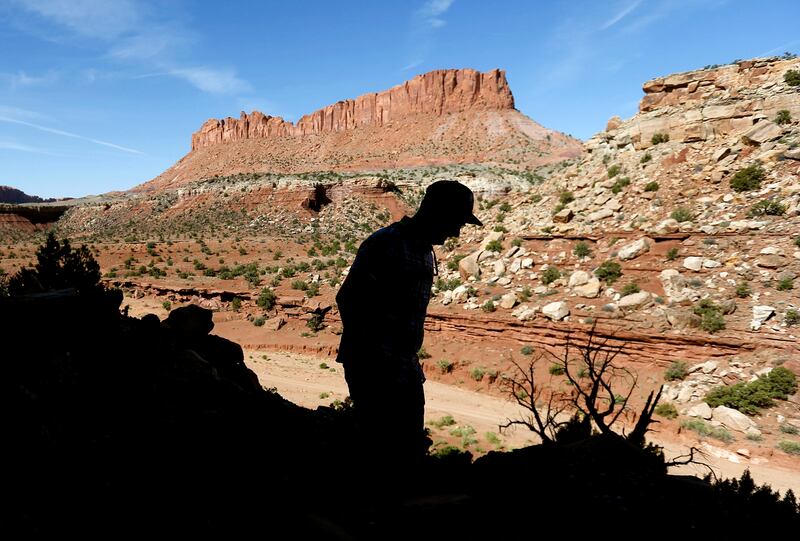

- Former solicitor of the Interior John Leshy wrote a history of public lands titled "Our Common Ground."
- Despite polarization, Leshy maintains that imperfect government can yield popular, successful results.
- Leshy played a pivotal role in creation of Grand Staircase-Escalante National Monument in Utah.
In 1957, when John Leshy was 12, his maternal grandparents took him and his two sisters on a grand road trip through the West. They took Route 66.
The Leshys lived in Peebles, Ohio, in the Appalachian south of the state close to Kentucky. Growing up, he was a Boy Scout and spent a lot of time outdoors in what was a very poor and very rural part of the country. He was not yet familiar with the concept of “public lands,” nor how awe-inspiring America’s landscapes could be.
That was until his grandparents packed him up and drove West. As they meandered their way to the Golden State, they stopped at the Grand Canyon, then up to Yosemite and back east to Yellowstone. A few of the places Wallace Stegner referred to as “the best idea we ever had,” and part of what Leshy, now 81, would later describe as “some of the best long-term thinking the American political system has ever produced.”

Seeing the West on that trip, he said, was one of the pivotal experiences of his life. “All these things completely blew my mind,” Leshy said. “I knew at that moment I was going to come back West in one way or another.”
Come back he did.
He has lived a lot of his adult life in Arizona or California, but his return was as much intellectual as it was physical. Leshy has spent the past 50 years working on America’s public lands, the vast majority of the 640 million acres of which are in the West. He did so as both a law professor at Arizona State University and UC Law San Francisco — writing several key legal text books on public land and water rights — but he also spent quite a few years living in Washington, D.C. as a public servant.
During the Carter administration, Leshy was the associate solicitor for energy and resources in the Department of the Interior. When Bruce Babbitt was governor of Arizona in the 1980s, he worked on several large land transfers between the state and the federal government that traded revenue-producing tracts for conservation areas. In the early 1990s, he was the special counsel for the chairman of the House Natural Resources Committee. Then from the first day of the Clinton administration to the last, Leshy was the top lawyer for the Interior.

Yes, that means that Leshy worked on the Grand Staircase-Escalante National Monument. Not just worked on it, but played a pivotal role in its determination, proclamation and creation. To boot, he called it “the most satisfying” project he worked on.
But in a conversation with the Deseret News, he also admitted that there was “one huge stupid mistake.” More on that later.
Was he public lands enemy No. 1 for some of Utah?
In Utah, many people aren’t likely to know his name. But a long list of primarily politicians along with rural residents, ranchers, grazing permit holders and mining interests would argue Grand Staircase-Escalante is far from his finest work. It is an ongoing source of significant anger, contention and frustration between the state and the federal government.
At the time, Utah elected officials were incensed that they were not involved in the planning of a nearly 2-million acre monument within the state’s borders. They say they only found out about it five days prior, and were angry about being excluded from such a significant action.
At a congressional hearing in 1999, Leshy said it was not done in secret and that Utah was included in vigorous debates about the monument in the days leading up to the announcement. One Utah representative was incredulous.
“I congratulate you for keeping a straight face while you said that,” said Rep. Chris Cannon, R-Utah, in response.
And that perspective and anger has endured for the past 30 years.
“One of the largest monument designations done in the continental United States, it was done without the input of the Utah delegation, without local governments at the table,” said Rep. Celeste Maloy, R-Utah, in a video address from mid-March. ”That decision did not just change a map, it upended lives."
Just last month, Maloy and Sen. Mike Lee, R-Utah, introduced legislation to use the Congressional Review Act to throw out the monument’s current land-use plan. It has not yet been voted on, but it is expected to come to the floor once Congress returns from its break.
While one might think that something so significant and controversial as the Grand Staircase-Escalante National Monument would be Leshy’s enduring legacy — for good or for ill — there’s something else he wants to be known for.
‘Our Common Ground’
In addition to co-authoring two widely used legal text books — “Federal Public Land and Resources Law,” the primary public land text, and “Legal Control of Water Resources: Cases and Materials,” which represent a small fraction of his academic contributions — Leshy wrote “Our Common Ground‚” published in 2022.
The book is an exhaustive legal and political history of America’s public lands. Dry though that sounds, its value lies in how it compiles the histories of the primary governing agencies — Bureau of Land Management, U.S. Forest Service, U.S Fish and Wildlife Service, and the National Park Service — in one text and shows how many decisions over time yielded such big results.
The book makes the case that, despite contentious and competing visions of America, public lands have long been one of the rare bright spots of bipartisan support and coalition building since America was founded.
“When examined through the long lens of the nation’s history, our public lands have shown how our governing process, for all its imperfections, can work to produce a result that most Americans support,” Leshy wrote.
The numbers support that perspective. More than 330 million people visit national parks every year. According to the most recent State of the Rockies poll, 84% of Western voters think rolling back public land protections is a serious problem, 86% think reducing their funding is a problem (74% of Republicans agree) and 91% of Western voters support maintaining existing national monument designations.
The poll, from Colorado College, surveyed at least 400 registered voters in each of eight Western states (Arizona, Colorado, Idaho, Montana, Nevada, New Mexico, Utah and Wyoming) for a total 3,419-voter sample. It used both Republican and Democratic pollsters, and received a grant from the Hewlett Foundation, nonpartisan philanthropy.
While the policies, events and debates that Leshy dives into over the 600 pages of the book are nuanced and exhaustive in detail, his overarching perspectives are rather straightforward.
He finds America’s public lands just as awesome as he thought they were as 12-year-old on that road trip back in ‘57. He maintains that holding such vast lands for recreation, education and conservation was the result of bipartisan support over more than a century and not an arbitrary, partisan, federal land grab.
Leshy believes the enduring success of public lands — the fact that a third of American lands have been set aside for a variety of benefits for future generations — represents something, he wrote, that a country struggling with polarization should find inspiring.
From the Civil War era through today leaders across all ideological lines — Richard Nixon signed the National Environmental Policy Act and Theodore Roosevelt expanded protections for public lands — have made a priority of conserving parts of America for the public good.
“In an age of skepticism about our political process,” Leshy wrote, “decision making about public lands demonstrates our ability as a people to work together and find genuine common ground.”
What do Leshy’s peers think of his work?
While he worked for Democratic administrations, not just his supporters celebrate his work. His adversaries do too, even if they were upset with how the monument came to be designated, with little input from Utah.
Brad Barber was the state planning coordinator for the Utah Governor’s Office of Planning and Budget for 25 years, where he worked under Gov. Mike Leavitt in 1996.
“The big thing that happened was the creation of Grand Staircase,” Barber said. “It was a very contentious event. The process — the way the monument was created — was kind of a surprise ... a lot of people in Utah were not very happy. It was a tough process."
After it was created, Barber helped negotiate Utah receiving nearly 500,000 acres of revenue-generating land in exchange for various “inholdings” — state lands that are surrounded by federal land and otherwise unusable as a result — in the subsequent land swap. He thought the exchange was mutually beneficial, even if he was frustrated with Utah’s lack of involvement.
Still, he said that Leshy’s writing will be his lasting legacy.
“I just have a great deal of respect for him,” Barber said. “Of course, with his book, there’s probably nobody that really knows the public land law better than John Leshy.”
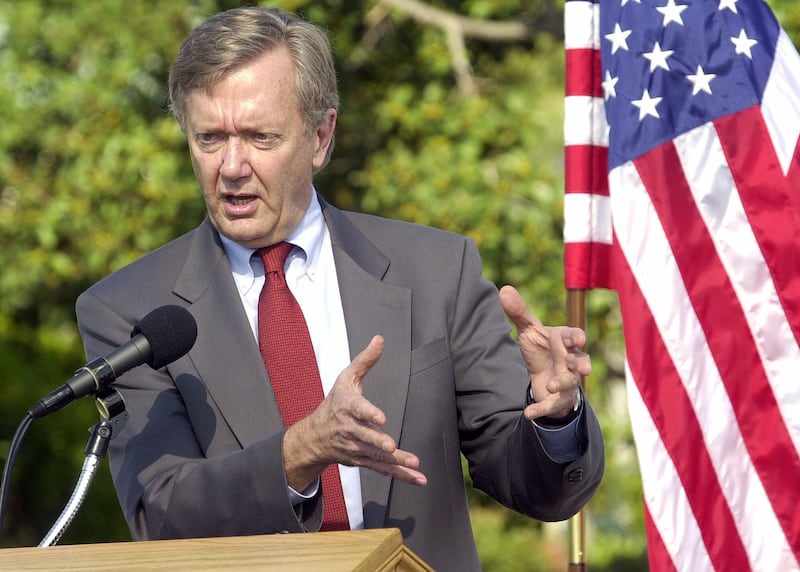
Babbitt, Leshy’s boss at the Interior, was more effusive in an interview with the Deseret News.
“When Clinton invited me to become secretary of the Interior, I had one condition,” Babbitt said. “I said, ‘I accept if I can bring John Leshy as my solicitor.’ Leshy thought about it, and he had a lot going on, but I persuaded him.”
He called Leshy’s book “a marvelous work.”
“It’s quite remarkable, really, that in the United States of America, nearly a third of the land is public land. How that happened in such an entrepreneurial (country) of development ... didn’t happen all at once. It started with the debates between Thomas Jefferson and Alexander Hamilton framing visions of America that have now endured for more than two centuries,” said Babbitt. “And what Leshy has done is put that all together and showed us what this heritage is, why it’s so important and what it means.”
How he remembers Grand Staircase-Escalante
Even though he spent more time working as a law professor, Leshy said that working for the Interior was the “best job I’ll ever have.” And during his time the project that meant the most to him was Grand Staircase-Escalante.
Its history goes back longer than this current iteration, which Leshy cites as the long-time conservation interest in the region.
But some Utahns had long-opposed the idea of conserving the Escalante region; far longer than even the current iteration from 1996. Its designation as a monument or national park was first a major issue in the 1930s, when Harold Ickes — FDR’s Interior secretary — first attempted to preserve the area. At that time, the idea was dropped as a result of the staunch opposition from Utah.
For Leshy, however, the region is inherently special. When he was a professor at Arizona State, Brant Calkin — an early executive director of the Southern Utah Wilderness Alliance — offered to show him southern Utah from a prop plane.
“I had backpacked up there a few times, and so I went up and we spent a couple of days in a small plane just flying over southern Utah,” Leshy said. “It was just an unbelievable place. I mean, once you see it, you just can’t forget it.”

Fast forward to a Friday in July 1996, Leshy got a call from Katie McGinty, one of Clinton’s deputies, right before he left for a rafting trip in Idaho. She said they wanted to use the Antiquities Act to designate a monument in Utah, could he look into it?
Leshy was familiar with the law and assisted with its use when the Carter administration created a series of monuments in Alaska totaling 56 million acres in 1978. He knew the legal mechanism would work well.
There were some mining interests in what would be the conservation area that the Clinton administration was trying to stop, which Leshy remembers as being an unprofitable proposition in the first place.
To emphasize that point, the same month the administration was working out the details, there was a story in Car and Driver magazine that determined what part of the United States was farthest from a paved road. It was the Kaiparowits Plateau.
“We all laughed, because the magazine said it was in the heart of what became the Grand Staircase National Monument,” Leshy said. As such, he remembers Andalex Resources (what is now UtahAmerican Energy) were happy to forgo the leases and the Interior bought them out.
“They were gonna have to build roads, a community, an infrastructure to develop the coal, (and) build roads to take it out of there. The roads would connect to St. George, Utah, where they would put the coal on rail cars and send it to Long Beach, California, and put it in ships and send it to Korea. And the coal would be burned in Korea,” Leshy said. “Now — even then — that was a completely, economically difficult, stupid idea."
Speaking of economics, he helped Babbitt as a civilian on a few large land swaps in Arizona that consolidated state inholdings — state lands surrounded by federal land — and swapped those for parcels that benefited each side of the deal. Arizona received land near Phoenix for development, while the BLM created a conservation area.
“Which is actually where I began to appreciate how that process could work and which we, of course, later — when I became secretary of the Interior — worked out the state federal land exchange that involves (Utah School and Institutional Trust Lands Administration) lands and the Grand Staircase," Babbitt said.
Since the state has consistently sought opportunities to drive natural resource extraction when it makes economic sense, Leshy made sure to include in the proclamation a plan to work out land swaps. Utah’s state inholdings from the public lands being conserved in the monument would be traded for revenue producing tracts of lands in northern Utah.
“The land exchange was definitely mutually beneficial,” Barber said. “The state has made some good revenue from those lands that were blocked up.”
In an op-ed for the Deseret News in 2017, Barber had calculated the deal to have generated more than $360 million for the state. That was nearly 10 years ago. In that article, he quoted Leavitt, who said, “The success of the national parks and Grand Staircase Escalante National Monument land exchange reminds us that we can all agree on some land-use opportunities right in front of us.”
Leshy does admit that at least one part of the whole exchange was done horribly wrong. What he calls “one huge stupid mistake.”
There was no air strip large enough for Air Force One to land near Grand Staircase-Escalante and, as a result, Clinton famously celebrated the massive conservation effort taking place in Utah from a perch along the Grand Canyon in Arizona.
“That was seen, correctly, I think, as a huge insult. And people in Utah never got over that one thing,” Leshy said.
“The ceremony, everything went fine. The only thing wrong was he was in the wrong (expletive) place.”
The long arc of history
Today, Grand Staircase-Escalante National Monument remains a major moment of frustration and anger for some and joy and excitement for others. Some still celebrate it and others know it as that insult Leshy referred to it as, and its boundaries have contracted and expanded a few times as a result.
This current effort to alter the management plan introduced by Maloy and Lee makes the monument’s future, in some ways, uncertain.

Leshy said that actions like Utah’s current delegation is really a hiccup or an aberration within the long history of our public land management. His career and work have contextualized many such moments and made clear that having these places set aside at all — big or small — is a testament to America’s politicians prioritizing future generations having access to the country’s wide open spaces.
“In his seminal work ‘The Wealth of Nations,’ published the same year as the Declaration of Independence, the Scottish philosopher Adam Smith, the champion of free-market capitalism, made a strong case for private ownership of land, but for a single exception. A ‘great and civilized’ nation, he wrote, ought to own and hold lands ‘for the purposes of pleasure and magnificence’ for everyone’s benefit,“ Leshy wrote near the end of ”On Common Ground."
“That the national government, responding to public opinion, has heeded Smith’s ... advice is a bipartisan success story deserving of celebration—a welcome counter to the political polarization and distrust that currently plagues us.”
In an interview last year with his alma mater, Harvard Law School, Leshy made a basic civics argument to students, but passed it through the lens of public lands. It was a fitting suggestion from a man who’s made service to public lands within our democratic experiment his life’s work.
“Nothing in the U.S. Constitution says we must have public lands. All it takes is an ordinary act of Congress to transfer every last acre out of U.S. ownership, even iconic treasures like the Everglades or Yellowstone,” Leshy said to Rachel Reed, the reporter for the Harvard Law Bulletin. “Each new generation must decide what it wants to do with its public lands.”
Correction: The first name of former Utah state planning coordinator Brad Barber was misidentified in an earlier version of this story.