


- Congress used the Congressional Review Act for the first time last year to invalidate three BLM land-use plans.
- Experts from across the spectrum warned that it would sow confusion and create a cascade of problems.
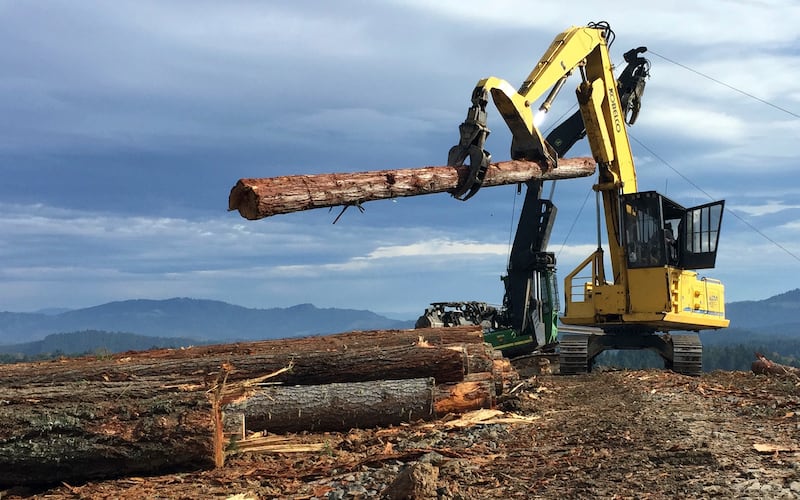
- An Oregon nonprofit sued the BLM and Interior Department over a plan authorizing a timber sale.
When Congress used a little-known federal law called the Congressional Review Act last year to overturn land-use plans — not once, but several times — it worried some folks.
At the time, experts said that using the CRA for that purpose was the “nuclear” option. Legal scholars said that doing so could bring back “the Wild West,” and another wrote that it would “sow chaos.”
While those outcomes are yet to be seen, a lawsuit filed in Oregon is the first example highlighting what those legal scholars and energy executives were worried about.
Cascadia Wildlands, an Oregon-based conservation group, sued the Bureau of Land Management and the Department of the Interior over a land-use plan authorizing a timber sale. They argue that because Congress now applies the law to land-use plans, the Aloha Trout Forest Management Project does not meet its basic requirements and is, therefore, “invalid.”
It sounds somewhat droll, but the implications for public lands are potentially staggering. That’s because hundreds — if not thousands — of land-use plans have been adopted across the country since the law was signed in 1996 and most of those do not fulfill the obligations of the CRA either.
Every grazing allotment, oil and gas lease or recreation use now has some form of standing. And with conservation groups and other stakeholders watching closely, how the courts and the Department of Justice manage the case will have far-reaching impacts on the future of American public lands.
“Congress has been warned many times by many legal experts that using the CRA in this manner is going to have unintended consequences,” said Susan Jane Brown, the principal and chief legal counsel of Silvix Resources, which is representing Cascadia Wildlands.
“Congress disregarded those warnings. And now we find ourselves in this situation where the chickens, I think, have come home to roost.”
Arguments on both sides
The Congressional Review Act is a mechanism that allows Congress to overturn the rules of certain federal agencies, many of which are part of the executive branch. In short, it gives Congress some teeth in its pursuit of checks and balances.
For the first 29 years of the law’s existence, however, the CRA was not applied to review land-use plans or resource management plans like those implemented by the BLM or Forest Service. Local land-use rules did not necessarily need federal review by the legislative branch.
But when three land-use plans were overturned using the CRA in Alaska, Montana and North Dakota last year — the Cascadia Wildlands complaint argues — it meant all land-use plans are considered rules.
For legislators in the states that overturned management plans with the CRA last year, it was the right tool for the right job.
“This is what the Congressional Review Act exists to do, to pull back on agencies that are rogue,” said Rep. Julie Fedorchak, R-N.D., who sponsored one of the bills, in an interview with Deseret News last year. “There’s no other way to describe this process.”
Members of the Utah congressional delegation supported using it when they thought it necessary.
“The Congressional Review Act exists for moments like this,” wrote Sen. Mike Lee, R-UT, in an op-ed in Deseret News arguing for its use against the Grand Staircase-Escalante National Monument management plan.
“When agencies impose rules with generational consequences without the consent of the American people or their representatives, Congress has the authority and the responsibility to review them and ensure that the people are not simply presented with a fait accompli.”
Within the law’s language, there are some broad parameters for what constitutes a “rule,” but — herein lies the rub — any such rule must be submitted to Congress for approval before taking effect. Based on the language of the law and the Administrative Procedure Act, those that are not submitted are not valid rules.
“Because defendants have never submitted any RMP (Resource Management Plan) for these lands to Congress pursuant to the CRA,” reads the complaint, “there are no valid RMPs in effect for public lands in western Oregon.”
John Ruple, a research law professor at the University of Utah and director of the Wallace Stegner Center who signed a letter to the Senate last September urging it not to use the CRA in that way, said “the argument to me is pretty clear, pretty logical.”
“The dot-to-dot is easier,” he said. “I don’t have to make — and I don’t think a reviewing court would have to make — a whole lot of leaps of faith.”
What are the implications?
Brown said that allowing Congress to make the final decision about land-use plans upends the years of work done by local communities to determine them in the first place. Even if it’s slow, painful and time-consuming, she calls it “a quintessentially democratic process.”
“When Congress intervenes and really throws all of that work out the window, it certainly makes a mockery of the planning process and of all of that hard, hard work that people on the ground have done to come together around a plan,” she said.
“I think that that’s wrong. And I don’t think that that’s really what the drafters in 1996 intended.”
Ruple echoed Brown’s sentiment, calling Congress’ use of the CRA to overturn land-use plans “bad for democracy.”
It creates a new front in the escalating partisan back-and-forth of today’s politics. A Democratic-led government could abandon President Donald Trump’s documents, too, and Ruple said he wants to see the CRA go away completely. “That kind of instability is bad for a country.”
Chris Winter, the executive director of the Getches-Wilkinson Center at the University of Colorado Boulder School of Law, emphasized how the law can come back to bite Republicans.
“It isn’t just a one-way street,” Winter said. “If you’re going to invalidate these land-management plans using this tool, then the consequences of that are gonna be potentially meaningful for a lot of other kinds of activities that industry and the conservative forces wanna see move forward.”
What’s next?
Ruple said that the “the only clear way out of this morass is for Congress to amend the law.”
Which is the opportunity, Brown said, that the court case really represents for federal lawmakers.
“Even if that ultimately may moot this lawsuit, I think that the higher purpose is that the CRA is really confined to its original intent,” Brown said, “which was to disapprove of formal rules, not land-management plans and decisions.”
Yet, there are many different options for the courts, the BLM, Congress or the Forest Service to take. Winter thought it possible that the land-use agencies simply submit all of the plans retroactively. In the meantime, the courts have until the end of August to respond.
For the time being, Brown prefers being on this side of this argument. With so many different land-use plans that could suddenly be overturned by Congress, she said the decision came down to “political calculus.”
“Well, we can either be at the table or we can be on the menu,” she said. “And being on the menu is no fun.”